
🔄 Cập nhật lần cuối: 08/10/26

Teaching your children financial skills before studying abroad is a gift as practical as tuition. Managing a large sum of money in foreign currency for the first time, amidst countless shopping temptations and unforeseen expenses, many young people "burn out" in the first month. The article suggests a 6-month roadmap for parents to help their children master budgeting, control spending, use cards safely and identify financial traps.
Why must you teach your children financial skills before studying abroad?
At home, most students do not have to pay for electricity, water, go shopping or worry about housing. Going abroad, you have to handle everything yourself - in a new currency, with prices that you don't yet have a sense of "expensive or cheap". Lack of financial skills leads to:
- If you run out of money before the next transfer period, you have to constantly ask for more.
- Credit card debt, late payments, penalty fees.
- It's easy to fall into "investment opportunities", loans or scams.
- Stress affects learning.
On the contrary, when you know how to manage money, your family will worry less and you will be much more confident.
5 financial skills children need
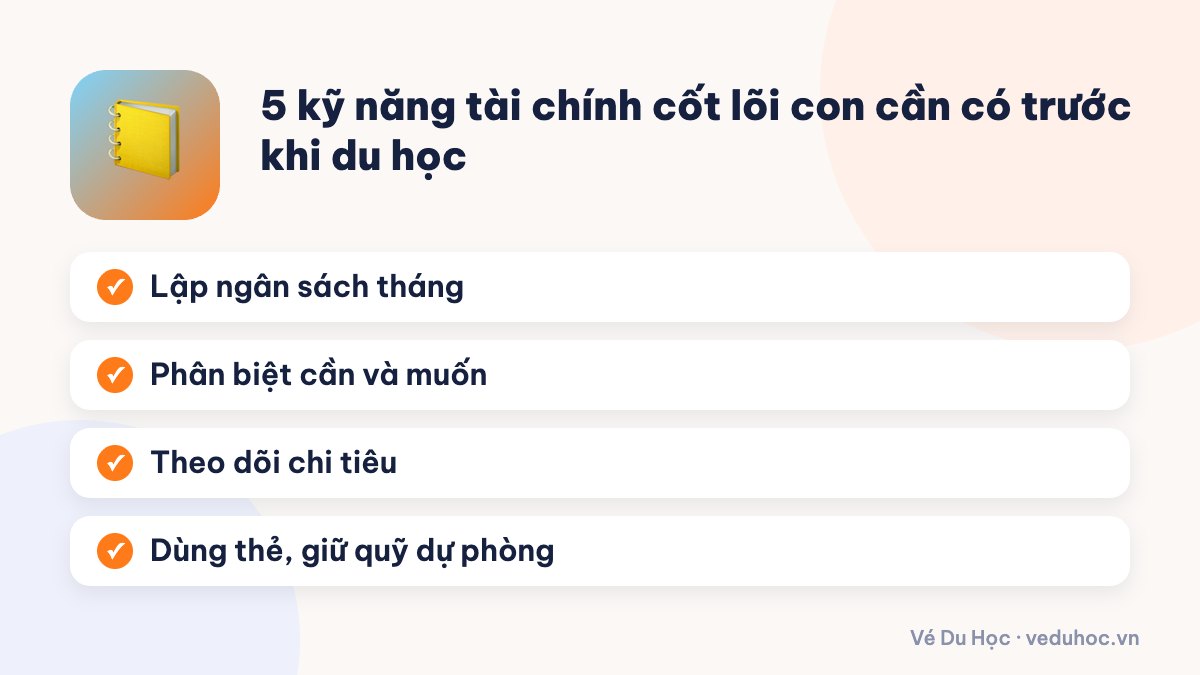
1. Make a monthly budget
List income (family money, scholarships, part-time work) and fixed expenses (house, phone, transportation) and then flexible expenses (food, entertainment). Free tools like Moneysmart's budgeting program (Australian Government) are good examples for your child to practice.
2. Distinguish between "need" and "want"
A simple rule: before every non-essential expense, wait 24–48 hours before deciding.
3. Track spending
Record all expenses for at least the first 2–3 months, using a banking app or spreadsheet. At the end of the month, look back: where does the money "flow" the most?
4. Use cards and banks safely
- Understand the difference between debit and credit cards; Always pay your credit card balance in full on time.
- Know the fees: transfer fees exchange foreign currency, ATM withdrawal fees, account maintenance fees.
- Do not share OTP codes or passwords; Turn on transaction notifications.
5. Set up a reserve fund
Keep a separate amount (e.g. equivalent to 1 month's living expenses) only for emergency situations: illness, lost belongings, urgent return ticket.
6-month roadmap to practice at home
| Time before flight | Activities |
|---|---|
| 6 months | Let your child manage pocket money + a family expense (eg weekly grocery shopping) |
| 5 months | I make a monthly budget, record my expenses, and review it with my parents at the end of the month |
| 4 months | I pay some bills (phone, internet) myself with my own account |
| 3 months | I find out about prices in the city I'm visiting: rent, transportation, food; prepare a proposed budget |
| 2 months | Open an international card, learn how to use electronic banking, and exchange foreign currency |
| 1 month | Agree financial agreement; Make a list of expenses for the first week |
Combine cooking practice to reduce the cost of eating out – see Economical cooking for international students and other skills in the lesson Independent skills needed before studying abroad.
Financial traps that international students often encounter
- “Buy now, pay later” and credit cards: convenient but easy to spend beyond your means.
- Fraudulent impersonation of a state agency demanding fines and "account verification".
- A "high-paying" job requires a loan from a bank account - which can turn your child into a money-laundering link.
- Cryptocurrency and multi-level investment recommended by friends.
- Rent a deposit before viewing the house – see Experience renting a house and avoid deposit scams.
Teach your children a golden rule: anyone who asks for quick money transfers, secrecy, or a “chance” for a quick profit is a red flag. See more safe when studying abroad.
Financial agreement between parent and child
Before your child leaves, the whole family should clearly agree:
- Monthly amount and transfer time - see channels in article Send money for your children to study abroad.
- Which amounts are paid directly by the family (tuition, insurance, air tickets) and which ones are managed by the child themselves.
- What is extra income used for (savings, personal expenses).
- How to handle lack of money: notify early, explain the reasons, and adjust the budget together.
- Periodic reports: each month, children briefly share their spending situation - the purpose is to support, not control.
When arriving, this skill is enhanced in the lesson Personal financial management for international students.
VeDuHoc always quotes transparently for each component (ticket price, taxes, baggage), has 30+ Bookers hunting for multi-carrier tickets and continues to hunt even when the price is high - if a better price is found after payment, HVSC will transfer the money back to refund the difference. Export VAT invoice, 24/7 support. See Experience in booking airline tickets to study abroad.
Frequently asked questions
Should I give my child a credit card when studying abroad?
Maybe, but should be a supplementary card or low limit, used for emergencies and online payments. You need to clearly understand how interest is calculated and always pay the full balance on time.
Transfer money to your child monthly or periodically?
Tuition is usually paid by term; Living expenses should be transferred monthly (or quarterly for children who have good self-management) to help them practice spending discipline.
What should parents do if their child spends more than their budget?
Calmly find the reason with your child: is it because the actual price is higher than expected or is it due to spending habits. Adjust the budget if necessary, but avoid unconditional "rescue" every time there is a shortage of money.
Should children be encouraged to work part-time?
Working part-time legally within the allowed hours helps children gain experience and understand the value of money, as long as it does not affect their studies. See work part-time while studying abroad.
Financial skills will follow your child throughout his or her life, not just during the years of studying abroad. When it's time to book tickets for your child, please contact VeDuHoc via hotline/Zalo 090.1800.918.
Reference source
Booker HVSC gives a free quote in 15 minutes, Zalo reports take-off and landing for the whole family.
📚 Articles on the same topic
 Study abroad handbookExit procedures at Vietnam airport for international students28/03/26 · 6 phút đọc
 Study abroad handbookHelp your child choose a major and a suitable country to study abroad10/02/25 · 7 phút đọc
 Study abroad lifeFirst day at school: orientation and things to do20/12/24 · 6 phút đọc
 Study abroad lifePersonal financial management for international students: create a monthly budget08/09/24 · 6 phút đọc
 Study abroad handbookWhen children encounter problems abroad: what parents need to do28/05/24 · 7 phút đọc
 Study abroad lifeStaying in touch with family while studying abroad: tools and habits21/01/24 · 6 phút đọc
🔥 Read a lot
- Hành lý ký gửi chặng quốc tế cho du học sinh: kiện hay cân, 40kg hay 2 kiện 23kg và mẹo đóng vali
- Master's scholarships: strategies for choosing majors, choosing schools and contacting professors
- Why should study abroad centers have specialized airline ticket partners?
- Choosing a reputable dispatching company: signs to recognize and avoid scams
- Stipendium Hungaricum Scholarship: full study abroad in Hungary




 ▶
▶ ▶
▶ ▶
▶ ▶
▶ ▶
▶ ▶
▶ ▶
▶