
🔄 Cập nhật lần cuối: 08/10/26

The first time you hold a large amount of money abroad, many people fall into a situation where they feel comfortable at the beginning of the month and eat instant noodles at the end of the month. Managing personal finances for international students doesn't need to be complicated: just a clear monthly budget, some good habits and an emergency fund. This article provides step-by-step instructions on budgeting, how to allocate spending, and common financial "traps".
Why do international students need a budget?
- Money from family often comes in batches (semester, quarter), it's easy to overspend at first.
- Expenses abroad are different from Vietnam: housing, travel, and eating out often account for a large proportion.
- Exchange rate fluctuations cause the amount of money received to change.
- Unexpected expenses: medical examination, laptop repair, urgent plane ticket home.
The minimum living expenses that governments require when applying for a visa (for example, the UK requires 1,529 GBP/month in London and 1,171 GBP/month elsewhere according to GOV.UK) are a good reference point for you to know where your budget is. A comparison table for many countries is available in the article Cost of studying abroad in other countries.
5 steps to create a monthly budget
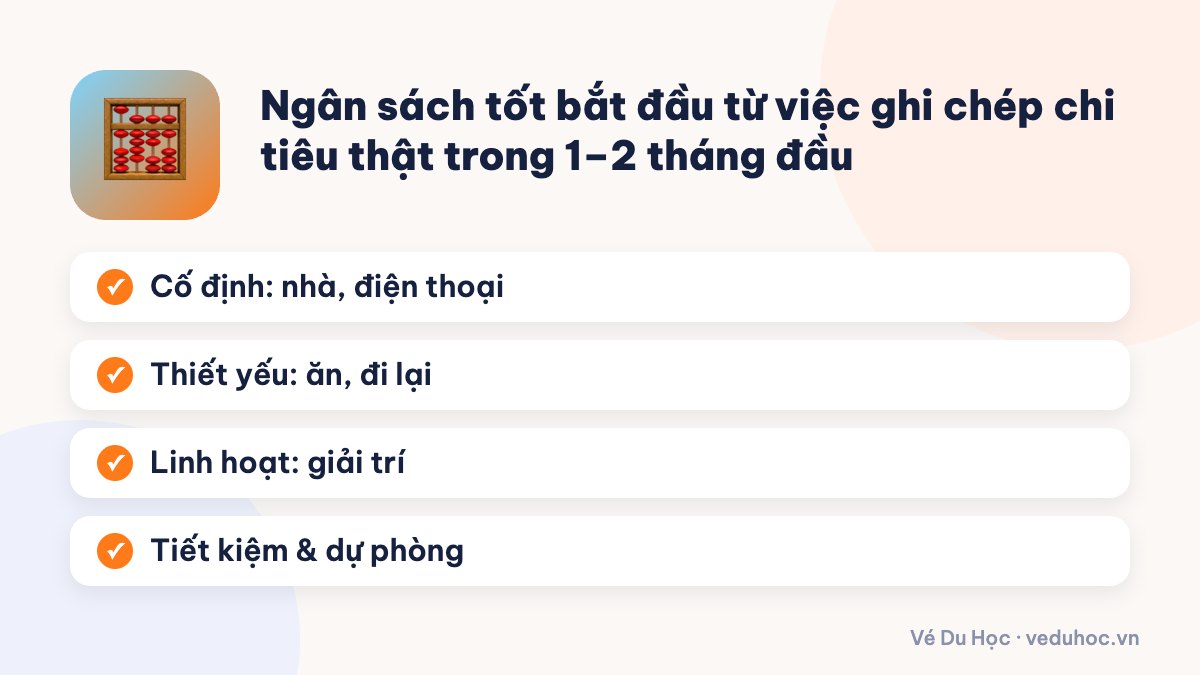
The Australian Government's financial information portal Moneysmart suggests a simple budgeting process that works well for international students:
- List income: money sent by family (converted by month), Living expenses scholarship, overtime income (if it fluctuates, take the low average).
- List of expenses: start with essential items (rent, food, utilities, transportation, phone, insurance), then move to irregular items (books, visa fees, air tickets). Compare bank statements to avoid omissions.
- Compare income and expenses: if expenses are more than income, find areas that can be cut.
- Set a savings goal: no matter how small, regular savings are a "safety net" when the unexpected happens.
- Review monthly: adjust when changing houses, having a part-time job or changing prices.
Tips for the first month
The first month usually costs more because of the house deposit, appliances, sim card, and books. Separate the “initial stability” budget, and record all expenses in the first 1–2 months to have real figures for the following months' budget.
Reference expenditure allocation sample
The rates below are for reference only; Big cities with high housing costs will need to adjust.
| Expenditure group | Reference rate | Optimal suggestions |
|---|---|---|
| Housing and bills | 40–50% | Rent together, choose a place that includes bills |
| Eating and drinking | 15–20% | Cook for yourself, go to the market according to the list |
| Travel | 5–10% | Student and bicycle transportation cards |
| Phone, internet | 3–5% | Prepaid packages, student packages |
| Study | 3–5% | Old books, library, electronic copies |
| Entertainment, personal | 5–10% | Student incentives, free activities at school |
| Savings, backup | 10% or more | Transfer automatically as soon as you receive money |
Tips for economical cooking are in the article Economical cooking for international students; There are also travel expenses to read articles travel while studying abroad.
Personal financial management habits for international students
Use multiple accounts for multiple purposes
Moneysmart suggests separating accounts: one for bills, one for daily expenses, one savings account. For international students, you can add an account/card in Vietnam to receive money from your family. Open a local account to view articles Open a bank account abroad.
Automation
- Set orders to pay rent and bills automatically to avoid being late.
- Transfer money to savings automatically as soon as you receive money.
Track spending
Use a banking app or spreadsheet and take notes daily or on weekends. Turn on balance fluctuation notifications to stay in control.
Emergency fund
The goal should be to have enough funds for about 1–3 months of living expenses, or at least enough for a plane ticket to return home when the family has urgent business.
Collaborate with family
Unify the deposit schedule, legal money transfer channels with fees and good exchange rates - see Send money for your children to study abroad.
Financial traps to avoid
- Credit card debt: high interest rate; Only use when sure to pay in full before due date.
- Buy now, pay later (BNPL) for non-essential items.
- Self-renewing subscription (movies, music, gym) forgot to cancel.
- Loan, in household name accounts, receiving money transfers on behalf of strangers - may be involved in fraud and money laundering. See safe when studying abroad.
- Spend according to peer pressure: proactively suggest affordable activities.
If you need more saving ideas, read the article 15 ways to reduce the cost of studying abroad. When planning to return home, consult the service ticket back home to proactively budget.
Frequently asked questions
Should I receive money from my family monthly or periodically?
Monthly makes it easier to control spending; Periodically reduces money transfer fees but requires high discipline. Can be combined: receive in installments but divide into savings account and withdraw monthly.
Which app to track spending?
Banking apps often already have spending categories. A simple spreadsheet is effective enough if you take notes regularly.
Should I use a credit card when studying abroad?
Can be used to build credit history and for emergency situations, but only spend within your means and pay in full each month.
How to reduce the impact of exchange rates?
Monitor exchange rates, transfer money when convenient, compare fees across channels, and always reserve an extra 5–10% of your budget.
A simple budget will help you live more comfortably and confidently throughout your years studying abroad. Need advice on flight tickets that suit your budget, contact VeDuHoc via hotline/Zalo 090.1800.918.
Reference source
Booker HVSC gives a free quote in 15 minutes, Zalo reports take-off and landing for the whole family.
📚 Articles on the same topic
 Study abroad handbookExit procedures at Vietnam airport for international students28/03/26 · 6 phút đọc
 Study abroad lifeInternational students who are pregnant, married or bring their families over: basic regulations05/02/26 · 10 phút đọc
 Study abroad lifeFind housing while studying abroad: dormitory, homestay or shared rental29/09/25 · 6 phút đọc
 Study abroad lifeWorking part-time while studying abroad: hour limits, salary and legal notes18/06/25 · 6 phút đọc
 Study abroad lifeFirst day at school: orientation and things to do20/12/24 · 6 phút đọc
 Study abroad lifeStaying in touch with family while studying abroad: tools and habits21/01/24 · 6 phút đọc
🔥 Read a lot
- International checked baggage for international students: pieces or scales, 46kg and tips for packing suitcases
- Master's scholarships: strategies for choosing majors, choosing schools and contacting professors
- Why should study abroad centers have specialized airline ticket partners?
- Choosing a reputable dispatching company: signs to recognize and avoid scams
- Stipendium Hungaricum Scholarship: full study abroad in Hungary


 ▶
▶ ▶
▶ ▶
▶ ▶
▶ ▶
▶ ▶
▶ ▶
▶