
🔄 Cập nhật lần cuối: 08/10/26

Sending money for their children to study abroad is something parents have done regularly for many years, so choosing the right channel not only helps save fees but also ensures safety and compliance with the law on foreign exchange management. This article summarizes popular legal ways to transfer money, documents to prepare, how to calculate actual costs and risks to avoid.
Legal basis when transferring money to study abroad
Vietnam strictly controls foreign exchange transactions. According to the guidance of the State Bank (Circular 20/2022/TT-NHNN on one-way money transfer from Vietnam to abroad), residents who are Vietnamese citizens are allowed to buy and transfer foreign currency abroad for purposes such as studying and medical treatment - including transferring to relatives studying abroad - when presenting documents proving need at an authorized bank.
In other words: tuition and living for expenses studying abroad are legal purposes, but must go through an authorized bank/organization channel and have valid records. Buying and selling foreign currency at unauthorized places (unlicensed gold shops, "black markets") may result in administrative sanctions.
Legal ways to send money for your children to study abroad
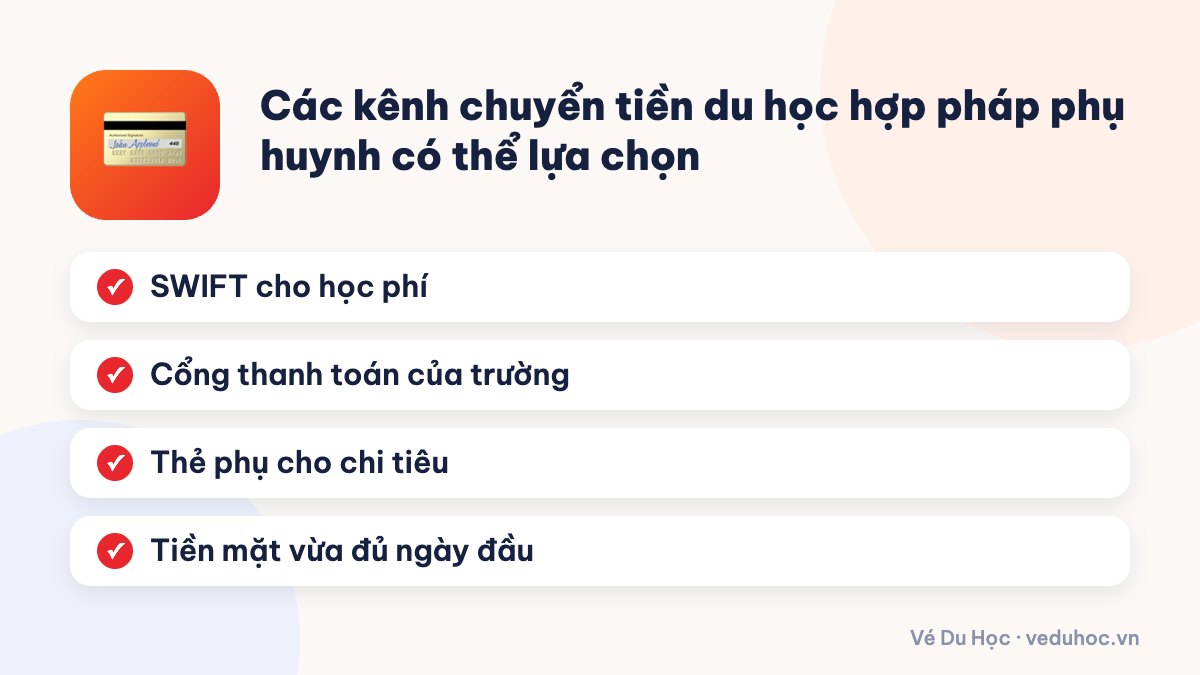
1. International bank transfer (SWIFT)
Most popular for tuition and large sums. Parents bring documents to the bank (many banks allow online processing), banks sell foreign currency and transfer directly to the school account or their child's account abroad.
- Advantages: safe, has documents, suitable for large amounts of money.
- Disadvantages: transfer fee + intermediary bank fee; duration 1–5 working days.
2. Pay tuition directly through the school's portal
Many schools partner with international tuition payment platforms, allowing payments in local currency via partner banks. Please only use links from the school's official email/student portal.
3. International cards (debit cards, credit cards, supplementary cards)
Suitable for daily expenses and the first weeks when your child has not yet opened an account abroad. Parents can open additional cards to track spending. Note foreign currency conversion fees and overseas cash withdrawal fees.
4. Licensed money transfer service
Some banks and licensed institutions offer fast money transfer services. Please check if that organization is allowed to operate in Vietnam and in your country of study.
5. Bring cash when leaving the country
You should only bring enough amount for the first few days. According to regulations, carrying over 5,000 USD (or equivalent) or over 15 million VND in cash when leaving the country must be declared to customs and have a bank confirmation. See Exchange foreign currency, bring cash and cards when studying abroad.
| Channel | Suitable for | Speed | Note |
|---|---|---|---|
| SWIFT transfer | Tuition, big amount | 1–5 days | Intermediary fee, documents needed |
| School payment portal | Tuition | A few days | Only use official links |
| International card / supplementary card | Daily spending | Instant | Currency conversion fee |
| Licensed money transfer service | Living expenses | Fast | Check the license |
| Bring cash | The early days | — | Declare if excess |
Documents need to be prepared
Each bank has its own list, but it usually includes:
- Identity documents of the transferor (CCCD/passport).
- Admission letter, tuition notice, school invoice; or documents proving that your child is studying (student card, school confirmation).
- Notification/estimate of living expenses (many schools have written cost estimates).
- Documents proving kinship (birth certificate) if parents transfer it to their child.
- Copy of child's passport and visa.
Tip: prepare a complete set of scans and update each school year for faster transfers.
How to compare money transfer costs
Don't just look at the "transfer fee". Total actual costs include:
- The bank's foreign currency selling rate - the exchange rate difference is usually the largest amount.
- Money transfer fee (fixed or %).
- Intermediary and receiving bank fees – may be deducted from the received amount.
Simple comparison: with the same amount of VND spent, how much foreign currency do you actually receive? When transferring tuition, choose the "OUR" fee method (sender bears all fees) if the school requests to receive the full amount.
Risks to avoid
- Transferring through intermediaries, "carrying money service": without documents, easy to lose money and violate foreign exchange regulations.
- School impersonation scam: email requesting to change tuition account number - always verify through the school's official channel.
- Fraud targeting international students: crooks impersonate immigration authorities, police, demanding "fines", or take over children's social network accounts to borrow money from parents. Please call for video verification before transferring. See Be safe when studying abroad, avoid fraud.
- One transfer is too much: children easily spend without planning. Living expenses should be transferred monthly/quarterly – see Teach children financial skills and Personal financial management for international students.
In addition to tuition and living expenses, airfare is a recurring expense that parents can proactively optimize. VeDuHoc issues VAT invoices, receives domestic transfer payments, has 30+ Bookers to hunt for multi-carrier tickets and refund the difference if a better price is found after parents have paid. See air tickets to study abroad.
Frequently asked questions
Can parents transfer living expenses to their children abroad?
Have. Studying is the purpose for which one-way money transfer abroad is allowed, provided that it is done through an authorized bank and has required proof documents.
Is there a limit to the amount of money that can be transferred to children studying abroad?
The amount is usually based on actual needs shown on documents (tuition notice, estimated living expenses). Ask your bank for specific records for the amount you need to transfer.
Is it possible to transfer money through acquaintances abroad?
The form of "exchanging money through acquaintances" does not have documents and may violate foreign exchange management regulations. Should use banking channels or licensed organizations.
How to reduce money transfer fees?
Compare rates between banks, combine small transfers into fewer transfers, and transfer to your child's local bank account instead of withdrawing cash by card.
Choosing the right money transfer channel helps parents feel secure and their children are financially proactive. When you need to book tickets for your child, please contact VeDuHoc via hotline/Zalo 090.1800.918.
Reference source
Booker HVSC gives a free quote in 15 minutes, Zalo reports take-off and landing for the whole family.
📚 Articles on the same topic
 Study abroad handbookHelp your child choose a major and a suitable country to study abroad10/02/25 · 7 phút đọc
 Study abroad handbookWhen children encounter problems abroad: what parents need to do28/05/24 · 7 phút đọc
 Study abroad lifeStaying in touch with family while studying abroad: tools and habits21/01/24 · 6 phút đọc
 Study abroad handbookMonitor and support your child remotely while studying abroad29/06/23 · 7 phút đọc
 Study abroad handbookParents visiting children studying abroad: visit visa and air tickets08/05/23 · 7 phút đọc
 Study abroad handbookTeach your children financial skills before studying abroad25/02/22 · 6 phút đọc
🔥 Read a lot
- Master's scholarships: strategies for choosing majors, choosing schools and contacting professors
- Hành lý ký gửi chặng quốc tế cho du học sinh: kiện hay cân, 40kg hay 2 kiện 23kg và mẹo đóng vali
- Why should study abroad centers have specialized airline ticket partners?
- Choosing a reputable dispatching company: signs to recognize and avoid scams
- Scholarships to study in Australia at high school and preparatory levels: opportunities for students in grades 10–12




 ▶
▶ ▶
▶ ▶
▶ ▶
▶ ▶
▶ ▶
▶ ▶
▶