
🔄 Cập nhật lần cuối: 08/10/26
Safety when studying abroad is not just about avoiding going out at night or locking the door carefully. Most of the risks that Vietnamese international students face today come from fraud via phone, social networks and money transactions when they are still in a foreign country. This article helps you identify common tactics, build self-protection habits, and know exactly what to do when something goes wrong.
Why are international students easy targets?
Thieves often target international students because of some easy-to-exploit characteristics:
- Not familiar with the laws and procedures of the host country, so it's easy to believe when threatened with "visa problems" or "being evaluated".
- Have cash flow from family (tuition, living expenses), sometimes keeping a large amount in the account.
- The language barrier makes it easy to trust Vietnamese speakers, even if they are scammers.
- Needing housing and part-time work urgently in the first weeks, so it's easy to accept unusual conditions.
Common scams targeting international students
International student support agencies such as Study Melbourne (Australia) and the international student offices of many American universities all list repeated scenarios. Knowing the "script" means you can avoid most risks.
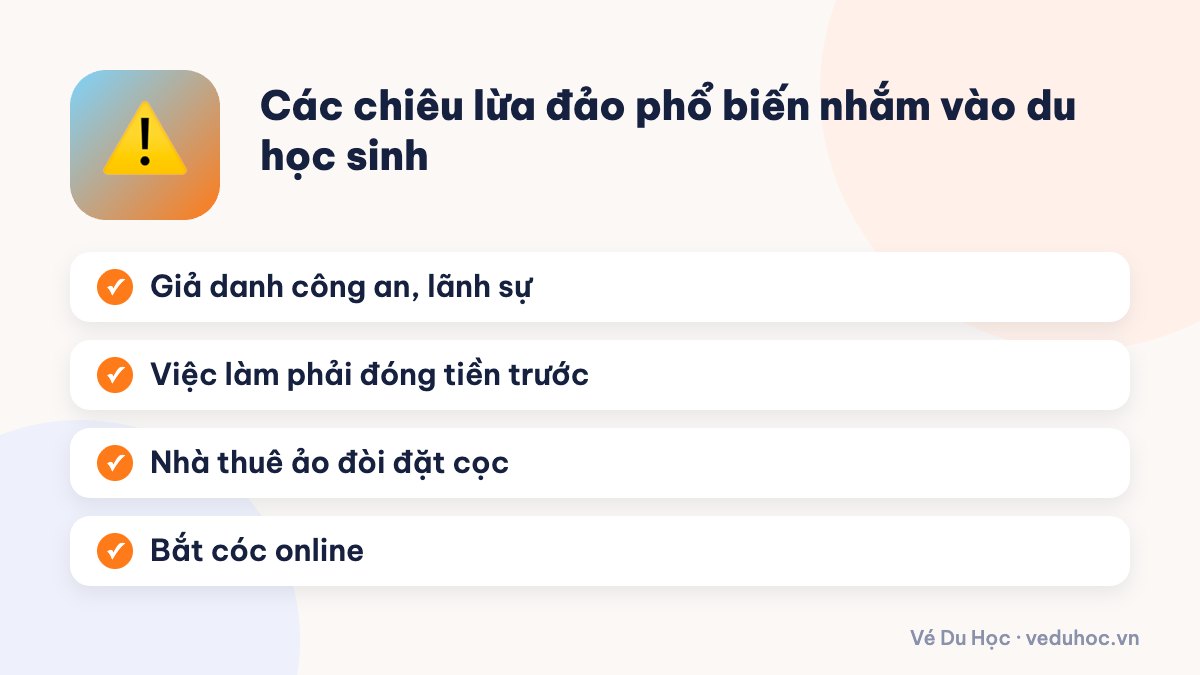
| Trick | Identification signs | The right way to react |
|---|---|---|
| Impersonate police, consulates, immigration agencies | Call to inform you that you are involved in a case, money laundering, or that your visa is about to be canceled; require confidentiality and “verified” money transfers | Hang up. Call back the official number found on the agency's website yourself, do not use the number provided by the caller |
| “Online kidnapping” | Forcing you to isolate yourself, cut off contact with your family, take videos/photos as if you were being arrested to blackmail your parents | If you do not comply, immediately notify the school, police and family |
| Virtual part-time jobs | Unusually high salary, need to pay "training", "uniform" fees, or ask to receive/transfer money on your behalf | Not paying to work; Do not lend bank accounts |
| Virtual rental house | Cheap price, the owner is "abroad", requires a deposit before viewing the house | View the house or watch live video, sign a contract, deposit through a protected channel |
| Reduce tuition fees, "pay" tuition fees | Some people, including friends, invite them to pay tuition through them to receive a discount | Only submit according to the method stated in the school's invitation/invoice |
| Fake emails and messages | Strange link asking for bank login, student portal, passport information | Don't click links; Log in directly from the official app or website |
Impersonating authorities
Thieves can send "arrest warrants", fake business cards, or even fake the calling number to match the real agency's number. Remember: the police, immigration or embassy do not ask to transfer money, buy gift cards or cryptocurrency over the phone, and do not force you to keep it a secret from your family. In Australia, only the Department of Home Affairs has the authority to grant, refuse or cancel student visas.
Housing and employment fraud
These are the two most urgent needs in the first month, so thieves fully exploit them. Article Experience renting a house and avoiding deposit scams when studying abroad Analyze each sign in detail. For part-time jobs, read carefully regulate working hours and salary limits to know what is an unusual offer; Working "under the table" or overtime is not only disadvantageous but can also affect your visa.
Other safety risks to be aware of
- Petty theft: phones, laptops, wallets at libraries, cafes, and public transportation. Enable device location and screen lock.
- Traveling at night: choose a well-lit route, use the school's safe shuttle service (many schools have vehicles or security guards on campus).
- Inadvertent violation of the law: Carrying goods, lending accounts, and documents can get you implicated. See more Things international students cannot do according to host country laws.
- Mental health: Stress and loneliness make you more susceptible to manipulation. Don't be afraid to seek support and refer to the article Take care of your mental health when studying abroad away from home.
Golden rules to stay safe when studying abroad
- Pause – verify – then act. Any urgent request to transfer money is a red signal.
- No one can keep your passport, not even your landlord or employer.
- Do not share passwords, OTP codes, card numbers, or passport photos via text message or email.
- Save emergency numbers: local police/emergency, campus security, international student office, Vietnamese Embassy or Consulate General.
- Share schedules with family or close friends when going away or going out at night.
- Back up documents: scan passports, visas, admission letters to secure cloud storage.
Maintaining regular contact with family is also a very effective "shield": parents who know their child's daily routine will quickly recognize anything unusual. See suggestions in the article Keep in touch with family while studying abroad.
When a problem occurs: how to handle it?
If you have accidentally transferred money or disclosed bank information
- Call the bank immediately to block the card and request to check the transaction. The sooner you have the chance to block the money.
- Change email and banking passwords, log out of any unfamiliar devices.
- Report to local police and scam reporting platforms (e.g. Scamwatch, ReportCyber in Australia; FTC in the US).
- Report to the school's international student office for advice and interpretation support.
If you lose your passport
Report to the police to get a report, contact the Vietnamese Embassy/Consulate General to get a new passport or travel document, then contact the immigration agency about the visa. If you have an upcoming flight, please notify us immediately to get advice on changing the flight date to suit the time needed to re-do your documents.
Parents' role
Parents should not transfer money to any calls that have not been directly contacted with their children. Article What should parents do when their child has a problem abroad? There is a list of specific steps.
Safety starts from the first flight. When booking tickets at VeDuHoc, a team of more than 30 Bookers not only hunts for good prices from many airlines but also checks transit visa requirements, advises on checked baggage of 40–46kg, supports 24/7 and Send flight information to parents via Zalo, so the whole family can understand your journey from takeoff to landing.
Frequently asked questions
Did the police or embassy call to request a money transfer?
Are not. Authorities do not request money transfers, gift card purchases or cryptocurrency purchases over the phone. If in doubt, hang up and call the official number on the agency's website yourself.
Is it okay for the landlord to ask to keep his passport?
Should not be accepted. Passport is your document and issued by the state; Homeowners simply need to view or save a copy to verify their identity.
Does being cheated out of money affect your visa?
Being a victim of fraud itself does not affect your visa. It is important that you do not participate in violations (such as lending accounts to receive money) and that you fully report them.
Which phone numbers should I save when I first move?
National emergency number, campus security, international student office, bank, Vietnamese Embassy or Consulate General and a local relative/friend.
Proactive prevention is always cheaper than overcoming the consequences. Please share this article with your friends who are about to study abroad, and if you are preparing for the journey, the VeDuHoc team is ready to advise via hotline/Zalo 090.1800.918 or at the website Book tickets.
Reference source
Booker HVSC gives a free quote in 15 minutes, Zalo reports take-off and landing for the whole family.
📚 Articles on the same topic
 Study abroad handbookExit procedures at Vietnam airport for international students28/03/26 · 6 phút đọc
 Study abroad lifeFirst day at school: orientation and things to do20/12/24 · 6 phút đọc
 Study abroad lifePersonal financial management for international students: create a monthly budget08/09/24 · 6 phút đọc
 Study abroad handbookWhen children encounter problems abroad: what parents need to do28/05/24 · 7 phút đọc
 Study abroad lifeStaying in touch with family while studying abroad: tools and habits21/01/24 · 6 phút đọc
 Study abroad handbookOne-way or round-trip tickets when studying abroad: cost analysis30/11/23 · 6 phút đọc
🔥 Read a lot
- International checked baggage for international students: pieces or scales, 46kg and tips for packing suitcases
- Master's scholarships: strategies for choosing majors, choosing schools and contacting professors
- Why should study abroad centers have specialized airline ticket partners?
- Choosing a reputable dispatching company: signs to recognize and avoid scams
- Stipendium Hungaricum Scholarship: full study abroad in Hungary


 ▶
▶ ▶
▶ ▶
▶ ▶
▶ ▶
▶ ▶
▶ ▶
▶