
🔄 Cập nhật lần cuối: 08/10/26

Academic pressure, language barriers, finances, homesickness and feelings of loneliness are things many international students experience. Taking care of your mental health while studying abroad is as important as taking care of your physical health, but is often overlooked or afraid to talk about it. This article helps you identify signs that need attention, build self-care habits, and know where to go when you need support.
Correct understanding of mental health when studying abroad
According to the World Health Organization (WHO), mental health is a state that helps people cope with stress in life, develop their abilities, study and work effectively, and contribute to the community. WHO also points to protective factors such as social skills, supportive relationships, education, stable employment and community cohesion; While financial difficulties and adverse environments increase risks.
Studying abroad is a period when many factors change at the same time: being away from home, old support networks no longer around, new academic and cultural environments, and financial pressure. Feeling sad and worried at first is a normal reaction - see more Culture shock when studying abroad and how to overcome it. It's important to recognize when the feeling is no longer "normal."
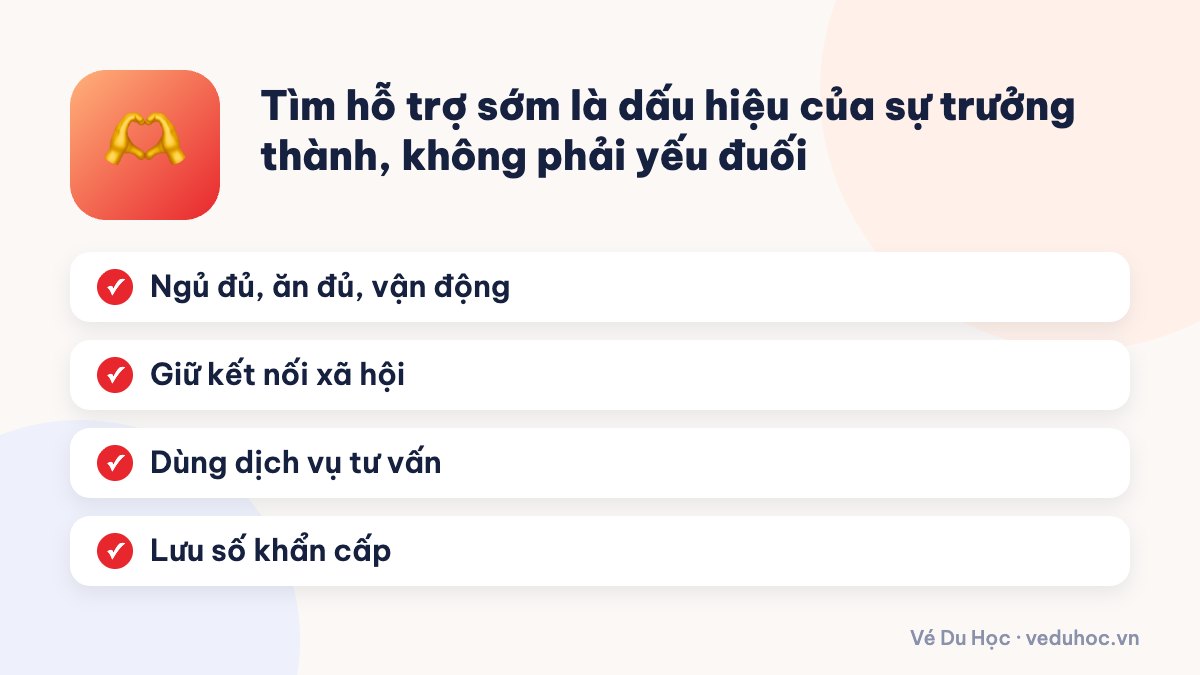
Signs to pay attention to
| Level | Common manifestations | Should do |
|---|---|---|
| Normal stress | Anxiety before exams, homesickness, temporary fatigue | Take care of yourself, share with friends and family |
| Need attention | Insomnia, loss of appetite or overeating, separation from friends, missing many classes, loss of interest lasting several weeks | Contact your school's counseling service or your doctor |
| Urgent | Having thoughts of harming yourself, feeling like you can't stand it anymore | Call the emergency number or crisis hotline immediately |
UKCISA advises international students not to suffer alone: if feelings of loneliness, anxiety or sadness persist and do not improve, seek further support.
Daily self-care habits
- Get enough and regular sleep: Staying up late to constantly meet deadlines reduces your ability to withstand pressure. In the early days, handle the time zone difference according to the lesson Prevents fatigue and jet lag.
- Eat enough food: cooking familiar dishes is also a way to "cure homesickness".
- Exercise: walking, school gym, sports club.
- Get out into natural light, especially in countries with long winters.
- Stay connected: maintain some close relationships, participate in group activities – see Make friends while studying abroad.
- Academic and financial management: clear study plans and budgets significantly reduce anxiety – see Personal financial management.
- Limit alcohol and stimulants; Be careful with social media that makes you compare yourself.
Where to find support
In school
According to UKCISA, most schools have health services, psychological counseling (counselling) or student support, and these services are confidential. The international student office and academic advisor can refer you to the right place. Many services are free for students.
General practitioner and insurance
Family doctors (GPs) support both physical and mental health. Check in with your GP soon after arriving and find out what your study abroad insurance covers – see Medical insurance for studying abroad.
Hotline and emergency numbers
| Water | Urgent | Emotional support (reference) |
|---|---|---|
| the USA | 911 | 988 (call, text or chat, 24/7) |
| Canada | 911 | 988 |
| Australia | 000 | Lifeline 13 11 14 |
| You | 999 | Samaritans 116 123 |
| EU countries | 112 | Line for each country, ask the school |
Please check the phone number on the official website upon arrival and save it in your contacts. America's 988 line, according to the official site, is free, secure and available 24/7.
What can families do?
- Listen without judgment, avoid comparing or creating performance pressure.
- Keep a regular contact schedule but not so dense that it is difficult for your child to integrate.
- Notice changes: your child rarely communicates, has a tired voice, and mentions dropping out of school.
- Encourage your child to use the school's support services; consider psychological counseling normal.
- Make plans to meet: trip home during the summer, Tet or when parents come to visit - see Parents visit their children studying abroad and Monitor and support your child remotely.
When you need a ticket to return home or a ticket for your parents to visit, consult the service ticket back home of VeDuHoc.
Frequently asked questions
Does going to see a school counselor affect your visa?
School counseling services are confidential. Seeking mental health support is normal; If you are worried, you can ask directly about the privacy policy when making an appointment.
How long after homesickness should I take to see a doctor?
If sadness, insomnia, or loss of interest lasts for several weeks and affects schoolwork and activities, contact a counseling service or doctor.
Is there a fee for psychological counseling at school?
Many schools offer free sessions to students, but the number of sessions may be limited. Ask the school and check insurance.
Can I receive consultation in Vietnamese?
Some schools, insurances or services offer multilingual counseling or interpretation support; Please ask when scheduling.
Taking care of your mental health is the foundation for you to study well and enjoy your study abroad journey. If you need flight support, VeDuHoc is always ready via hotline/Zalo 090.1800.918.
Reference source
Booker HVSC gives a free quote in 15 minutes, Zalo reports take-off and landing for the whole family.
📚 Articles on the same topic
 Study abroad lifeInternational students who are pregnant, married or bring their families over: basic regulations05/02/26 · 10 phút đọc
 Study abroad lifeFind housing while studying abroad: dormitory, homestay or shared rental29/09/25 · 6 phút đọc
 Study abroad lifeWorking part-time while studying abroad: hour limits, salary and legal notes18/06/25 · 6 phút đọc
 Study abroad lifePersonal financial management for international students: create a monthly budget08/09/24 · 6 phút đọc
 Study abroad lifeStaying in touch with family while studying abroad: tools and habits21/01/24 · 6 phút đọc
 Study abroad handbookMonitor and support your child remotely while studying abroad29/06/23 · 7 phút đọc
🔥 Read a lot
- Master's scholarships: strategies for choosing majors, choosing schools and contacting professors
- Hành lý ký gửi chặng quốc tế cho du học sinh: kiện hay cân, 40kg hay 2 kiện 23kg và mẹo đóng vali
- Why should study abroad centers have specialized airline ticket partners?
- Choosing a reputable dispatching company: signs to recognize and avoid scams
- Scholarships to study in Australia at high school and preparatory levels: opportunities for students in grades 10–12





 ▶
▶ ▶
▶ ▶
▶ ▶
▶ ▶
▶ ▶
▶ ▶
▶