
🔄 Cập nhật lần cuối: 08/10/26

The first week abroad, everything was new and interesting. But a few weeks later, many students began to feel tired because they didn't understand their classmates' jokes, missed Vietnamese food, and were frustrated with the rules that "no one said." It's culture shock when studying abroad - a very normal reaction. This article helps you understand the stages, recognize the signs and have a healthy way to overcome them.
What is culture shock when studying abroad?
Culture shock is the feeling of confusion, anxiety, and loss when living in a cultural environment different from what you are familiar with. According to UKCISA (UK Council for International Student Affairs), factors that often cause culture shock include climate, food, language, dress, social behavior, hidden norms (such as punctuality) and differences in values. UKCISA emphasizes that culture shock is normal, is usually temporary and can happen to anyone.
Common manifestations
- Confusion with everyday tasks such as shopping, communicating, and traveling.
- Feeling lonely, lost, lacking confidence.
- Missing family, friends, food, familiar sounds.
- Easily irritable and frustrated with new environments, especially when tired or time zone difference.
- Withdrawing and being afraid to participate in activities affects learning.
Stages of culture shock
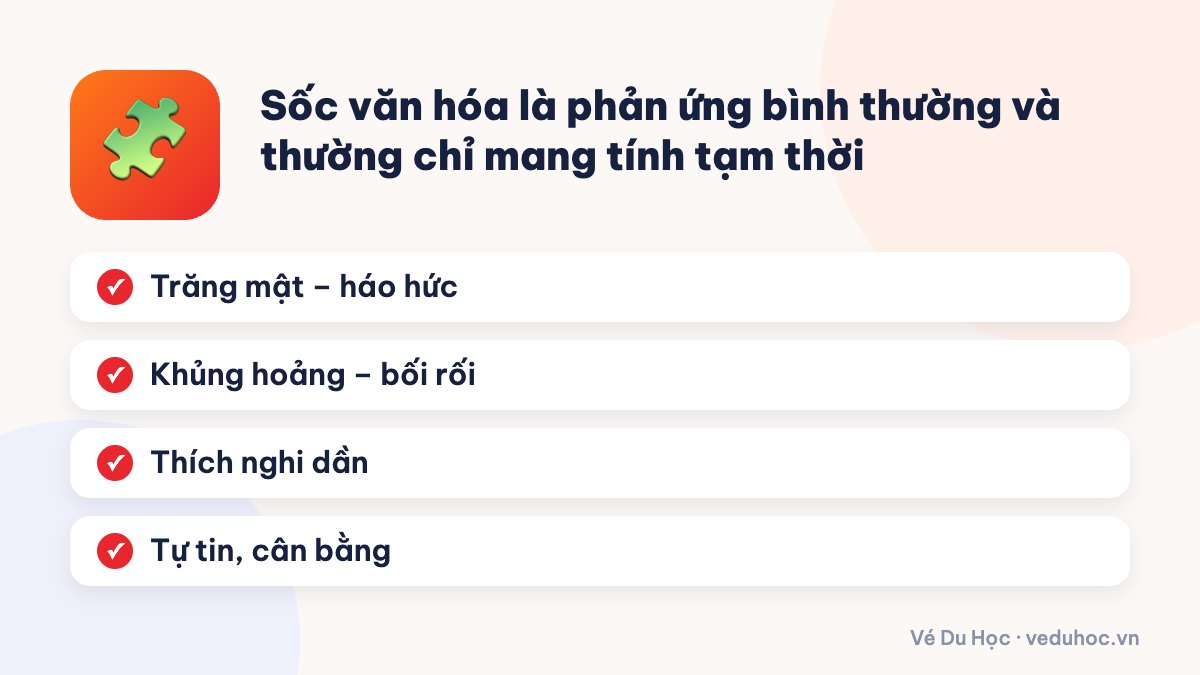
UKCISA describes culture shock according to the "W curve" model with the following stages:
| Phase | Common emotions | What should be done? |
|---|---|---|
| Honeymoon | Exciting, every difference is interesting | Explore, record experiences, build habits early |
| Crisis | Confused, isolated, feeling incompetent | Remind yourself this is normal; Find someone to share with |
| Resistance | Frustrated, negative comparisons, only thinking about home | Keep a schedule of activities, exercise, and participate in group activities |
| Autonomy | Begin to accept differences and become more comfortable | Challenge yourself with new experiences |
| Independence | Appreciate both differences and commonalities, be confident | Support newcomers and expand your network |
Note, you may go through these stages multiple times; Feelings of sadness can return on special occasions such as Tet or a loved one's birthday.
The differences are shocking to Vietnamese students
- Learning style: Encourage speaking, debate with lecturers, group work, critical thinking; strict rules on plagiarism – see study abroad.
- Communication: speaking directly or very indirectly depending on the country; small talk, how to address teachers by name.
- Time: absolutely on time, make an appointment in advance for most services.
- Eating: taste, meal time, high cost of eating out.
- Climate: long winters, short days in northern countries.
- Community rules: garbage classification, keeping quiet, dormitory rules – see international students and host country laws.
How to overcome culture shock
Before leaving
- Learn about the culture, customs, and codes of conduct of the destination country; Talk to your brothers and sisters in advance.
- Practice independent skills: cooking, managing money, traveling independently - see Independent skills needed before studying abroad.
- Bring a few familiar items: family photos, favorite spices (in accordance with customs regulations).
When arrived
- Accept your emotions: being sad or homesick doesn't mean you're weak or making the wrong choice.
- Maintain a balance of contact with family: UKCISA notes that too much contact at first can make settling in more difficult. Please schedule a fixed call time.
- Health care: eat a balanced diet, get enough sleep, exercise regularly.
- Connect: make friends with both international and local students through clubs, sports, volunteering – see Make friends and build networks while studying abroad.
- Suspend judgment: try to understand behavior in their cultural context instead of comparing right and wrong.
- Use the school's support services: orientation program, international student office, psychological counseling services.
If feelings of sadness or anxiety persist and don't improve, don't suffer alone – contact your school's counseling service or your doctor. Read more Take care of your mental health when studying abroad away from home.
Reverse culture shock when returning home
UKCISA also mentions the phenomenon of "reverse culture shock" when you return home after a long period of living abroad: feeling unfamiliar with the pace of life, difficult to share experiences, different opinions with family and friends. Prepare yourself mentally, give yourself time to adjust, and connect with the alumni community. If you are considering the future, see the article return home or stay after studying abroad.
Whether visiting home or returning completely, VeDuHoc supports searching for multi-airline tickets to return home, optimizes 40–46kg luggage for belongings from many years of studying abroad, and provides flight information via Zalo to family - reference ticket back home.
Frequently asked questions
How long does culture shock last?
Each person is different, usually a few weeks to a few months. The feeling can come back in waves, especially during the holidays.
Is culture shock depression?
Are not. Culture shock is a normal adaptive reaction. However, if sadness, insomnia, or loss of interest persist, you should seek professional help.
Does studying abroad in Asia cause culture shock?
Maybe, although to a lesser extent. Japan, Korea, Singapore... still have different rules of conduct and pace of life than Vietnam.
How can parents help?
Listen without judgment, encourage your child to participate in school activities, avoid creating pressure and keep a regular communication schedule.
Culture shock is a natural part of the study abroad journey and is also an opportunity for you to grow. Need flight support, please contact VeDuHoc via hotline/Zalo 090.1800.918.
Reference source
Booker HVSC gives a free quote in 15 minutes, Zalo reports take-off and landing for the whole family.
📚 Articles on the same topic
 Study abroad lifeInternational students who are pregnant, married or bring their families over: basic regulations05/02/26 · 10 phút đọc
 Study abroad lifeFind housing while studying abroad: dormitory, homestay or shared rental29/09/25 · 6 phút đọc
 Study abroad lifeWorking part-time while studying abroad: hour limits, salary and legal notes18/06/25 · 6 phút đọc
 Study abroad lifePersonal financial management for international students: create a monthly budget08/09/24 · 6 phút đọc
 Study abroad lifeSafety when studying abroad: avoiding scams and common risks19/08/23 · 8 phút đọc
 Study abroad handbookMonitor and support your child remotely while studying abroad29/06/23 · 7 phút đọc
🔥 Read a lot
- International checked baggage for international students: pieces or scales, 46kg and tips for packing suitcases
- Master's scholarships: strategies for choosing majors, choosing schools and contacting professors
- Why should study abroad centers have specialized airline ticket partners?
- Choosing a reputable dispatching company: signs to recognize and avoid scams
- Stipendium Hungaricum Scholarship: full study abroad in Hungary




 ▶
▶ ▶
▶ ▶
▶ ▶
▶ ▶
▶ ▶
▶ ▶
▶