
🔄 Cập nhật lần cuối: 08/10/26

Many Vietnamese international students study well in the country but are still confused in the first semester: long readings, having to speak in class, essays require separate arguments and strict citations. Understanding how to study, take exams and avoid plagiarism from the beginning helps you achieve good results and avoid violations that can affect both your studies and your visa. This article summarizes what you need to know about the academic environment abroad.
Studying abroad is different from Vietnam
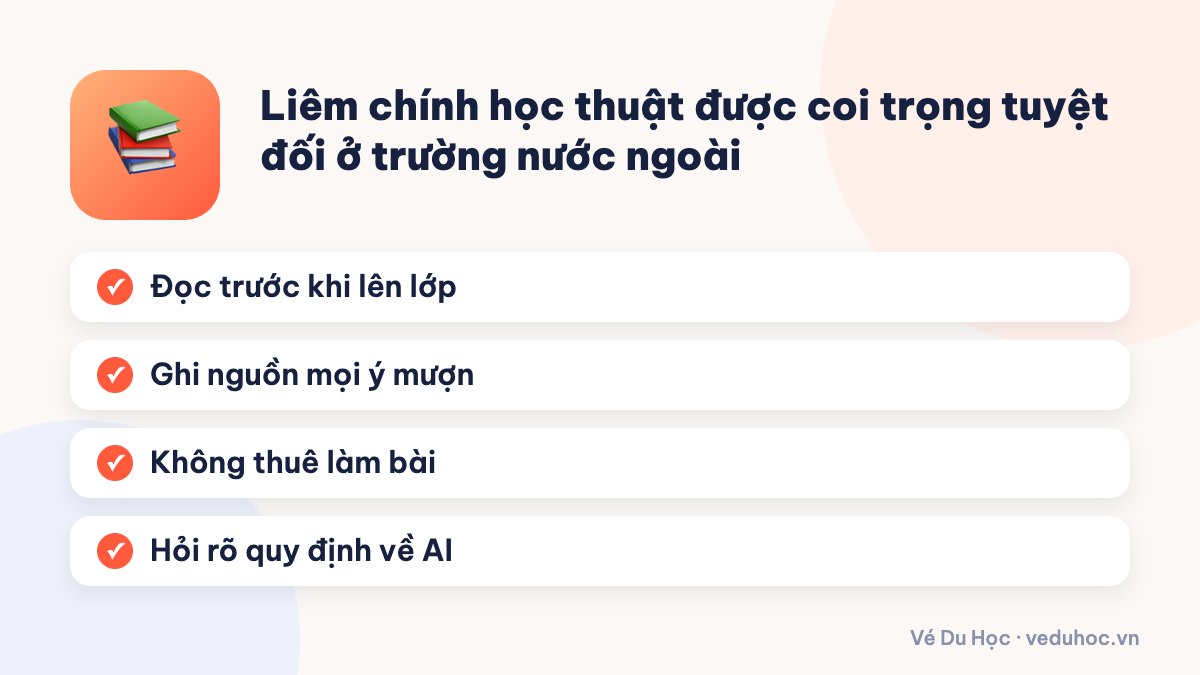
- Self-study is key: class hours are few, but the amount of reading and research outside of class is large. The instructor expects you to have read the material before class.
- Critical thinking: not only summarize, you must analyze, compare, evaluate and give your arguments with evidence.
- Class participation: speeches, group discussions (tutorials, seminars) are often graded.
- Continuous assessment: scores come from many papers in the semester, not just the final exam.
- Teacher-student relationship: more open; You are encouraged to come to office hours to ask questions.
These differences are part of culture shock – see Culture shock when studying abroad and how to overcome it.
How to learn effectively
Read smart
Don't try to read every word. Read the summary, opening and closing, and title first; jot down key notes and questions; Read carefully the sections related to the assignment.
Time management
Write all due dates for the semester on your calendar the first week. Divide large cards into small parts with separate markers; Avoid leaving it until the last night.
Academic writing
- Read carefully the question and marking criteria (rubric).
- Create an outline with a clear main thesis.
- Each paragraph has an idea, with evidence and quotations.
- Write a draft, leave it for a day and then edit; Check grammar and citation format.
Study effectively in groups
Clear assignments, regular meetings, and keep minutes. The assigned group assignment is valid; But individual assignments cannot be done together.
Forms of assessment and examination
| Form | Characteristics | Note |
|---|---|---|
| Essay, report | Requires argument, structure, citation | Correct citation format required by the school (APA, Harvard...) |
| Presentation | Individual or group, with Q&A | Practice first, time it |
| Written exam, multiple choice | Documents can be closed or opened | Ask clearly about the regulations for bringing documents and computers |
| Online exam | Can be monitored via software | Check the device and network first |
| Join class | Attendance and discussion points | Prepare questions and comments before the session |
If you are sick or have a family emergency that affects the test, learn about the school's special consideration, extenuating circumstances and submit the documents on time.
Academic integrity and how to avoid plagiarism
The Australian Tertiary Education Quality Assurance Agency (TEQSA) defines some common types of violations:
- Plagiarism: using someone else's ideas or words without crediting the source, whether accidentally or intentionally. Changing a few words or copying and editing does not make it yours.
- Contract cheating: asking or paying someone else to do all/part of the test or take the exam for you. TEQSA says fraud commercial services are illegal in Australia; Users also run the risk of being blackmailed later.
- Collusion: do individual exercises together and share answers.
- Posting teaching materials (test questions, slides) on "note sharing" pages may also be considered a violation.
The consequences could be redoing an assignment, failing a subject, suspension or expulsion – and according to TEQSA, this could affect your student visa.
How to avoid plagiarism
- Write down the source as soon as you take notes, clearly mark what is a verbatim quote and what is your own opinion.
- Use quotation marks for verbatim quotes; Paraphrase must be in your own writing and still credit the source.
- Use reference management software for consistent citations.
- Do not reuse your own work for another subject without permission.
- If the school allows it, check yourself for duplicates before submitting.
Use AI responsibly
Regulations on generative AI tools vary between schools, and even between subjects: some subjects completely ban it, while others allow it to be used to find ideas but must declare. Please read the course instructions carefully and ask the instructor if you are unclear; Submitting AI-written content as your own may be considered a violation of academic integrity.
Sources of learning support in school
- Academic Skills Center: guidance on writing, citation, presentation skills.
- Library: instructions for finding documents and academic databases.
- Lecturers, teaching assistants: student reception hours.
- Academic advisor: choose subjects, handle poor grades.
- English support: free writing and speaking classes.
Studying well is also a condition to keep a scholarship – see keep the scholarship throughout the course; and balance it with extra homework work part-time while studying abroad. When choosing your first flight, you should arrive in time for orientation week, where these services are introduced first day at school. VeDuHoc can advise on flight schedules suitable for admission, see Admission schedule and time to book study abroad tickets.
Frequently asked questions
Do I need to cite the source to quote the ideas of the lecture?
Usually yes, according to school instructions. When in doubt, cite the source.
Is accidental plagiarism punishable?
Maybe. TEQSA notes that plagiarism includes accidental cases; The level of handling depends on the level and regulations of each school.
Can I use translation and grammar correction software?
Depends on subject regulations. Basic spelling corrections are generally accepted; Using a full rewrite may not be allowed.
Does failing a subject affect your visa?
Prolonged unsatisfactory academic results may affect visa status in some countries. Please contact your academic advisor early if you have difficulty.
Getting used to a new academic culture takes time, but with the right habits, you will gain more confidence each semester. Need advice on flight tickets according to class schedule, contact VeDuHoc via hotline/Zalo 090.1800.918.
Booker HVSC gives a free quote in 15 minutes, Zalo reports take-off and landing for the whole family.
📚 Articles on the same topic
 Study abroad lifeCulture shock when studying abroad and how to overcome it19/09/22 · 6 phút đọc
 Study abroad lifeTraveling economically while studying abroad: experiences for students04/01/22 · 6 phút đọc
 Study abroad lifeTraveling while studying abroad: student transportation card and buying a car09/10/18 · 7 phút đọc
 Study abroad lifeStaying in touch with family while studying abroad: tools and habits21/01/24 · 6 phút đọc
 Study abroad lifePost-graduation jobs abroad: work visas from different countries08/09/19 · 7 phút đọc
 Study abroad lifeEconomical cooking for international students: menus and shopping tips15/01/20 · 7 phút đọc
🔥 Read a lot
- International checked baggage for international students: pieces or scales, 46kg and tips for packing suitcases
- Master's scholarships: strategies for choosing majors, choosing schools and contacting professors
- Why should study abroad centers have specialized airline ticket partners?
- Choosing a reputable dispatching company: signs to recognize and avoid scams
- Stipendium Hungaricum Scholarship: full study abroad in Hungary





 ▶
▶ ▶
▶ ▶
▶ ▶
▶ ▶
▶ ▶
▶ ▶
▶