
🔄 Cập nhật lần cuối: 08/10/26
One of the "rewards" of studying abroad is the opportunity to explore new lands during vacation. Traveling economics while studying abroad is completely feasible if you know how to choose the right time, take advantage of student incentives and understand visa regulations. This article summarizes practical experiences so you can travel more without affecting your studies and budget.
Plan and budget
Travel should not disrupt your financial plans for the entire semester. Separate a separate "travel fund" in your monthly budget as suggested in the article Personal financial management for international students.
- Choose a time: reading week, mid-semester break is usually less crowded than major holidays. Avoid overlapping school holidays in the host country.
- Do not overlap exam schedules or deadlines: check the class schedule carefully before ordering anything.
- Travel in a group: split house and car rent, significantly reduces costs.
- Set a spending ceiling for each trip and record actual costs.
Economical travel: plane, train, bus
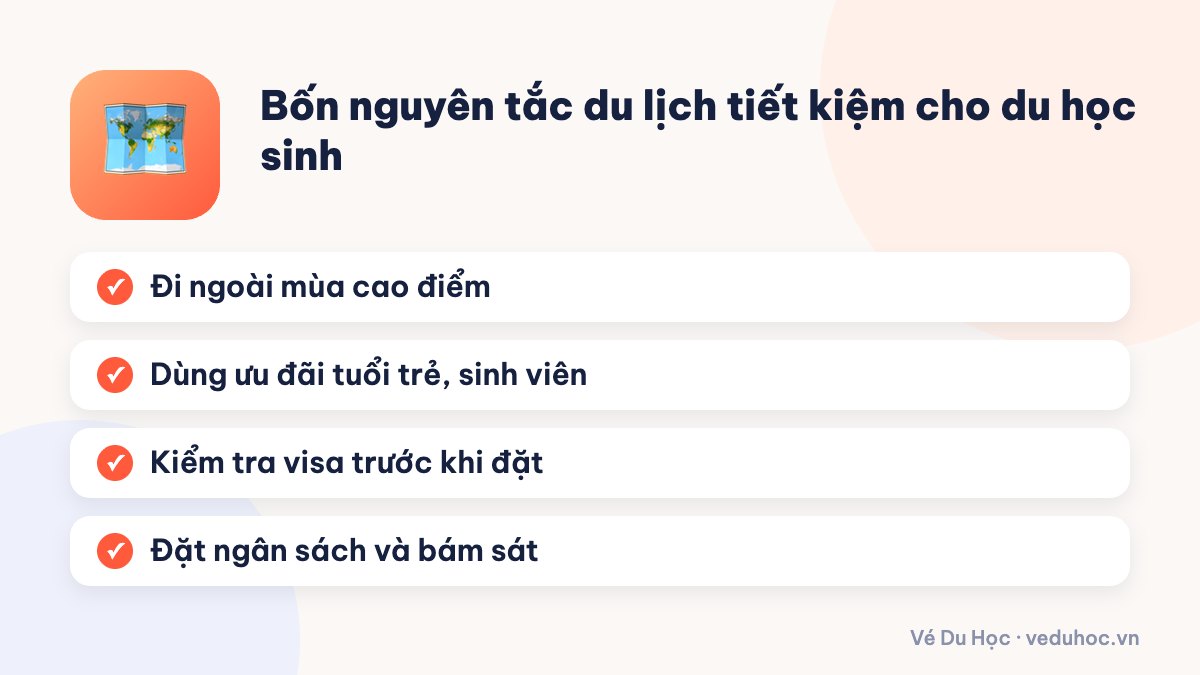
Travel expenses are often the largest expense of the trip. A few principles to help you save:
Airplane
- Low-cost airlines have low base fares but charge fees for baggage, seat selection, and boarding pass printing. Compare total costs, not just ticket prices.
- Flexible flight dates, midweek flights are often cheaper than weekends.
- Note that the secondary airport is far from the center, plus additional travel costs.
- Learn the Discount air tickets for students of firms.
Trains and buses
- In Europe, the Interrail Pass offers a 25% discount for people from 12 to 27 years old (calculated on the trip start date). People residing in Europe often buy Interrail; Non-residents use Eurail.
- In the UK, Railcard for young people and students helps reduce train ticket prices by 1/3. See more articles travel while studying abroad.
- Long-distance buses are often the cheapest option for short and medium-distance trips; Overnight flights also help save one night of accommodation.
International student card
School student cards and international student cards (such as ISIC) can help reduce ticket prices to museums, attractions, and transportation in many places. Always ask “student discount?” before buying tickets.
Visa and documents: part not to be missed
This is the most common mistake international students make: booking a ticket and then finding out they need a visa. With a Vietnamese passport, most destinations require a visa. Some common cases:
| You are studying at | Go to | Key note |
|---|---|---|
| Schengen countries (Germany, France, Netherlands...) | Other Schengen countries | Holders of a valid residence card of one Schengen country can stay short-term in another Schengen country for a maximum of 90 days in every 180 days, bringing their passport and residence card with them. |
| Schengen country | England, Ireland | Non-Schengen, need to check separate visa requirements |
| You | Continental Europe | UK student visa not allowed to enter Schengen; usually require a Schengen visa |
| Australia, USA, Canada | Another country | Check the destination's visa and conditions for returning to the country of study (expired visa, re-entry documents) |
Additionally, make sure your passport is valid (many countries require at least 3–6 months remaining) and your student visa is valid to return. If your passport is about to expire, see instructions in the article Passport for international students. When transiting through a third country, it is also necessary to check transit visa requirements.
Accommodation and meals
- Dormitory hostels are a popular choice for students; Read carefully the reviews about security and location.
- Renting an apartment in groups with a kitchen helps save money on meals.
- Breakfast on your own, lunch at local restaurants, dinner bought at the supermarket.
- Bring a water bottle, in many European countries tap water is drinkable.
Safe when traveling
- Share schedules with friends and family; Keep in touch regularly as suggested in the article Keep in touch with family while studying abroad.
- Buy travel insurance if study abroad insurance does not cover outside your home country.
- Be careful of pickpocketing in crowded tourist spots, especially train stations.
- Save the Vietnam Embassy number at the destination. Other risks are included in the article safe when studying abroad.
For long flights or complex multi-stop itineraries, VeDuHoc's 30+ Booker team can hunt for multi-carrier tickets, check transit visa requirements and continue to monitor prices after you pay; If there is a better price, HVSC will refund the difference. Submit a request on the page Book tickets.
Frequently asked questions
Do I need a visa to study in Germany to go to France?
If you have a valid residence card issued by Germany, you can go to other Schengen countries for short-term stays of up to 90 days within 180 days without needing to apply for a separate visa. Bring your passport and residence card.
Does traveling during the semester affect my visa?
Some visas require attendance points. Taking time off from school to travel can affect your academic performance and visa status. It is recommended to go only on official vacations.
I'm studying in the UK and want to go to Europe, what do I need to prepare?
You usually need to apply for a Schengen visa in the UK, prepare your passport, valid UK visa (eVisa) status, student confirmation, financial proof, room reservation and travel insurance. Check the specific requirements of the destination country's consulate.
How to make the trip cheapest?
Go outside of peak season, book early, compare total costs, go in groups, and cook for yourself when possible.
Traveling is a great way to learn beyond the classroom. Prepare carefully, you will have memorable trips while still keeping to your budget. Contact VeDuHoc via hotline/Zalo 090.1800.918 when you need itinerary advice.
Reference source
Booker HVSC gives a free quote in 15 minutes, Zalo reports take-off and landing for the whole family.
📚 Articles on the same topic
 Study abroad handbookExit procedures at Vietnam airport for international students28/03/26 · 6 phút đọc
 Study abroad lifeFirst day at school: orientation and things to do20/12/24 · 6 phút đọc
 Study abroad lifePersonal financial management for international students: create a monthly budget08/09/24 · 6 phút đọc
 Study abroad lifeStaying in touch with family while studying abroad: tools and habits21/01/24 · 6 phút đọc
 Study abroad handbookOne-way or round-trip tickets when studying abroad: cost analysis30/11/23 · 6 phút đọc
 Study abroad lifeSafety when studying abroad: avoiding scams and common risks19/08/23 · 8 phút đọc
🔥 Read a lot
- Hành lý ký gửi chặng quốc tế cho du học sinh: kiện hay cân, 40kg hay 2 kiện 23kg và mẹo đóng vali
- Master's scholarships: strategies for choosing majors, choosing schools and contacting professors
- Why should study abroad centers have specialized airline ticket partners?
- Choosing a reputable dispatching company: signs to recognize and avoid scams
- Stipendium Hungaricum Scholarship: full study abroad in Hungary




 ▶
▶ ▶
▶ ▶
▶ ▶
▶ ▶
▶ ▶
▶ ▶
▶