
🔄 Cập nhật lần cuối: 08/10/26

Geographic distance and time zone difference makes many families worried when their children study abroad. Keep in touch with family while studying abroad It's not just about making phone calls, it's about building a steady, comfortable connection for both sides. The article suggests tools suitable for each country, how to handle time zone differences, and habits that help you stay mentally strong and your parents can rest assured.
Why do we need a “communication plan”?
In the first weeks, many of you called home very often; A few months later, when busy with school and part-time work, contact gradually decreased and my parents began to worry. On the contrary, some people feel pressured because they have to constantly "report". A clear plan helps:
- Parents know when to hear from their child, reducing anxiety.
- You take the initiative in your time, without interruption in your studies.
- The whole family quickly realized something was unusual, for example when a crook pretended to commit fraud.
Universities such as the University of Jyväskylä (Finland) also advise students to keep in touch regularly but in a balanced manner, avoiding constantly checking home news, making them miss home even more.
Popular communication tools and notes by country
Before flying, agree with your family on one primary application and one backup application.
| Tools | Advantages | Note |
|---|---|---|
| Zalo | Familiar with Vietnamese parents, video calls, family groups | Needs a stable internet connection |
| Messenger, WhatsApp | Popular internationally, easy to contact even foreign friends | Blocked in mainland China |
| FaceTime, Google Meet | Good video quality | FaceTime is only used between Apple devices; Google services are blocked in China |
| WeChat, KakaoTalk, LINE | Popular in China, Korea, Japan | Useful for communicating with friends and hosts in the host country |
| Regular calls, SMS | No internet needed | High international fees; Should be used for emergencies |
If studying abroad in China, note that many services such as Google, Facebook, WhatsApp, Messenger are blocked and this list may change; Please check with the school in advance and comply with local laws. For immediate connection upon landing, refer to the article SIM, eSIM and internet when you first arrive abroad.
Handling time zone differences
Vietnam uses the UTC+7 time zone and does not apply summer time, while many countries studying abroad change time according to the seasons. The table below helps you choose a reasonable calling time frame (hours vary depending on the season):
| Study place | Difference compared to Vietnam | Suggested call box (Vietnam time) |
|---|---|---|
| Tokyo, Seoul | 2 hours early | Evening 7pm–9pm |
| Sydney, Melbourne | 3–4 hours earlier | Evening 18:00–20:00 |
| London | 6–7 hours later | Late evening from 9:00 p.m. to 11:00 p.m. or noon on weekends |
| Berlin, Paris | 5–6 hours later | Evening 8pm–10pm |
| Toronto, New York | 11–12 hours later | Early morning 7am–9am |
| California, Vancouver | 14–15 hours later | Morning 9am–11am |
Pro tip: add world clocks of two cities to both parent and child's phones to avoid misdiagnosing bedtime or exam time.
Healthy communication habits
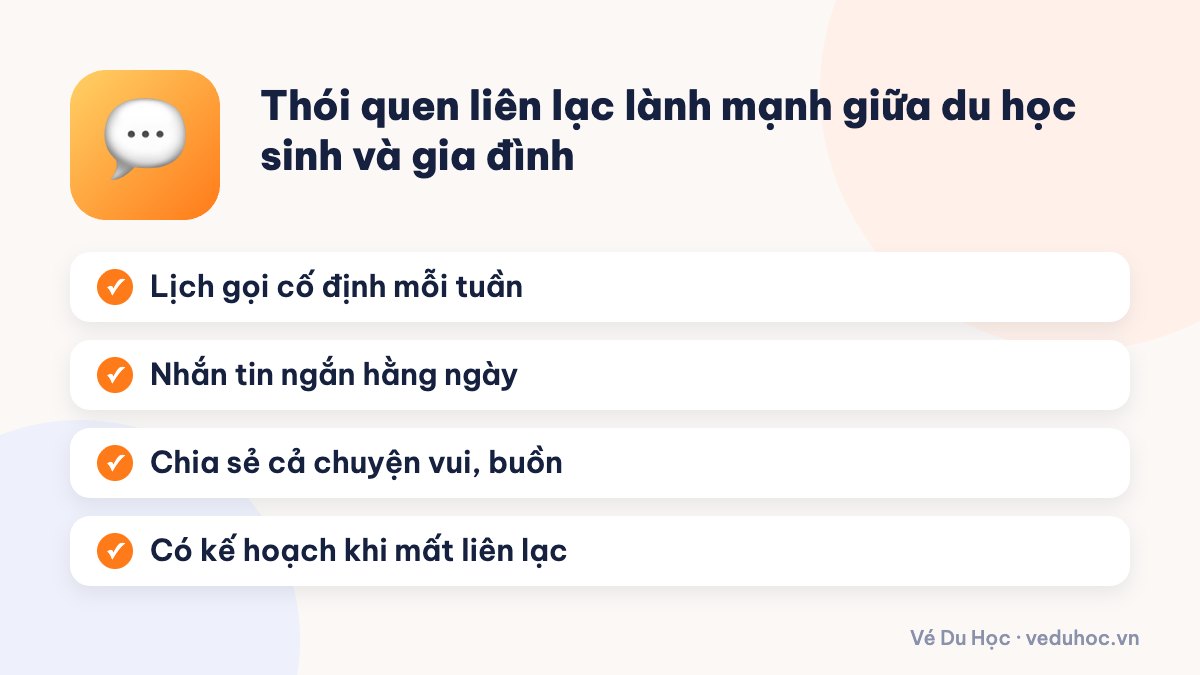
- One fixed video call per week (eg Sunday morning Vietnam time), long enough to chat comfortably.
- Short daily messages: a photo of a meal, a line "I'm at school" is enough.
- Share even difficult stories, not just fun. Parents may not be able to solve everything, but listening will help you feel better. See more articles Take care of your mental health while studying abroad.
- Balance with new life. Calling home too much can make it difficult to fit in; Take the time to make friends and participate in activities, according to the suggestions in the article Culture shock when studying abroad.
- Parents respect personal space: asking instead of controlling. Parents can refer to the article Monitor and support your child remotely while studying abroad.
Emergency communication plan
Please agree with your family in advance:
- How long does it take to be unreachable before action is needed (e.g. 24–48 hours outside the regular schedule).
- Who is the second point of contact at your place of residence: roommates, acquaintances, international student office.
- A “family password” to verify when there is a strange call saying your child is in trouble and asking for money. Read more articles safe when studying abroad.
- Vietnam Embassy/Consulate General number in the host country. Detailed steps are in the article when you encounter problems abroad.
The connection starts right from the first flight. At VeDuHoc, service Parents track flights via Zalo Helps families understand each flight route, with a 24/7 support team in case of delays, cancellations or schedule changes.
Frequently asked questions
How many times a week should I call home?
There is no standard number. Many families maintain one long video call each week and short messages daily. The important thing is that it's regular and both sides feel comfortable.
What application do you use when studying abroad in China to call Vietnam?
Many international students use WeChat for on-site communication; With your family, try familiar applications in advance and ask for experience from the school or Vietnamese student association there, because access status may change.
Is it a worrying sign that your child rarely calls home?
Not really, maybe your child is busy and has adapted well. However, if your child changes suddenly, withdraws, has insomnia, or drops out of school, parents should talk gently and encourage their child to seek support.
Should you share your phone location with your parents?
This is a separate agreement for each family. Sharing your location when traveling long distances or staying out late at night can be helpful for safety, as long as both parties agree.
Keeping in touch regularly is the simplest way for the whole family to accompany you on your study abroad journey. If you need flight advice for your child, parents can contact VeDuHoc via hotline/Zalo 090.1800.918.
Reference source
Booker HVSC gives a free quote in 15 minutes, Zalo reports take-off and landing for the whole family.
📚 Articles on the same topic
 Study abroad handbookExit procedures at Vietnam airport for international students28/03/26 · 6 phút đọc
 Study abroad handbookHelp your child choose a major and a suitable country to study abroad10/02/25 · 7 phút đọc
 Study abroad lifeFirst day at school: orientation and things to do20/12/24 · 6 phút đọc
 Study abroad lifePersonal financial management for international students: create a monthly budget08/09/24 · 6 phút đọc
 Study abroad handbookWhen children encounter problems abroad: what parents need to do28/05/24 · 7 phút đọc
 Study abroad handbookOne-way or round-trip tickets when studying abroad: cost analysis30/11/23 · 6 phút đọc
🔥 Read a lot
- International checked baggage for international students: pieces or scales, 46kg and tips for packing suitcases
- Master's scholarships: strategies for choosing majors, choosing schools and contacting professors
- Why should study abroad centers have specialized airline ticket partners?
- Choosing a reputable dispatching company: signs to recognize and avoid scams
- Stipendium Hungaricum Scholarship: full study abroad in Hungary




 ▶
▶ ▶
▶ ▶
▶ ▶
▶ ▶
▶ ▶
▶ ▶
▶