
🔄 Cập nhật lần cuối: 08/10/26

Monitoring and supporting your child remotely while studying abroad is a delicate balance: care enough to make your child feel safe, but don't control to the point that your child loses independence or is afraid to share. This article suggests how parents can build effective communication channels, recognize signs that their children are having difficulties, coordinate with the school, and prepare support plans when needed.
Principle: companionship, no supervision
When children go abroad, the parent's role shifts from "manager" to "mentor". Some principles for a healthy relationship:
- Agree expectations in advance: frequency of calls, how to share expenses, academic results - agree before your child leaves to avoid misunderstandings.
- Ask about feelings, not just grades: “How are you feeling this week?” often opens up more stories than "How many points did you get?".
- Respect privacy: tracking your child's location or reading your text messages can break trust. If you use location sharing, let it be a two-way agreement, serving safety.
- Accept the "quiet" period: in the first weeks of exam season, your child may have little contact - that's usually a sign that your child is busy, not something wrong.
Build communication habits
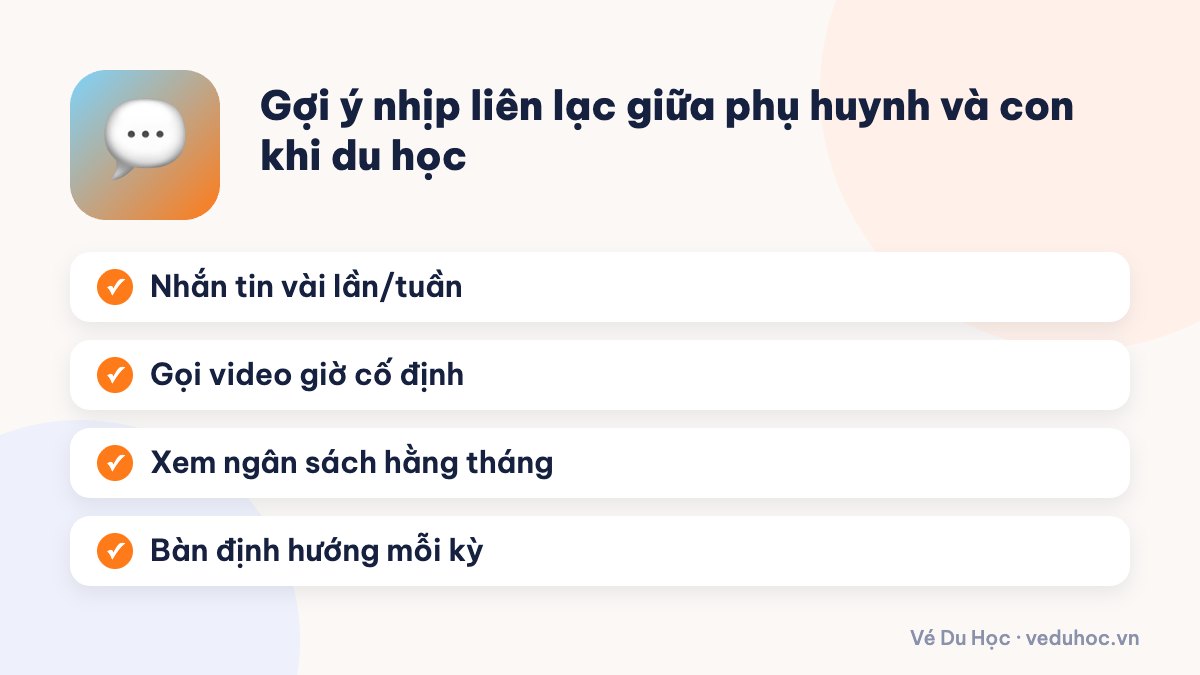
| Form | Suggested frequency | Purpose |
|---|---|---|
| Short text messages | Several times/week | Ask gently, share family stories |
| Video calling | 1 time/week, fixed time frame | Seeing each other, knowing the mood |
| Financial exchange | Every month | Review the budget and emerging needs |
| Talking about learning and orientation | Every semester | Choose subjects, internships, summer plans |
Note the difference time zone difference: for children in the US or Canada, choose early morning or late evening Vietnam time. Popular communication tools are compared in the article Keep in touch with family while studying abroad.
Signs your child is having trouble
Pay attention if your child has changes that last more than 2 weeks:
- Less unusual contact or conversely, calling back constantly, or crying.
- Complain of fatigue, insomnia, loss of appetite, and not wanting to leave the room.
- Avoid talking about studying, missing many classes, or suddenly dropping grades.
- Asking for money unusually often, for unclear reasons (could be a sign of fraud, gambling, or debt).
- Saying negative things about yourself, feeling hopeless.
This could be culture shock, academic pressure or mental health issues. Listen before giving advice, and encourage your child to seek out school counseling services. Read more Culture shock when studying abroad and Take care of your mental health while studying abroad. If your child has thoughts of harming themselves, immediately contact the emergency number in your home country or school.
Coordinate with schools and support networks
Understand the limits of access to information
In many countries, when a child turns 18 years old or goes to college, the school will not automatically provide scores and academic status to parents. For example, in the US, according to the US Department of Education, rights to educational records under FERPA transfer from parents to students when the student turns 18 or enters post-secondary education, regardless of age. To communicate directly with the school, parents need their child to sign a form agreeing to share information.
Build an on-site support network
- Please contact the international student support department, academic advisor, or dormitory.
- Connect with the Vietnamese student association at your school/city.
- Have at least one trusted acquaintance nearby (relative, family friend).
- For students under 18 years old: keep in regular contact with guardians and homestays.
- Store information of the Vietnamese Embassy/Consulate General and the Ministry of Foreign Affairs' Citizen Protection Hotline.
Practical remote support
- Finance: transfer money on time through legal channels, have an emergency fund ready that you can use immediately. See Send money for your children to study abroad.
- Documents: save scanned copies of your child's passport, visa, insurance, and invitation letter to assist when your child loses their documents.
- Flight: track the journey when your child goes/returns; Hold the booking code to support ticket changes in case of problems. See Parents track flights via Zalo.
- When there is a major incident: refer to the procedure in the article when you encounter problems abroad.
- Visit your child: a visit on an appropriate occasion helps parents understand their child's living environment – see Parents visit their children studying abroad.
When your child flies to or from the country, VeDuHoc sends flight information to parents via Zalo, providing 24/7 support in case of late flights, missed connections or urgent need to change tickets. 30+ Booker hunts for multi-carrier tickets, refunds the difference if a better price is found after payment. Learn more at the page air tickets to study abroad.
Frequently asked questions
How many times a week should I call my child?
There is no standard number. A fixed video call each week with a few short messages is a suitable rhythm for many families; It is important that both sides agree and maintain regularity.
Can parents ask the school directly about their child's scores?
At the university level, many schools only share when students agree in writing. Please discuss with your child and go through the procedures to agree to share information if necessary.
What if I don't answer the phone for many days?
Contact your roommate, acquaintance, dormitory or international student support office. If you still cannot contact and have safety concerns, report to local police and the Vietnamese Embassy.
How do you know if your child is experiencing psychological pressure?
Watch for lasting changes in sleep, eating, communication, and attitude toward school. Listen without judgment and encourage your child to use the school's free counseling service.
I'm far away but that doesn't mean I'm alone. With proper companionship, parents will be their children's strongest support. Need assistance with tickets and flight schedules, please call VeDuHoc via hotline/Zalo 090.1800.918.
Reference source
Booker HVSC gives a free quote in 15 minutes, Zalo reports take-off and landing for the whole family.
📚 Articles on the same topic
 Study abroad handbookHelp your child choose a major and a suitable country to study abroad10/02/25 · 7 phút đọc
 Study abroad handbookWhen children encounter problems abroad: what parents need to do28/05/24 · 7 phút đọc
 Study abroad lifeStaying in touch with family while studying abroad: tools and habits21/01/24 · 6 phút đọc
 Study abroad lifeSafety when studying abroad: avoiding scams and common risks19/08/23 · 8 phút đọc
 Study abroad handbookParents visiting children studying abroad: visit visa and air tickets08/05/23 · 7 phút đọc
 Study abroad lifeCulture shock when studying abroad and how to overcome it19/09/22 · 6 phút đọc
🔥 Read a lot
- Hành lý ký gửi chặng quốc tế cho du học sinh: kiện hay cân, 40kg hay 2 kiện 23kg và mẹo đóng vali
- Master's scholarships: strategies for choosing majors, choosing schools and contacting professors
- Why should study abroad centers have specialized airline ticket partners?
- Choosing a reputable dispatching company: signs to recognize and avoid scams
- Stipendium Hungaricum Scholarship: full study abroad in Hungary





 ▶
▶ ▶
▶ ▶
▶ ▶
▶ ▶
▶ ▶
▶ ▶
▶