
🔄 Cập nhật lần cuối: 08/10/26

Helping your child choose a major and a suitable country to study abroad is one of the family's biggest decisions, affecting their finances, career and happiness for many years. Parents should not make decisions for their children, but they should also not "pay it forward". The article offers a 4-step thinking framework, country comparison criteria, and common mistakes parents make.
Parent's role: advisor, not decider
You are the person who will sit in the lecture hall for 3–5 years and do that job for many years later. If the major chosen by the parents is not something the child is interested in, the risk of dropping out, changing majors or burning out is very high. The most effective role of parents is:
- Help children understand themselves through observation, conversation, and career testing guidance.
- Provides practical information about career, income, and working environment.
- Set your family's financial limits clearly from the beginning.
- Assess risks and backup plans with your child.
4 steps to help your child choose a major to study abroad
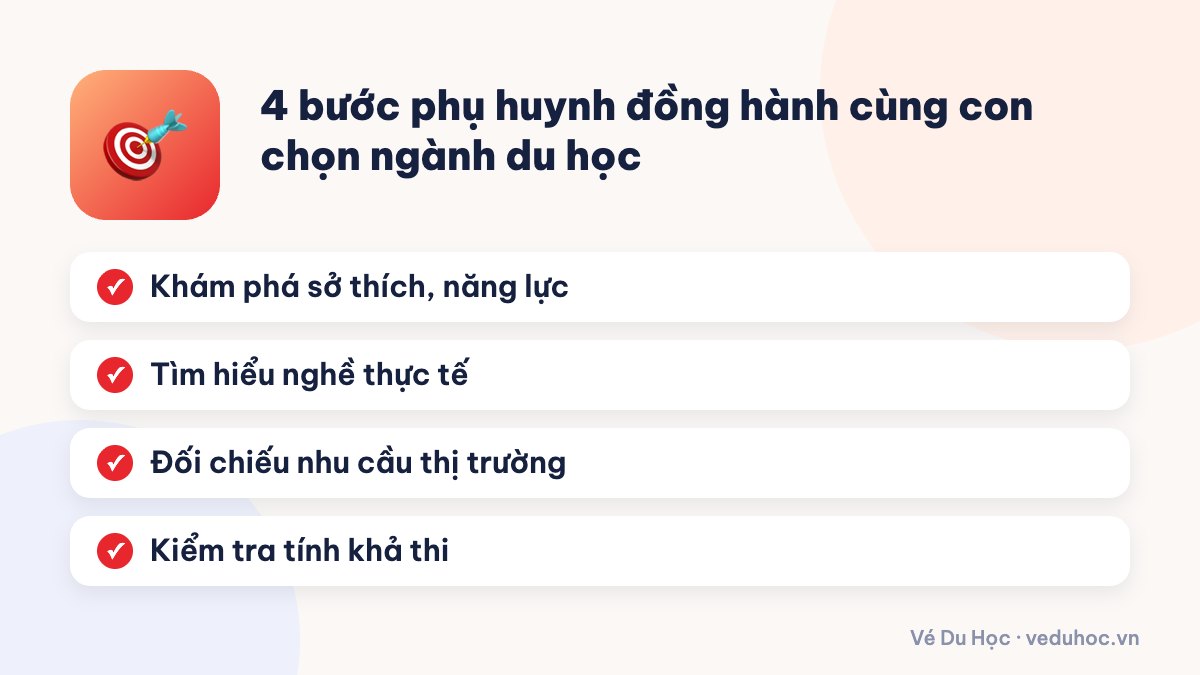
Step 1: Explore interests and abilities
Do you like working with people, numbers, machines or ideas? What subjects are you good at and interested in? Career testing tools (like the Holland model) are for reference only, but are a good starting point for conversation.
Step 2: Find out practical careers
Encourage your child to talk to people who are working, participate in extracurricular activities, short-term courses or internships. A week of "experimenting" can help your child realize whether he or she really likes it or not.
Step 3: Compare market demand
Many countries publish data on occupations lacking human resources. For example, Jobs and Skills Australia publishes the Occupation Shortage List by occupation code, indicating which occupations are lacking and in urban or regional areas. This is useful reference data, but market demand may change during 4–5 years of schooling. Article Choose a major to study abroad that has job and settlement opportunities deeper analysis.
Step 4: Check feasibility
Are the scores, foreign language certificates, prerequisite subjects, costs and study time of that major suitable? Medicine, pharmacy, and law in many countries have significantly longer and more expensive routes.
Criteria for choosing a suitable country to study abroad
| Criteria | Questions need answering |
|---|---|
| Quality of the field of study | Which country is strong in your chosen industry? Is the school accredited and good for internships? |
| Cost | Are tuition fees + living expenses within the family's ability? Are there scholarships? |
| Language | Study in English or have to learn a new language (German, Japanese, Korean, French)? |
| Visa policy, part-time work | How many overtime hours can I work? Is there a post-graduation work visa? |
| Living environment | Climate, safety, Vietnamese community, flight distance home |
| Long-term plan | Do you want to return home, stay and work, or go to another country? |
The cost comparison table for different countries is in the article Cost of studying abroad in other countries; Scholarship opportunities by country are summarized below Compare scholarships from other countries.
Geographic distance is also a practical factor: flying to Singapore, Japan, Korea, and Australia is often shorter and cheaper than the US, Canada, and Europe - affecting the frequency of children's visits home and the cost of annual tickets.
Don't ignore visa and employment policy
Study abroad policies change quite quickly. An example: according to IRCC, from November 1, 2024, applicants Canadian study permit Studying in college programs (not bachelor's, master's, or doctoral degrees) must study a major on the list of eligible fields - associated with long-term shortage occupations - to be considered for a post-graduation work permit (PGWP); Language requirements include Club 5 for colleges and Club 7 for universities. If your child's plan includes staying to work, parents need to check that country's latest policy before choosing a major.
See more about post-graduation work visas in this article post-graduation jobs abroad.
Mistakes parents often make
- Choose according to the "trend": the hot industry today may be saturated when your child graduates.
- Just look at the school rankings, ignoring your child's industry strengths and suitability.
- Choose a country because you have acquaintances without considering the field of study or the cost.
- Place emphasis on settlement goals: policies change, no one can guarantee in advance.
- There is no plan B: If I can't follow the major, can I change majors and how long will it take? See Change schools or majors while studying abroad.
Once the family has chosen the country and school, VeDuHoc is ready to advise on flight schedules according to the enrollment period, suitable airlines, and luggage for each leg. 30+ Booker hunts for multi-carrier tickets, refunds the difference if a better price is found after payment; Optimal checked baggage of 40–46kg and 24/7 support. See air tickets to study abroad.
Frequently asked questions
Should I choose industry first or country first?
You should usually choose an industry (or industry group) first, then find a country and school that is strong in that industry within your family's financial capacity.
What if I don't know what industry I like?
You can choose a program that allows you to explore before choosing a major (like a liberal arts university in the US) or a preparatory program or foundation year. At the same time, give your child experience through short-term courses and internships.
Should I choose an industry that is "easy to settle in"?
Should only be a secondary criterion. Settlement policies change frequently; A major that matches your abilities and passion will help you achieve long-term success.
What if parents and children disagree about choices?
Let's list the pros and cons, find more information from professionals and career counselors. A goal is a decision that the child is confident in pursuing and that the family can afford to support.
Choosing the right major and the right country is the foundation for the entire study abroad journey. When you're ready to go, contact VeDuHoc via hotline/Zalo 090.1800.918 for advice on suitable tickets. Read more What should parents prepare when their children study abroad?.
Reference source
Booker HVSC gives a free quote in 15 minutes, Zalo reports take-off and landing for the whole family.
📚 Articles on the same topic
 International laborWhat is vocational study abroad? Compare vocational study abroad and university study abroad07/03/25 · 8 phút đọc
 Study abroad handbookWhen children encounter problems abroad: what parents need to do28/05/24 · 7 phút đọc
 Study abroad lifeStaying in touch with family while studying abroad: tools and habits21/01/24 · 6 phút đọc
 Documents & student visaChoose a study abroad major with job and settlement opportunities25/07/23 · 6 phút đọc
 Study abroad handbookMonitor and support your child remotely while studying abroad29/06/23 · 7 phút đọc
 Study abroad handbookParents visiting children studying abroad: visit visa and air tickets08/05/23 · 7 phút đọc
🔥 Read a lot
- International checked baggage for international students: pieces or scales, 46kg and tips for packing suitcases
- Master's scholarships: strategies for choosing majors, choosing schools and contacting professors
- Why should study abroad centers have specialized airline ticket partners?
- Choosing a reputable dispatching company: signs to recognize and avoid scams
- Stipendium Hungaricum Scholarship: full study abroad in Hungary





 ▶
▶ ▶
▶ ▶
▶ ▶
▶ ▶
▶ ▶
▶ ▶
▶