
🔄 Cập nhật lần cuối: 08/10/26

What should parents prepare when their children study abroad? In addition to tuition and visas, parents also need to take care of legal documents, financial planning, insurance, emergency contact channels and psychological preparedness - for their children and themselves. This article is a to-do list for each stage, helping parents be proactive instead of chasing after things that "arise" close to the flight date.
6–12 months ahead: orientation and finances
This stage largely determines the success of the study abroad journey. Parents should answer three questions with their children:
- What do you study, where and why? The field of study and country must match the child's abilities, interests and the family's long-term plans. Article Help your child choose a major and a country to study abroad have a specific frame of mind.
- How much can families pay during the course? Including tuition, living expenses, insurance, plane tickets to visit home and reserve fund. See Parents need to plan their study abroad budget.
- Are there any scholarship opportunities? Scholarship applications usually need to be prepared 9–12 months early.
If working with a consulting center, sign a clear consulting contract. According to a summary of the provisions of Minh Khue Law based on Decree 86/2021/ND-CP, self-funded international students are responsible for signing a contract with a consulting organization (if using the service) and declaring truthful documents.
Legal documents parents need to prepare
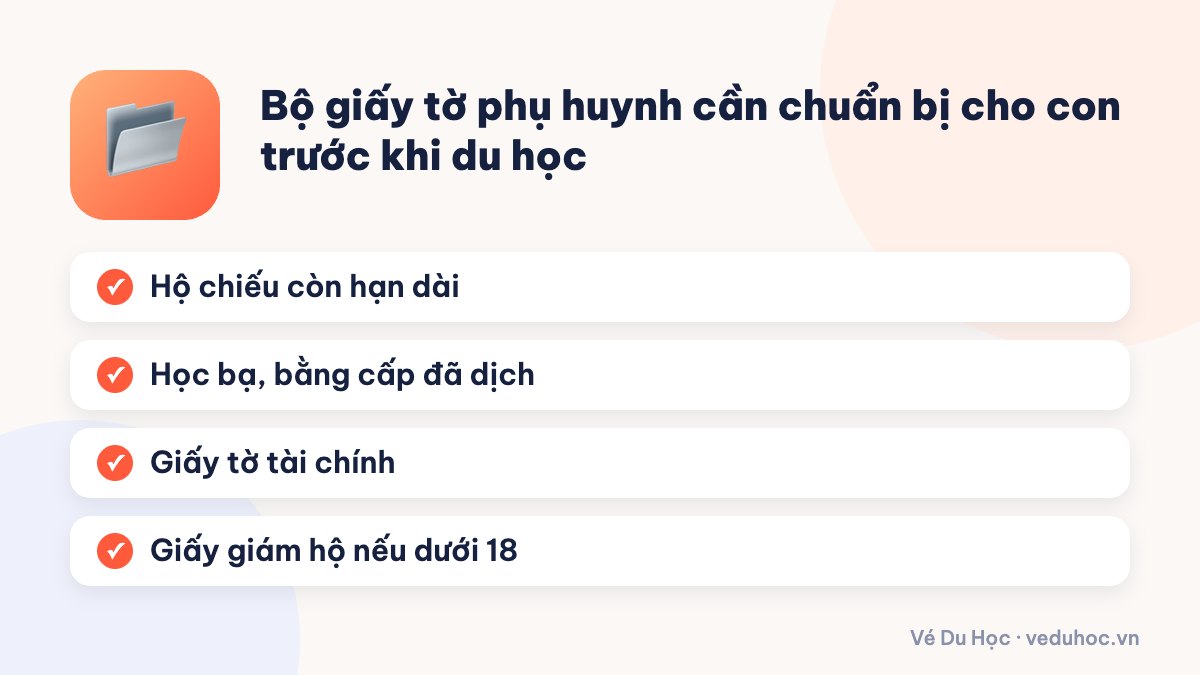
- Child's passport Long term, minimum course duration as possible to avoid extension abroad. See Passport for international students.
- Academic documents: transcripts, diplomas, transcripts - originals and notarized translations.
- Financial documents: savings book, income confirmation, asset documents according to visa requirements.
- Birth certificate (copy, translation) – often needed to prove parent-child relationship when sponsoring finances.
- With children under 18 years old: parental consent, guardian documents abroad according to each country's requirements (for example, Australia requires confirmation of suitable accommodation and welfare arrangements or accompanying eligible relatives). Details in the article Study abroad documents for students under 18 years old.
- Health records: vaccination records, examination results, prescriptions if your child takes medicine regularly.
Pro tip: scan all documents, save to a cloud storage service and share access for both parents and children.
Finance, insurance and money transfer channels
| Category | Parents need to do it |
|---|---|
| Tuition | Transfer via bank according to the school's invoice/invitation letter; keep documents |
| Living expenses | Prepare monthly budget; Choose a legal money transfer channel |
| Payment card | Open an international card (possibly a supplementary card) for your child to use in the first days |
| Insurance | Buy mandatory health insurance according to visa requirements (eg OSHC in Australia), consider travel insurance for flights |
| Reserve fund | Set aside money for emergency situations: illness, urgent return ticket |
Banks in Vietnam allow money to be transferred abroad to pay tuition and living expenses for international students when there is proof. Popular ways to transfer money are analyzed in the article Send money for your children to study abroad.
Prepare your child's skills and psychology
Many students are good in class but are confused when they have to cook, do laundry, go to the bank or handle paperwork. In the few months before leaving, parents should "assign tasks" to their children to practice:
- Cook a few simple dishes and go shopping according to your weekly budget.
- Manage your own monthly expenses – see Teach children financial skills.
- Make your own appointment, call to ask for information, read the rental contract carefully.
- Identify scams via phone and social networks; know the emergency number in the destination country.
Psychologically, agree with your child on how to contact (frequency, time frame) and remind them that asking for help is not a failure. Foreign universities all have international student support services and psychological counseling.
Legally, according to current regulations, international students have the right to receive consular protection from Vietnamese representative agencies abroad and are responsible for registering citizenship. Parents should save the Civil Protection Hotline number of the Ministry of Foreign Affairs and information about the Vietnamese Embassy in their child's country of study.
Before the flight: tickets, luggage and contacts
- Book tickets at the right time: usually fly 1–2 weeks before admission/orientation date. See Admission schedule and ticket booking time.
- Luggage: choose a ticket with enough checked baggage; Valuables and documents in carry-on baggage.
- Airport pick up and residence: Confirm pick-up service from school or acquaintance, address in the first days.
- Sim/eSIM: prepare for your child to contact you as soon as you land.
Vé Du Học đồng hành cùng phụ huynh trong khâu vé máy bay: 30+ Booker săn vé đa hãng, tiếp tục săn kể cả khi giá đang cao và hoàn lại tiền chênh lệch nếu tìm được giá tốt hơn sau khi đã thanh toán; tối ưu hành lý ký gửi 40kg hoặc 2 kiện 23kg, kiểm tra visa quá cảnh, báo tin chuyến bay cho phụ huynh qua Zalo và hỗ trợ 24/7. Xem trang air tickets to study abroad.
Frequently asked questions
When should parents start preparing for their children to study abroad?
Ideally 12–18 months before admission to choose a school, prepare for certification exams, hunt for scholarships and prepare financially.
What additional documents do children under 18 years old need to study abroad?
Usually requires parental consent and guardian/accommodation arrangements approved by the school or immigration authorities, depending on country regulations.
Should I buy insurance in addition to the school's mandatory insurance?
Compulsory insurance is usually enough for basic medical examination and treatment. Parents can consider adding travel insurance for flights (delayed flights, lost luggage) depending on their needs.
Do parents need to accompany their children on the first flight?
Optional. Many families choose to go with them to help their children settle in; If not, you can use the service to support children traveling alone (for young students) and monitor the flight remotely.
Careful preparation helps the whole family feel secure. Once you have a visa, please contact VeDuHoc via hotline/Zalo 090.1800.918 to get advice on suitable flight schedules and luggage for your child.
Reference source
Booker HVSC gives a free quote in 15 minutes, Zalo reports take-off and landing for the whole family.
📚 Articles on the same topic
 Study abroad handbookSim, eSIM and internet when you first arrive abroad09/07/26 · 7 phút đọc
 Documents & student visaChecklist of complete study abroad documents: documents need to be prepared in each stage09/08/25 · 6 phút đọc
 Study abroad handbookHelp your child choose a major and a suitable country to study abroad10/02/25 · 7 phút đọc
 Study abroad lifeFirst day at school: orientation and things to do20/12/24 · 6 phút đọc
 Study abroad handbookWhen children encounter problems abroad: what parents need to do28/05/24 · 7 phút đọc
 Documents & student visaWhat are CoE, I-20, CAS? "Key" documents to apply for a visa12/03/24 · 5 phút đọc
🔥 Read a lot
- Hành lý ký gửi chặng quốc tế cho du học sinh: kiện hay cân, 40kg hay 2 kiện 23kg và mẹo đóng vali
- Master's scholarships: strategies for choosing majors, choosing schools and contacting professors
- Why should study abroad centers have specialized airline ticket partners?
- Choosing a reputable dispatching company: signs to recognize and avoid scams
- Stipendium Hungaricum Scholarship: full study abroad in Hungary




 ▶
▶ ▶
▶ ▶
▶ ▶
▶ ▶
▶ ▶
▶ ▶
▶