
🔄 Cập nhật lần cuối: 08/10/26

Studying abroad budget is the first question - and also the biggest worry - of most parents. The actual figure includes not only tuition but also living expenses, insurance, visa, air tickets, incidental expenses and reserve funds for the entire course. This article helps parents understand the cost structure, refer to the minimum financial level required by countries when considering visas, and make realistic plans.
Study abroad budget structure
The budget can be divided into 3 groups:
- Pre-departure expenses (one time): foreign language certificate exam preparation, application fee, notarized translation, health examination, visa fee, tuition/dormitory deposit, air tickets, carry-on items.
- Recurring expenses (yearly/monthly): tuition, housing, meals, transportation, telephone, books, health insurance.
- Incidental and contingency expenses: tickets to visit home, travel, illness, exchange rate changes, re-study, visa extension.
Tuition fees vary greatly by country, type of school (public/private), level of study and field (medicine and engineering are often higher than business and social studies). A detailed comparison table is included in the article Cost of studying abroad in other countries.
Minimum living expenses required by countries
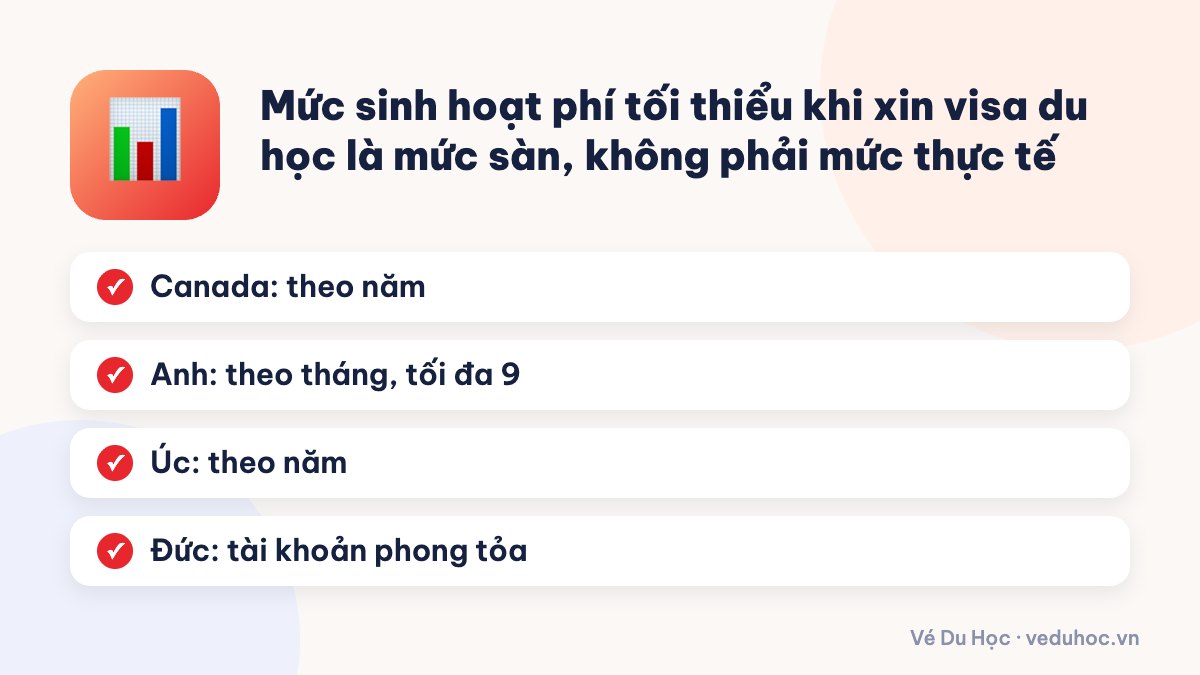
An objective reference is the minimum financial level required by immigration authorities when considering a visa. This is the floor level, actual spending is often higher, especially in big cities.
| Country | Minimum living expenses (excluding tuition) | Notes |
|---|---|---|
| Canada | 23,448 CAD/year for 1 person (file from September 1, 2026); previously 22,895 CAD | Outside Quebec; according to IRCC |
| You | 1,529 GBP/month in London; 1,171 GBP/month outside London | Calculate up to 9 months; according to GOV.UK |
| Australia | About 29,710 AUD/year (announced rate from May 2024) | Can be adjusted; see Australian Department of Home Affairs |
| Germany | Approximately 11,900 EUR/year via blocked account (applicable level 2025) | Adjust periodically |
Note: these levels are adjusted regularly, parents should check the official page at the time of application. How to prove financial standards correctly is in the article Proof of finances for studying abroad.
"Hidden" costs that parents often overlook
- House deposit (usually 1–2 months rent) and initial furniture: blankets, pillows, pots and pans, winter clothes.
- Visa and extension fees, biometric fees, health examination.
- Compulsory health insurance (OSHC in Australia, IHS health surcharge in the UK...) - a one-time payment for the entire course can be a large sum.
- Round-trip airfare to visit home during the summer and Tet holidays - peak prices can be double that of normal days.
- Exchange rate fluctuations: just a few percent can make a significant difference when multiplied by the total cost for many years.
- International money transfer fees, card fees, bank fees.
- Retake or extend the course if your child cannot keep up.
How to set up a study abroad budget for the entire course
- Get official data: tuition from the school's invitation letter, dormitory costs from the school's website, minimum living expenses from the immigration agency.
- Multiply by the number of years of study and add 3–5%/year for the increase in tuition and prices.
- Add the one-time cost before departure and airfare (at least 1 round trip/year if you plan to bring your child home).
- Reserve 10–15% of the total budget for exchange rate, illness, and other risks.
- Establish quarterly cash flow: tuition is usually paid periodically, living expenses are transferred monthly - helping families proactively source money.
Example of budgeting framework for 1 year (for parents to fill in the data themselves):
| Item | Frequency | Data source |
|---|---|---|
| Tuition | By period | School invitation/invoice |
| Housing | Every month | Dormitories, homestays, outsourcing |
| Eating, traveling, phone calls | Every month | Estimates by city |
| Health insurance | Year / whole course | Visa required |
| Airline tickets | 1–2 times/year | Seasonal quotes |
| Backup | — | 10–15% total |
How to reduce financial pressure
- Hunt for scholarships, including partial school scholarships. See Hunt for scholarships to study abroad from A to Z.
- Choose a city with lower costs or a country with low tuition fees (Germany, Nordic countries with some programs...).
- Working part-time is legal within the allowed hours - considered an extra payment, should not be relied on to pay tuition.
- Teach children financial management from before leaving. See Teach children financial skills and 15 ways to reduce the cost of studying abroad.
- Book tickets early, at the right time - especially tickets for Tet and tickets for the beginning of the school year.
VeDuHoc's team of 30+ Bookers hunts for multi-carrier tickets and continues to monitor prices even when they are high; If a better price is found after parents have paid, HVSC will refund the difference. We optimize checked baggage of 40–46kg, issue VAT invoices, notify flights via Zalo and provide 24/7 support. See air tickets to study abroad.
Frequently asked questions
How much does it cost to study abroad for 1 year?
Depends on country, school and city. Parents should add the tuition fee according to the invitation letter with the minimum living expenses required by the immigration agency, then add air tickets, insurance and 10–15% reserve.
Is the financial level to prove the visa enough to live?
That's the minimum. In big cities like London, Sydney, Toronto, actual costs are often higher, especially rent.
Should I transfer money to my children once a year?
Tuition is usually paid by term. Living expenses should be transferred monthly or quarterly so that children learn how to manage expenses and the family can proactively control cash flow. See Legal ways to transfer money.
Is working part-time enough to cover living expenses?
It is possible to partially compensate, but working hours are limited and studying is still the priority. Don't base your budget on extra income.
A clear budget helps families reduce pressure and children can study with peace of mind. When you need a quote for tickets for the entire school year, please contact VeDuHoc via hotline/Zalo 090.1800.918.
Reference source
Booker HVSC gives a free quote in 15 minutes, Zalo reports take-off and landing for the whole family.
📚 Articles on the same topic
 Study abroad handbookHelp your child choose a major and a suitable country to study abroad10/02/25 · 7 phút đọc
 Study abroad lifePersonal financial management for international students: create a monthly budget08/09/24 · 6 phút đọc
 Study abroad handbookWhen children encounter problems abroad: what parents need to do28/05/24 · 7 phút đọc
 Study abroad lifeStaying in touch with family while studying abroad: tools and habits21/01/24 · 6 phút đọc
 Study abroad handbookMonitor and support your child remotely while studying abroad29/06/23 · 7 phút đọc
 Study abroad handbookParents visiting children studying abroad: visit visa and air tickets08/05/23 · 7 phút đọc
🔥 Read a lot
- Master's scholarships: strategies for choosing majors, choosing schools and contacting professors
- International checked baggage for international students: pieces or scales, 46kg and tips for packing suitcases
- Why should study abroad centers have specialized airline ticket partners?
- Choosing a reputable dispatching company: signs to recognize and avoid scams
- Scholarships to study in Australia at high school and preparatory levels: opportunities for students in grades 10–12




 ▶
▶ ▶
▶ ▶
▶ ▶
▶ ▶
▶ ▶
▶ ▶
▶