
🔄 Cập nhật lần cuối: 08/10/26

Hunting for scholarships to study abroad is not a matter of luck but a project that requires planning, usually lasting 9–15 months from the beginning of research to receiving results. This article divides the process into a specific 12-month roadmap, helping newbies know which month to do what so they don't get stuck with tasks at the last minute.
Why do we need a 12-month roadmap when hunting for scholarships to study abroad?
Most major scholarships have a fixed cycle each year. For example, according to the schedule published on the official website, the British Government's Chevening scholarship usually opens applications from August, closes applications around early October - November, interviews in March - April of the following year and announces results around June, before admission in September - October. Australia Awards scholarships for Vietnamese people in recent years are usually open for applications from early February to early May. This means that from the time of applying to sitting on the plane, it can take nearly a year, not including the previous preparation time.
The "blocking points" that cause many people to miss appointments are usually: not having an English certificate on time, the person who wrote the letter of recommendation is slow to respond, the transcript needs a notarized translation, or the essay is written in a hurry. A clear roadmap helps you handle each task while there is enough time.
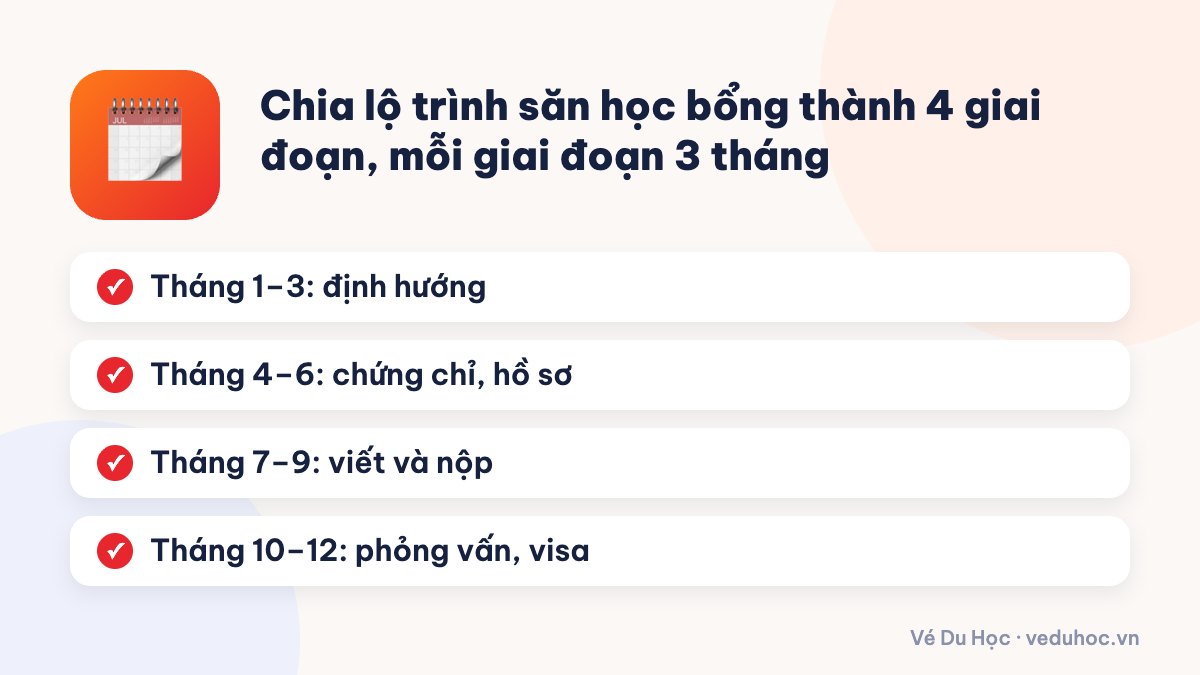
Months 1–3: Orientation and selection of target scholarships
Determine learning goals
Before looking for a scholarship, answer three questions: what level of study (high school, university, master's, doctorate), what major, and why. The "why" answer will be the backbone of the essay later. If you can't distinguish between scholarship groups, read the article first Types of study abroad scholarships.
Make a “long” list and then shorten it
- Find from official sources: government scholarship pages (Chevening, Fulbright, Australia Awards, DAAD, MEXT, GKS...), "Scholarships" page of each school, DAAD scholarship database.
- Record in the spreadsheet: scholarship name, benefits, conditions (GPA, certificate, work experience), deadline, required documents.
- Narrow down to 5–8 most suitable scholarships, including "just right" scholarships, not just the most competitive full scholarships.
Be wary of sites that promise “scholarship admission guaranteed” or charge scholarship application fees – see more instructions Find reputable scholarships and avoid fake scholarship traps.
Self-assess your profile
Compare your GPA, foreign languages, activities and experience to the minimum requirements. If your score is not outstanding, don't give up: there are still appropriate strategies analyzed in the article Hunt for scholarships when your scores are not so excellent.
April–June: Foreign language certificate and background documents
Take an English certificate exam (or another language)
Aim to have your IELTS/TOEFL results at least 2–3 months before the deadline to have a chance to retake the test. Each scholarship and each school accepts different certificates, so check before registering for the exam; post IELTS, TOEFL, Duolingo: which certificate to choose will help you decide.
Prepare "background" documents
- Transcript, diploma (original and notarized translation).
- Passport with long validity - many people forget this step until they have to apply for a visa.
- Academic CV: lists achievements, research, activities in reverse chronological order.
- List of people who can write letters of recommendation (lecturers, direct managers).
Compensation works
Three months is enough to complete a small project, a certified online course, or a volunteer role with measurable results. The Board values depth and impact over quantity.
July–September: Write essay and submit application
The essay is the "soul" of the application
Spend at least 4–6 weeks on the essay: create an outline, write a draft, ask someone with experience for feedback, and edit at least 3–4 times. Each scholarship has its own questions (Chevening asks about leadership, networks, career plans; Australia Awards emphasizes contributions to Vietnam's development), so don't use one question for all.
Letter of introduction
Please write early, attach your CV and a summary of your goals so that your recommender can write specifically. Gentle reminder 2 weeks before due date.
Submit before the deadline
The online system is often overloaded in the last days. Submit 1–2 weeks before the deadline and save the confirmation email and screenshot of the submitted page.
October–December: Interview, visa and flight preparation
Interview practice
If you get into the interview round, review your own essay because the questions often revolve around what you wrote. Practice speaking out loud with a friend or record yourself to correct yourself.
Receive results and apply for visa
When you receive the scholarship award letter, read the terms carefully: what does the scholarship cover, does it include airfare, and is there a commitment to return to your home country? Then prepare visa documents according to the requirements of the destination country.
Plan your flight
Even with a full scholarship, many expenses such as air tickets, excess baggage or expenses for the first days can still be taken care of by you – see article Are full scholarships truly free?. Should refer Admission schedule and time to book study abroad tickets to finalize a reasonable flight date.
Table summarizing the 12-month roadmap for hunting for scholarships to study abroad
| Phase | Main thing | Results needed |
|---|---|---|
| January–March | Determine goals, make a scholarship list, and self-assess | 5–8 targeted scholarships, deadline tracking sheet |
| April–June | Take certification exams, prepare documents, and foster activities | Foreign language certificate, CV, notarized translation, passport |
| July–September | Write an essay, ask for letters of recommendation, submit your application | Completed application submitted before deadline |
| October–December | Interview, receive results, visa, book tickets | Scholarship award letter, visa, flight schedule |
Note: month “1” is the month you start, not necessarily January. Please compare with the actual deadline of the target scholarship – essay seasonal scholarship application schedule help you align.
Frequently asked questions
What year is appropriate to start hunting for scholarships to study abroad?
For university level, you should start from grades 10–11; For master's degree, from 3rd year of university or after working for 1-2 years depending on scholarship requirements. The sooner you have time to build your profile.
How many scholarships should I apply at once?
Usually 4–8 scholarships are enough, combining highly competitive scholarships and school scholarships with higher rates. Submitting too much can easily reduce the quality of your essay.
Can I hunt for scholarships without IELTS?
Some schools accept other certificates or waive them when you study an English program, but most major scholarships require a recognized certificate. Please check on the official site.
Does the scholarship pay for airfare?
Depends on the scholarship. Some government scholarships cover round-trip economy class tickets, many school scholarships do not. Read the scholarship award letter carefully for accuracy.
Conclusion
Hunting for scholarships to study abroad is a long-distance race: breaking it down into stages, sticking to the deadline on the official website and carefully preparing each document will help you be much more confident. Once you have the results, don't forget the final step is the flight – you can Submit a ticket request or refer to the service air tickets to study abroad For advice via hotline/Zalo 090.1800.918.
Reference source
Booker HVSC gives a free quote in 15 minutes, Zalo reports take-off and landing for the whole family.
📚 Articles on the same topic
 Study abroad scholarshipWriting an academic CV for scholarships: presentation templates and ways to highlight achievements15/01/25 · 7 phút đọc
 Study abroad scholarshipRecommendation Letter: who to ask for, how to ask to convince the council30/10/24 · 6 phút đọc
 Study abroad scholarshipWhat GPA does it take to have a chance to get a scholarship? Correct understanding of scores and records20/02/23 · 6 phút đọc
 Study abroad scholarshipExtracurricular activities and personal projects: "weapons" that help differentiate scholarship applications14/11/21 · 6 phút đọc
 Study abroad scholarshipPersonal Statement: structure, examples and common mistakes19/07/19 · 7 phút đọc
 Study abroad scholarshipHunting for scholarships when your grades aren't that great: 7 practical strategies13/11/16 · 6 phút đọc
🔥 Read a lot
- Master's scholarships: strategies for choosing majors, choosing schools and contacting professors
- Hành lý ký gửi chặng quốc tế cho du học sinh: kiện hay cân, 40kg hay 2 kiện 23kg và mẹo đóng vali
- Why should study abroad centers have specialized airline ticket partners?
- Choosing a reputable dispatching company: signs to recognize and avoid scams
- Scholarships to study in Australia at high school and preparatory levels: opportunities for students in grades 10–12





 ▶
▶ ▶
▶ ▶
▶ ▶
▶ ▶
▶ ▶
▶ ▶
▶