
🔄 Cập nhật lần cuối: 08/10/26

When multiple applicants have similar GPAs and IELTS, extracurricular scholarship activities and personal projects are often what make the difference. But boards don't count the number of clubs you belong to – they want to see who you are by what you choose to do, how deep you go, and what change you create. The article helps you choose, develop and present activities convincingly.
What does the council look for in extracurricular activities when applying for scholarships?
The "Turning the Tide" report of the Making Caring Common project (Harvard School of Education), supported by many American universities, recommends that admissions departments prioritize quality, not quantity of activities, and appreciate persistent community service activities, chosen by students themselves, with reflection and "doing with" the community instead of just "doing for". At the graduate level, scholarships like Chevening evaluate leadership through examples that have tangible results: driving change, improving conditions for others, solving a specific challenge.
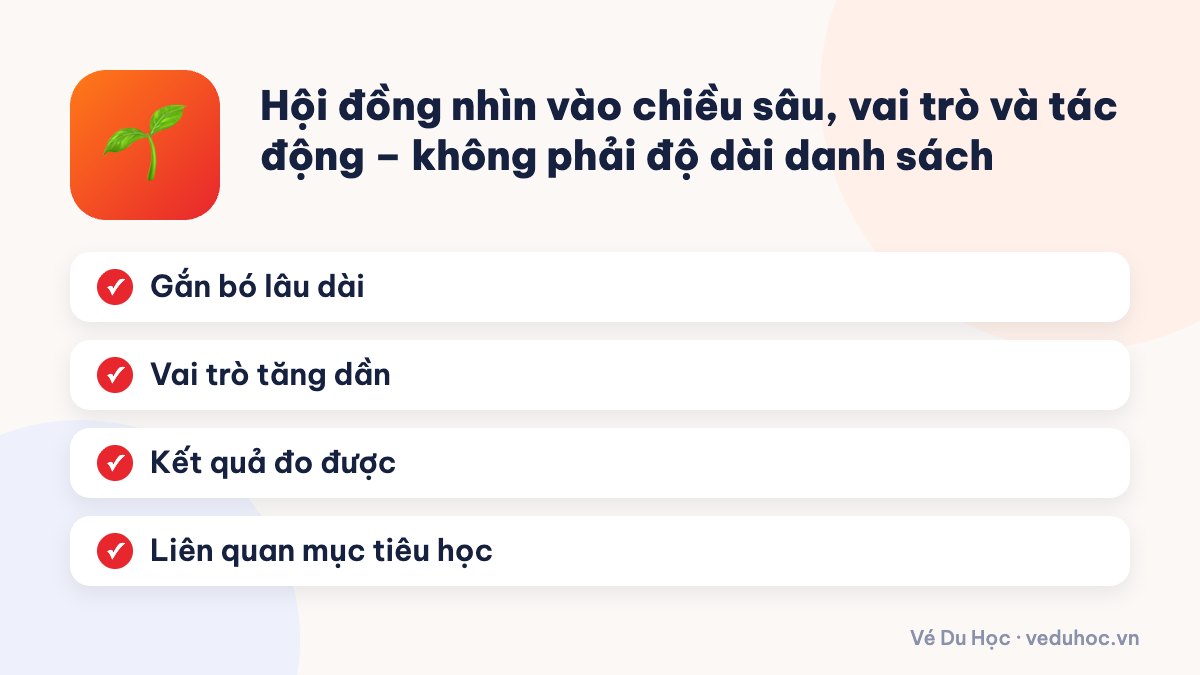
In summary, the panel looks for four things:
- Depth: long-term commitment, not "taking attendance" for the sake of it.
- Roles increase gradually: from member to person in charge, initiator.
- Impact: measurable change – number of beneficiaries, funds mobilized, products created.
- Consistency: activities related to the field of study and internal goals scholarship essay.
Extracurricular activity groups are valuable
| Activity group | For example | Express something |
|---|---|---|
| Academic | Scientific research, Olympic competition, professional clubs | Competence and passion for the field of study |
| Leadership | Club board of directors, event organizers, class representatives | Leadership, decision making, responsibility |
| Community | Long-term volunteering, social projects | Care, contribution, sympathy |
| Work, internship | Part-time jobs, internships, small businesses | Independence, practical skills |
| Creativity, talent | Art, sports, writing, programming | Discipline, character, perseverance |
| Family responsibilities | Take care of relatives, help with family business | Maturity, time management |
Don't overlook the last group: family responsibilities or side jobs are also valid "activities" in many filing systems, and say a lot about you.
Build personal projects from zero
A personal project is something you initiate yourself – that's why it shows the most initiative. Simple process:
- Start with the real problem: look around your school, neighborhood, and profession. The more specific the problem, the better.
- Linked to the field intended of study: people who want to study Computer Science can build small applications; People who want to study Public Health can do community health surveys.
- Set a measurable goal: “help 50 elementary school students improve their reading skills in 3 months.”
- Document the process: photos, data, feedback, products – this is evidence later.
- Evaluation and reflection: What worked, what failed, what did you learn. This reflection is the "golden material" for the essay and scholarship interview.
The project does not need to be large scale. A small, real, long-lasting project with clear results is more valuable than a monumental "project" that only exists on paper.
Present your extracurricular activities on your resume
In the application form
Many systems have very tight limits. For example, the Activities section of the Common App (used to apply to many US universities) allows listing up to 10 activities, each description is only about 150 characters. So write according to the formula: verb + action + result, remove pronouns, use figures.
Illustrative example: "Founded a reading club for 40 students in suburban areas; donated 600 books; maintained weekly activities for 2 years."
In CV and essay
- Arrange the most important activities first, according to the instructions in the lesson write an academic CV.
- Choose 1–2 typical activities to talk about in depth in your essay, let your CV "speak for" the remaining activities.
- Ask someone to lead the writing activity letter of introduction if appropriate – they can validate your role and impact.
Things to avoid
- List a one-time activity (attending a workshop) as an accomplishment.
- Exaggerate the role – the panel may ask for details during the interview.
- Participate massively at the last minute just to "beautify your profile".
If grades are not your strength, in-depth activities are one of the most effective ways to compensate – see 7 strategies for hunting scholarships when your scores are not so excellent.
Frequently asked questions
How many extracurricular activities are needed to apply for a scholarship?
There is no standard number. 3–5 deep activities are often more convincing than 15 superficial activities.
Should activities unrelated to the major be included?
Yes, if it demonstrates important qualities such as leadership, perseverance, responsibility. Just briefly explain the value you learned.
What about students in provinces with few extracurricular opportunities?
Board review in context. Part-time jobs, helping the family, self-study, small local projects, or online activities are all valuable.
Do I need to submit a certificate of participation?
Usually not required unless required by the scholarship. However, you should save it for proof when needed.
Conclusion
The most effective extracurricular activities for scholarship applications are the ones you really care about, do persistently, and create change. Start early and take good notes. When there is good news, VeDuHoc accompanies you with the service air tickets to study abroad – hotline/Zalo 090.1800.918.
Reference source
Booker HVSC gives a free quote in 15 minutes, Zalo reports take-off and landing for the whole family.
📚 Articles on the same topic
 Study abroad scholarshipWriting an academic CV for scholarships: presentation templates and ways to highlight achievements15/01/25 · 7 phút đọc
 Study abroad scholarshipRecommendation Letter: who to ask for, how to ask to convince the council30/10/24 · 6 phút đọc
 Study abroad scholarshipWhat GPA does it take to have a chance to get a scholarship? Correct understanding of scores and records20/02/23 · 6 phút đọc
 Study abroad scholarshipPersonal Statement: structure, examples and common mistakes19/07/19 · 7 phút đọc
 Study abroad scholarshipHunting for scholarships to study abroad from A to Z: 12-month roadmap for beginners21/04/16 · 8 phút đọc
 Study abroad scholarshipHow to find reputable study abroad scholarships and avoid the trap of "virtual scholarships"20/01/19 · 7 phút đọc
🔥 Read a lot
- International checked baggage for international students: pieces or scales, 46kg and tips for packing suitcases
- Master's scholarships: strategies for choosing majors, choosing schools and contacting professors
- Why should study abroad centers have specialized airline ticket partners?
- Choosing a reputable dispatching company: signs to recognize and avoid scams
- Stipendium Hungaricum Scholarship: full study abroad in Hungary





 ▶
▶ ▶
▶ ▶
▶ ▶
▶ ▶
▶ ▶
▶ ▶
▶