
🔄 Cập nhật lần cuối: 08/10/26

The scholarship essay (Personal Statement, Statement of Purpose or Scholarship Essay) is where the committee hears your "voice" behind the GPA and IELTS numbers. A good essay does not need to be flowery, but needs to be clear, specific and answer the right question. This article provides an easy-to-apply structure, illustrative examples, and common mistakes that cause applications to lose points.
Understand the topic correctly before writing a scholarship essay
Each scholarship asks different things, and the biggest mistake is using the same question everywhere. A few examples:
- UCAS (university in the UK): from the 2026 admission period, the Personal Statement will change to answer three questions - why do you want to study this field; How your studies and qualifications have prepared you; What out-of-school experiences helped prepare you? Total limit of 4,000 characters, each section minimum 350 characters.
- Chevening (master's degree in the UK): applications are assessed in four areas - leadership and influence, building relationships and networks, course/school selection, career planning. Chevening also clearly states that it is strictly forbidden to use AI software to generate answers.
- Master's scholarship, PhD from the school: usually a Statement of Purpose, focusing on academic direction, research, and fit with the program.
Copy each question, underline keywords (“why”, “how”, “give an example”) and limit words/characters before writing.
5-part structure of the scholarship essay
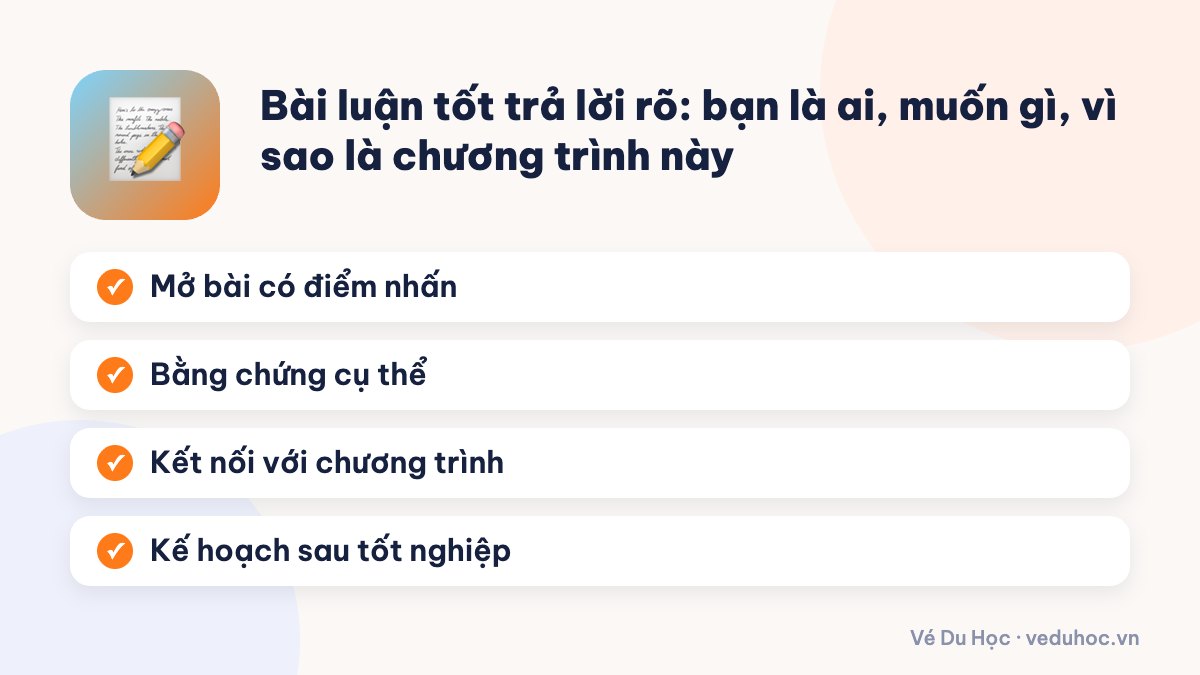
With free essay format (no divided questions), the following structure is suitable for most scholarships:
| Part | Purpose | Suggested rate |
|---|---|---|
| 1. Open the lesson | A moment, problem or question led you to the field of study | 10–15% |
| 2. Academic background | Coursework, projects, and research demonstrate competency | 20–25% |
| 3. Practical experience | Work, activities, leadership – with measurable results | 20–25% |
| 4. Why this program/scholarship | Specific subjects, instructors, and resources are appropriate to the goals | 20% |
| 5. Future plans | Short and long-term goals, contributing to the community/country | 15–20% |
The principle of “prove, don't declare”
Instead of writing “I am a leader,” tell a situation where you led a team, what you did, and what the results were. The STAR model (Situation – Task – Action – Result) is very useful for questions about leadership and problem solving.
The thread runs through
The parts must connect together into a logical story: past experience → need for further learning → how this program meets → what you will use the knowledge for. Extracurricular activities should be selected to serve this story - see more articles Extracurricular activities and personal projects.
Illustrative examples: general writing and specific writing
Below is a self-composed example to illustrate (not a real candidate's essay):
General: "Since childhood, I have been passionate about the environment and always wanted to contribute to society. I believe that your school's program will help me achieve my dream."
specific: "During two years as a clean water project coordinator in a coastal district, I realized that drilled wells were becoming saline faster than predicted because of a lack of monitoring data. The Water Resources Management module and hydrology laboratory of the program will help me build a forecasting model that the locality is lacking."
The second paragraph has the background, problem, reason for choosing the program, and application direction – all in just three sentences.
8 common mistakes when writing scholarship essays
- Didn't answer the question correctly – well written but off topic.
- Retell your CV – list achievements without explaining the meaning. CV has its own section, see How to write an academic CV.
- Open a cliché essay with a famous quote or "Since I was little, I have...".
- Lack of specific reasons for choosing a school – the sentence can be pasted into the article for any school.
- Vague future plans – “contribute to the country” without saying what or where.
- Complain and blame when telling about difficulties instead of emphasizing how you overcame them.
- Exceeding the word limit or misspelling or wrong field name.
- AI dependence or sample copying – many scholarships ban and have detection tools; More importantly, the essay loses its personal tone.
Writing and editing process
- Brainstorm: list 10–15 experiences, choose 3–4 strongest ones to serve the question.
- Outline: each paragraph has one main idea and one evidence.
- Draft 1: write freely, don't worry about word limits yet.
- Cut: delete redundant adjectives and repetitive sentences.
- Receive comments: from teachers, people who have passed scholarships, people not in the same major (to check understanding).
- Read aloud: detect clunky sentences.
- Final check: school name, program name, word limit.
Start at least 4–6 weeks before the deadline, along with work Ask for a letter of recommendation. The essay is also an important "review material" for the round scholarship interview, because the committee often asks in-depth questions about what you wrote.
Frequently asked questions
How are Personal Statement and Statement of Purpose different?
Personal Statement is more about personal stories and motivation; Statement of Purpose focuses on academic goals, research, and fit with the program. Many schools use the two terms interchangeably, so read the requirements carefully.
How many words should an essay have?
According to the limits of each scholarship. If there is no limit, 500–1,000 words is a common length for graduate school.
Should we talk about difficult circumstances?
Maybe, if it explains motivation or a period of affected learning outcomes. Focus on how you overcome and grow, not on eliciting sympathy.
Can AI be used to correct grammar?
Depending on the regulations of each scholarship. Some scholarships like Chevening prohibit the use of AI to generate answers. The safest way is to write it yourself and ask real people for feedback.
Conclusion
A good scholarship essay is one that is honest, specific, and answers the right question. Investing time in it is the most worthy investment in the record. Once you receive good news, please refer to it Study abroad air ticket service or contact hotline/Zalo 090.1800.918 to prepare for the flight.
Reference source
Booker HVSC gives a free quote in 15 minutes, Zalo reports take-off and landing for the whole family.
📚 Articles on the same topic
 Study abroad scholarshipWriting an academic CV for scholarships: presentation templates and ways to highlight achievements15/01/25 · 7 phút đọc
 Study abroad scholarshipRecommendation Letter: who to ask for, how to ask to convince the council30/10/24 · 6 phút đọc
 Study abroad scholarshipWhat GPA does it take to have a chance to get a scholarship? Correct understanding of scores and records20/02/23 · 6 phút đọc
 Study abroad scholarshipExtracurricular activities and personal projects: "weapons" that help differentiate scholarship applications14/11/21 · 6 phút đọc
 Study abroad scholarshipRejected scholarship: analyze the reasons and prepare for the next round10/02/20 · 7 phút đọc
 Study abroad scholarshipHunting for scholarships to study abroad from A to Z: 12-month roadmap for beginners21/04/16 · 8 phút đọc
🔥 Read a lot
- Master's scholarships: strategies for choosing majors, choosing schools and contacting professors
- International checked baggage for international students: pieces or scales, 46kg and tips for packing suitcases
- Why should study abroad centers have specialized airline ticket partners?
- Choosing a reputable dispatching company: signs to recognize and avoid scams
- Scholarships to study in Australia at high school and preparatory levels: opportunities for students in grades 10–12





 ▶
▶ ▶
▶ ▶
▶ ▶
▶ ▶
▶ ▶
▶ ▶
▶