
🔄 Cập nhật lần cuối: 08/10/26

A scholarship recommendation letter is a third person's perspective on your abilities and qualities - something an essay or transcript cannot say on its own. Many major scholarships take this part seriously: Chevening, for example, requires two valid references and checks references before the interview round. This article guides you in choosing the right person, asking in the right way and avoiding mistakes that make the letter lose its value.
What role does a scholarship recommendation letter play?
The committee uses letters of recommendation to verify what you write and find more information: how you study and work compared to others; Do you have a sense of responsibility, leadership ability, and research potential? A specific letter, with real comparisons and examples, can help your application stand out; On the contrary, a general letter reduces the weight of the entire application.
The letter of recommendation needs to match scholarship essay and Academic CV – these three documents should tell the same story from different perspectives.
Who should I ask for a letter of recommendation from?
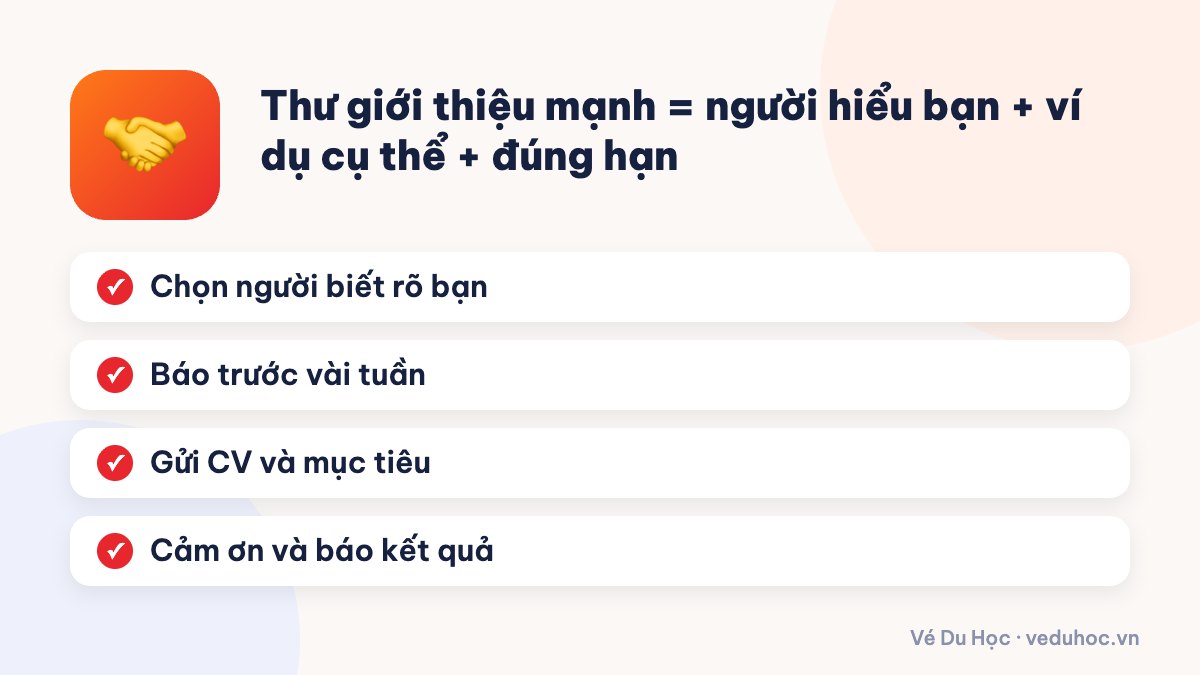
Golden rule: choose someone who knows you better than someone with a high title. A detailed thesis instructor will be more convincing than a leader who only meets you a few times.
| Target | Suitable referrer | Should be emphasized |
|---|---|---|
| University (high school submission) | Homeroom teachers, teachers of related subjects, advisors | Learning attitude, curiosity, personality |
| Academic Master | Instructors, lecturers in specialized subjects | Academic capacity and analytical thinking |
| Vocational master's degree, government scholarship | Direct manager + one lecturer | Leadership, work performance, potential |
| Doctor | Research supervisor, co-author | Research capacity, independence, results |
With scholarships that require work experience, combining an academic reference and a professional reference often gives a comprehensive picture. Read the requirements carefully: some programs only accept academic references.
How to ask for a letter of recommendation: 6-step process
- Ask early: according to Cornell Graduate School's recommendations, you should notify at least a few weeks in advance so that the recommender can write carefully and not rush. For busy people, 6–8 weeks is safe.
- Ask directly and frankly: “Can you write a strong letter of recommendation for me?” If they hesitate, thank them and find someone else – reluctant letters are rarely good.
- Send a set of supporting documents: CV, transcript, essay draft, list of scholarships/schools with deadlines and submission methods, academic and career goals, projects or achievements you want them to mention.
- Suggest specific examples: recall projects and events you have done with them so they have material to write about.
- Technical instructions: many systems send a link to submit a letter directly to the recommender via email. Please enter the correct email and notify them in advance so they don't miss it in the spam box.
- Gentle reminder and thanks: remind about 1–2 weeks before the deadline, confirm the letter has been submitted and notify them of the results when the news is available – a courtesy that many schools encourage.
What is the difference between strong letters and weak letters?
- Strong letter: clear state in what context and how long the writer knows you; have specific examples; there is comparison (“out of about 100 students I instruct…”); assessment of potential suitability for the program.
- Weak letters: full of generic compliments, repeat transcripts, no examples, or unusually short.
You don't control the content of the message, but you can increase your chances of a strong message by choosing the right people and providing enough material. This is also the reason why you should build good relationships with lecturers and administrators early on, as suggested in 12-month scholarship hunting roadmap.
Note on ethics and form
- Don't write it yourself and ask it to be signed: in Vietnam, it's quite common for recommenders to tell students to "compose it yourself and then the teacher will sign it". This has potential risks: the style resembles an essay, is easy to detect and violates the integrity regulations of many scholarships. If requested, provide a list of ideas/examples for the recommender to write themselves.
- Permission to view mail: some systems (especially in the US) ask if you waft the right to view mail. Choosing to abandon often causes the message to be evaluated more objectively.
- Format: letter on paper with letterhead, signature, contact information, official email of the recommender.
- Language: Letters are usually written in English. If the recommender writes in Vietnamese, a translation is required according to each program's requirements - see more Notarized translation of study abroad documents.
Frequently asked questions
How many letters of recommendation are needed?
Usually 2–3 letters, depending on the scholarship and school. Chevening, for example, requires two people to introduce themselves. Always check official requirements.
Can one letter be used for multiple scholarships?
If submitting through the system, recommenders usually have to submit separately for each place. Many people use an original copy and then adjust it for each program.
What if the recommender is not good at English?
They can write in Vietnamese and provide a certified translation if the program accepts it. You should not write for them yourself.
What if I've graduated for a long time and lost contact with my lecturer?
Priority is given to a line manager or senior colleague who understands your work, if the program accepts professional references.
Conclusion
A strong scholarship recommendation letter comes not from your title but from a true understanding of you. Ask early, prepare carefully and follow through to the end are three things you can be completely proactive about. Once you receive a scholarship, let VeDuHoc take care of it air tickets to study abroad – hotline/Zalo 090.1800.918.
Reference source
Booker HVSC gives a free quote in 15 minutes, Zalo reports take-off and landing for the whole family.
📚 Articles on the same topic
 Study abroad scholarshipWriting an academic CV for scholarships: presentation templates and ways to highlight achievements15/01/25 · 7 phút đọc
 Study abroad scholarshipWhat GPA does it take to have a chance to get a scholarship? Correct understanding of scores and records20/02/23 · 6 phút đọc
 Study abroad scholarshipExtracurricular activities and personal projects: "weapons" that help differentiate scholarship applications14/11/21 · 6 phút đọc
 Study abroad scholarshipPersonal Statement: structure, examples and common mistakes19/07/19 · 7 phút đọc
 Study abroad scholarshipHunting for scholarships to study abroad from A to Z: 12-month roadmap for beginners21/04/16 · 8 phút đọc
 Study abroad scholarshipScholarships to study in the UK: Chevening, GREAT and school scholarships03/05/19 · 5 phút đọc
🔥 Read a lot
- International checked baggage for international students: pieces or scales, 46kg and tips for packing suitcases
- Master's scholarships: strategies for choosing majors, choosing schools and contacting professors
- Why should study abroad centers have specialized airline ticket partners?
- Choosing a reputable dispatching company: signs to recognize and avoid scams
- Stipendium Hungaricum Scholarship: full study abroad in Hungary





 ▶
▶ ▶
▶ ▶
▶ ▶
▶ ▶
▶ ▶
▶ ▶
▶