
🔄 Cập nhật lần cuối: 08/10/26

Notarized translation of study abroad documents is a step that almost every family has to do, but it is also the step that easily wastes money: unnecessary documents, notarizing too many copies, or vice versa, making mistakes and having to do it again. The article helps you differentiate concepts, know when to do what and tips to save costs.
Distinguish common concepts
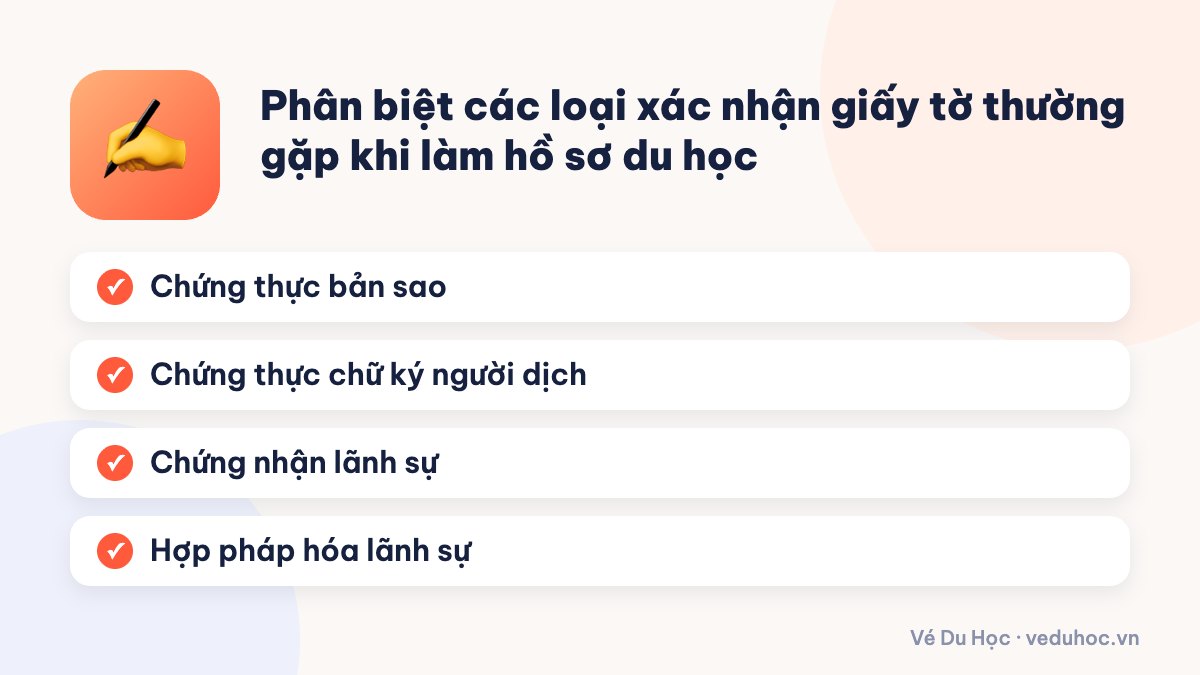
In real life, people often call it "notarized translation", but legally in Vietnam there are many different procedures:
- Authenticate copies from originals: confirm the photocopy is true to the original, usually done at the commune-level People's Committee or notary practice organization.
- Authenticate the translator's signature: confirm the translator's signature on the translation; The translator must meet the prescribed conditions (usually a registered translation collaborator).
- Notarized translation: the notary certifies the translation performed by the translator who is a collaborator of the notary organization.
- Consular certification: Consular Department (Ministry of Foreign Affairs), Ho Chi Minh City Department of Foreign Affairs or authorized agency to confirm stamps and signatures on Vietnamese documents for use abroad.
- Consular legalization: foreign representative agencies (embassies, consulates) documents, usually after consular confirmation certification.
According to Vietnam Lawyers Magazine, documents that can be consularly certified include diplomas, certificates, school records issued by establishments in the national education system, civil status documents, judicial records, health examination papers... Whether or not it is necessary depends on the requirements of the country and school to which you are applying.
Which documents need notarized translation for study abroad documents?
General rule: only translate documents that are not available in a language accepted by the recipient (usually English). Groups of documents that often need to be translated:
| Paper group | For example | Notes |
|---|---|---|
| Academic | High school transcript, diploma, temporary graduation certificate | College transcripts can usually be requested in English from the school |
| Civil status, residence | Birth certificate, confirmation of residence information | Used to prove relationship with the guarantor |
| Finance | Labor contract, business license, land use right certificate, lease contract | Confirmation of balance and statement should be requested in English directly from the bank |
| Other | Criminal record, job confirmation | Only do it when asked |
Let's compare Checklist of study abroad documents for each stage to know which documents are really needed at which step.
Common requirements according to where the application is received
School
Many schools accept scanned originals with translations for admission, and only require seeing the original or certified copy upon admission. Some systems require transcripts sent directly from the school or through a degree evaluation organization. Please read the admission instructions carefully before applying.
Visa agency
- You: according to GOV.UK, the translation requires written confirmation from the translator that it is a “true and accurate translation of the original”, with the date, full name and contact information of the translator. See more UK study visa.
- Australia, Canada, USA: usually require full English translation, with translator information; Some cases require an authenticated copy.
- Germany, Korea, Japan: may require consular legalization or separate qualification verification (like APS with Germany). See article German student visa and Korean student visa D-2, D-4.
Note: as of the time of updating this article, Vietnam has not yet applied the Apostille mechanism, so documents used abroad often have to go through consular certification and consular legalization when requested by the receiving country.
The right and economical way to do it
- Read the requirements before translating: does the school or visa agency need a regular translation, a translation certified by the translator, notarized or legalized?
- Ask for the original English version when possible: banks, universities, and companies often issue bilingual confirmations, which are both faster and more valuable than translations.
- Uniform name spelling: full name, date of birth, and school name must be the same as the passport on all translations.
- Translate once, use many times: save soft copy with confirmation; Only authenticate additional copies when absolutely necessary.
- Choose a translation unit with experience in studying abroad documents: terminologies, subject names, and classifications that need to be translated consistently.
- Scheduling: consular legalization can take days to weeks; Do it early so as not to affect the deadline.
After completing the application and having a visa, VeDuHoc can assist you with booking tickets, issuing VAT invoices to families who need documents, consulting on luggage and checking transit regulations. More than 30 Bookers hunt multi-company tickets and support 24/7. See air tickets to study abroad or Frequently asked questions about documents.
Frequently asked questions
How are notarization and authentication different?
In fact, the two words are often used interchangeably. Legally, copy authentication confirms the copy is true to the original; Notarized translation is a notary who certifies the accuracy and legality of the translation. Please ask clearly which type the recipient needs.
Does notarized translation have an expiration date?
Translations usually do not have a fixed deadline, but some places only accept certified copies for a short period of time (e.g. 3–6 months). Original documents such as criminal records and health certificates have their own deadlines.
Is it possible to self-translate?
Some schools accept it for admission, but visa agencies often require independent translators. You should not translate visa documents yourself.
Is it necessary to consularly legalize academic records?
Only if the country or school requires it. Many countries such as Australia, UK, and US often do not require it; Some Asian and European countries may require it.
Properly notarized translation of study abroad documents helps save both time and money. Always read the specific requirements of the school and visa agency before applying. When you need support for study abroad tickets, contact VeDuHoc via hotline/Zalo 090.1800.918.
Reference source
Booker HVSC gives a free quote in 15 minutes, Zalo reports take-off and landing for the whole family.
📚 Articles on the same topic
 Documents & student visaChecklist of complete study abroad documents: documents need to be prepared in each stage09/08/25 · 6 phút đọc
 Documents & student visaOffer Letter is conditional and unconditional25/01/23 · 5 phút đọc
 Documents & student visaStudy abroad on your own or through a consulting center: advantages and disadvantages05/12/22 · 7 phút đọc
 Documents & student visaPassport for international students: renewal, extension and notes when studying abroad14/12/20 · 8 phút đọc
 Documents & student visaStudent visa failure: common causes and how to reapply08/11/17 · 8 phút đọc
 Documents & student visaStudy abroad documents for students under 18 years old: guardianship and accommodation29/01/17 · 7 phút đọc
🔥 Read a lot
- International checked baggage for international students: pieces or scales, 46kg and tips for packing suitcases
- Master's scholarships: strategies for choosing majors, choosing schools and contacting professors
- Why should study abroad centers have specialized airline ticket partners?
- Choosing a reputable dispatching company: signs to recognize and avoid scams
- Stipendium Hungaricum Scholarship: full study abroad in Hungary





 ▶
▶ ▶
▶ ▶
▶ ▶
▶ ▶
▶ ▶
▶ ▶
▶