
🔄 Cập nhật lần cuối: 08/10/26

When studying abroad in Korea, you will encounter two familiar visa codes: D-2 and D-4. Many people think these two types are the same because they are both "study abroad visas", but in reality they are different in terms of subjects, documents, rights to work part-time and even the level of approval. This article clearly explains the difference between D-2 and D-4 Korean student visas so you can choose the right route.
What are D-2 and D-4 visas?
According to the Korean Visa Portal, these two visa groups are divided as follows:
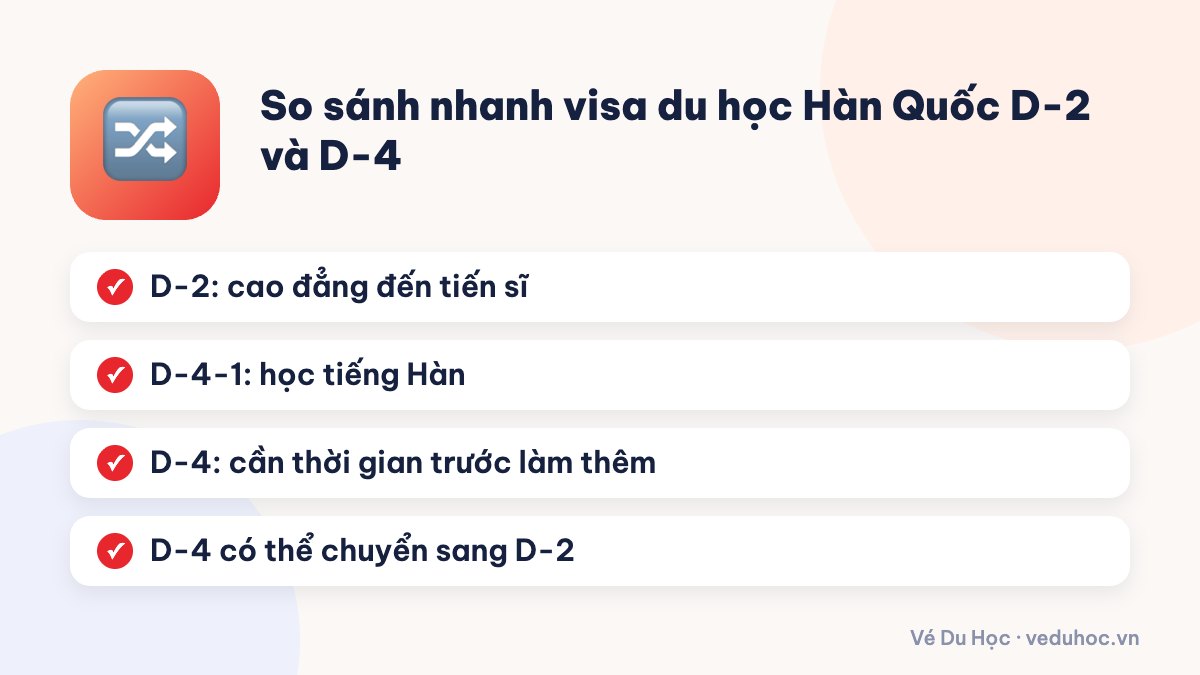
- D-2 (Study Abroad): for degree and research programs, including associate (D-2-1), bachelor's (D-2-2), master's (D-2-3), doctoral (D-2-4), research (D-2-5) and exchange students (D-2-6).
- D-4 (Training and professional development): includes learning Korean (D-4-1), general training (D-4-2), high school students (D-4-3), training Korean chefs (D-4-5), studying at private training facilities (D-4-6), learning foreign languages (D-4-7).
For Vietnamese international students, the two most common types are: D-4-1 (study language at a university language center/institute) and D-2 (straight into the regular program). See more costs and language routes in the article Study abroad in Korea: costs, scholarships, TOPIK.
Compare Korean student visa D-2 and D-4
| Criteria | D-2 | D-4 (mainly D-4-1) |
|---|---|---|
| Purpose | Study degree and research programs | Learn Korean or short-term training |
| Input | Official admission letter; Usually requires TOPIK or English according to the program | Invitation letter from the language institute; TOPIK is usually not required but requires a minimum Korean language background according to school requirements |
| Time | By program duration (2–4 years or more) | Shorter, issued each semester and need to be renewed as you continue your studies |
| Work more | Get permission to work overtime within the prescribed hour limit | Permission is often required after a certain period of stay, and the hour limit is stricter |
| Review level | Depends on school and profile | Often considered carefully in terms of finances and educational purposes |
| Next route | Graduate, find a job, transfer a suitable visa | Transfer to D-2 upon admission to the regular program |
Detailed regulations on overtime hours vary by level of study, TOPIK level and school rating, so check on HiKorea or with the international student office. Note that all part-time jobs must be approved in advance by the immigration agency.
Common profile
General profile
- Visa application, passport, photo according to regulations.
- Admission notice (invitation letter) and school business/registration certificate.
- Degrees, transcripts, transcripts (often require legalization or certification according to regulations).
- Documents proving finances and family relationships.
- Study plan, language certificate (if any).
Difference
The D-2 application typically focuses on a full-time program offer and appropriate language proficiency. The D-4-1 profile is often carefully checked for financial proof, reason for learning the language, previous study history and possibly an interview. Specific requirements (financial level, savings deposit time, legalization documents) are announced by the Korean Embassy and Consulate General in Vietnam and may change from time to time. See more articles Proof of finances for studying abroad and Translation and notarization of documents.
Switch from D-4 to D-2
A common route is to study the language for 6 months to 1.5 years with a D-4-1 visa, achieve TOPIK as required, and then apply to a university or college program. When you receive an invitation letter, you can complete the procedure to change your residence status from D-4 to D-2 at the immigration office in Korea, without needing to return to Vietnam. Conditions usually include: good attendance during language study, no violation of residence regulations, valid invitation letter and proof of finances.
On the contrary, if you meet the language requirements from the beginning, applying directly for D-2 will help save time and costs. If you are interested in a government scholarship (GKS) that includes a year of language study, see the article GKS Korean study abroad scholarship.
Note to avoid risks
- Attendance is vital for D-4: low attendance may prevent your visa from being renewed.
- Do not work part-time "under the table": working part-time without permission, overtime or in the wrong profession can result in fines and visa cancellation.
- Choose a reputable school: Korea evaluates the quality of international student management of each school, affecting visa consideration. Please research carefully and read the article Study abroad on your own or through a center.
- Financial honesty: financial records from unknown sources are a common cause of application rejection.
There are many airlines operating the Vietnam - Korea route, with prices varying significantly depending on luggage and flight time. VeDuHoc has more than 30 Bookers to hunt multi-company tickets, optimize luggage for international students with many items, 24/7 support and notify parents via Zalo. See more air tickets to study abroad.
Frequently asked questions
Can I work part-time on a D-4 visa?
It is possible, but usually must be after a certain period of stay from the time of entry, with a permit from the immigration agency and within the prescribed time limit. Please ask the school about specific requirements.
Should I choose D-2 or D-4?
If you already have enough Korean or English proficiency to enter the regular program, D-2 helps save time. If you are not yet fluent in Korean, D-4-1 is a reasonable stepping stone.
Is it possible to transfer from D-4 to D-2 in Korea?
Yes, when you are accepted into the regular program and meet the conditions and procedures at the immigration office in Korea.
How long is the D-2 visa valid?
The period of stay is granted according to the study program and can be extended in Korea while you are still validly studying.
Understanding Korean student visas D-2 and D-4 helps you choose the route that suits your ability and finances. Always compare the latest regulations of the Korean consulate. Once you have a visa, contact VeDuHoc via hotline/Zalo 090.1800.918 for flight ticket support.
Reference source
Booker HVSC gives a free quote in 15 minutes, Zalo reports take-off and landing for the whole family.
📚 Articles on the same topic
 Study abroad scholarshipScholarships to study in Korea: GKS (KGSP) and school scholarships15/02/24 · 7 phút đọc
 Study abroad scholarshipStudy abroad in Korea: costs, TOPIK scholarships and part-time work04/07/22 · 6 phút đọc
 Documents & student visaMedical examination for student visa: process and notes02/07/17 · 6 phút đọc
 Documents & student visaStudy abroad on your own or through a consulting center: advantages and disadvantages05/12/22 · 7 phút đọc
 Documents & student visaTime to consider student visas for different countries: how long in advance should you apply?25/12/18 · 7 phút đọc
 Documents & student visaChoosing a school to study abroad: rankings, majors and costs08/08/20 · 6 phút đọc
🔥 Read a lot
- Hành lý ký gửi chặng quốc tế cho du học sinh: kiện hay cân, 40kg hay 2 kiện 23kg và mẹo đóng vali
- Master's scholarships: strategies for choosing majors, choosing schools and contacting professors
- Why should study abroad centers have specialized airline ticket partners?
- Choosing a reputable dispatching company: signs to recognize and avoid scams
- Stipendium Hungaricum Scholarship: full study abroad in Hungary



 ▶
▶ ▶
▶ ▶
▶ ▶
▶ ▶
▶ ▶
▶ ▶
▶