
🔄 Cập nhật lần cuối: 08/10/26

Scholarship to study abroad in Korea There are two main groups: Korean Government scholarships GKS (Global Korea Scholarship, old name KGSP) managed by the National Institute of International Education (NIIED), and scholarships granted by the universities themselves. GKS is full scholarship, highly competitive; School scholarships are more common, often in the form of tuition discounts based on TOPIK and scores. This article helps you understand each type and how to prepare.
Main content
What is the GKS Scholarship (KGSP)?
GKS is a Korean Government scholarship program for international students, formerly known as KGSP (Korean Government Scholarship Program). The program has main branches: undergraduate (GKS-U), postgraduate (GKS-G, including masters and doctorates), and a number of short-term and research programs. Admission announcements are often published on NIIED's Study in Korea page and Korean Embassy pages in other countries; Vietnam is on the list of countries with allocated quotas.
The recruitment schedule in recent years is quite stable: graduate level applications usually open around February-March, undergraduate level around September-October, admission is in September of the following year (after the year of language study). However, deadlines may change, please stay tuned for official announcements each year.
Benefits and conditions of the GKS scholarship
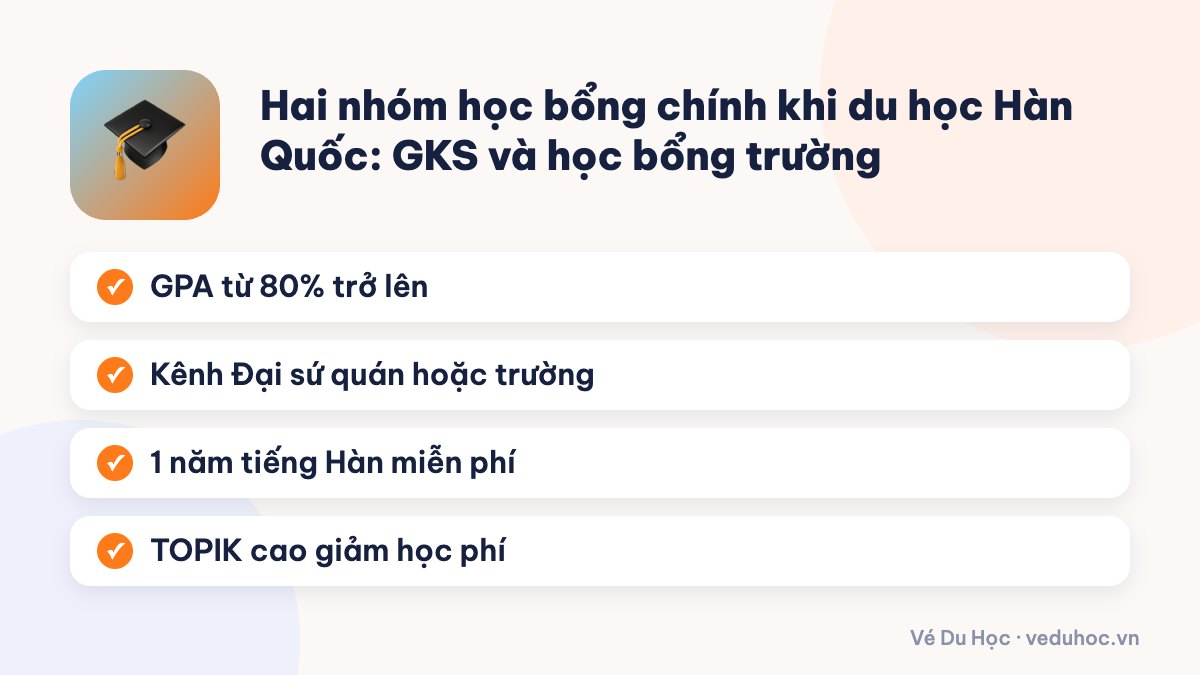
According to GKS guidelines published by partner schools, scholarships typically include:
- Economy class round-trip airfare (departure upon admission and return upon completion).
- Free tuition (paid by NIIED and the school), free admission.
- 1 year of free Korean language learning before entering the main program (can be waived if you already have high TOPIK).
- Monthly living allowance (from about 1,000,000 won or more depending on level of study and year of admission), initial stability allowance, health insurance, research and thesis printing support for postgraduate level.
- Additional allowance for those achieving TOPIK levels 5–6.
| Criteria | GKS at university level | Postgraduate GKS |
|---|---|---|
| Time | 1 year of language + 4 years of university | 1 year of language + 2 years of master's degree / 3 years of doctorate |
| Age | Usually under 25 years old | Under 40 years old (as of September 1 of the year of admission) |
| Academic ability | GPA from 80% or top 20% of class | CGPA equivalent to 80% or higher |
| Nationality | Applicants and parents do not hold Korean nationality | |
Korean (TOPIK) and English (IELTS, TOEFL) scores are not always required but are a big plus. Let's see more Which English certificate should I choose to apply for a scholarship? and With what GPA you have, you have the opportunity to hunt for scholarships.
Two application channels: Embassy and school
Embassy Channel (Embassy Track)
You submit your application to the Korean Embassy in Vietnam (or an authorized unit). Round 1 is selected by the Embassy, round 2 is considered by NIIED, round 3 is selected by schools; You can choose many schools of your choice. This channel has the advantage of being considered in many schools but must go through many rounds.
University Track
You apply directly to a designated Korean school. The school considers round 1, then NIIED considers round 2. Each candidate is usually only allowed to submit one channel per year; Duplicate submissions may be disqualified. Please read the recruitment year instructions carefully before choosing.
Scholarship to study abroad in Korea granted by the school
If you don't pass the GKS, a school scholarship is a more realistic path. Popular forms:
- Entrance scholarship: partial to full reduction of first semester tuition based on TOPIK, GPA or English certificate with program taught in English.
- Scholarship based on academic performance: considered each semester based on GPA at school.
- TOPIK scholarship: students who upgrade TOPIK during their studies can receive a tuition reduction for the next semester.
- Teaching and research assistant scholarships (postgraduate level): work in a professor's lab to receive tuition exemption and benefits.
The reduction and conditions vary greatly between schools, so you need to carefully read each school's international scholarship regulations. If you start from the language system, see more articles Study abroad in Korea: costs, TOPIK scholarships and part-time work, as well as distinction D-2 and D-4 visas.
Document preparation roadmap
- Before 12 months: maintain GPA, study TOPIK or IELTS, research majors and schools.
- Before 6 months: Prepare personal essay, study plan, application letter of introduction.
- Before 3 months: translate, notarize, legalize or consularly certify degrees as required.
- When notified: Submit to the right channel and on time; prepare scholarship interview.
- After passing: apply for a visa, arrange a flight to Korea according to the meeting schedule of NIIED or the school.
For GKS candidates, outbound air tickets are usually supported by the support program according to specific regulations, but if you are self-funded or receive a school scholarship, booking tickets early before the March and September enrollment periods will help save significantly. VeDuHoc has a team of more than 30 Bookers comparing many airlines flying to Seoul and Busan, continuing to hunt for prices even when prices are high and refunding the difference if a better price is found after you have paid; see air tickets to study abroad or tips in International checked baggage for international students.
Frequently asked questions
Are GKS and KGSP different?
Are not. KGSP (Korean Government Scholarship Program) is the old name; The program is currently called Global Korea Scholarship (GKS) with similar content.
Can I submit GKS without TOPIK?
Yes, because TOPIK is usually not required. However, having TOPIK or a good English certificate helps your profile stand out and can earn points.
Can I submit through the Embassy channel and the school channel at the same time?
Usually not. GKS instructions stipulate that each candidate can only choose one channel; Duplicate submissions may be disqualified.
Can school scholarships be maintained for 4 years?
Depends on regulations. Many scholarships are reviewed based on GPA each semester, so you need to maintain your academic results to continue to receive tuition reduction.
Scholarships to study abroad in Korea open up many opportunities, from full GKS to flexible school scholarships. Please prepare early, follow the official announcement and contact VeDuHoc via hotline/Zalo 090.1800.918 when you need advice on admission flight schedules.
Reference source
Booker HVSC gives a free quote in 15 minutes, Zalo reports take-off and landing for the whole family.
📚 Articles on the same topic
 Documents & student visaKorean student visa D-2 and D-4: what is the difference?24/08/22 · 6 phút đọc
 Study abroad scholarshipStudy abroad in Korea: costs, TOPIK scholarships and part-time work04/07/22 · 6 phút đọc
 Study abroad scholarshipScholarship to study abroad in China: CSC and Confucius scholarship (now International Chinese Teacher scholarship)08/07/21 · 7 phút đọc
 Study abroad lifeLearn the native language when studying abroad in a non-English speaking country02/09/20 · 6 phút đọc
 Study abroad scholarshipVietnamese Government Scholarship (Program) for international students: conditions and commitments01/04/20 · 7 phút đọc
 Study abroad scholarshipTypes of study abroad scholarships: full, partial, school, government and business scholarships23/07/18 · 7 phút đọc
🔥 Read a lot
- International checked baggage for international students: pieces or scales, 46kg and tips for packing suitcases
- Master's scholarships: strategies for choosing majors, choosing schools and contacting professors
- Why should study abroad centers have specialized airline ticket partners?
- Choosing a reputable dispatching company: signs to recognize and avoid scams
- Stipendium Hungaricum Scholarship: full study abroad in Hungary





 ▶
▶ ▶
▶ ▶
▶ ▶
▶ ▶
▶ ▶
▶ ▶
▶