
🔄 Cập nhật lần cuối: 08/10/26

Studying abroad in the Korean language system is the path many young Vietnamese people choose to familiarize themselves with the language and culture before entering university or graduate school in Korea. With a D-4 visa, you study at the language institute affiliated with the university, are allowed to work part-time with conditions and can receive a scholarship if you score well on TOPIK. This article summarizes costs, scholarships and overtime regulations so you can plan properly.
Main content
What is the Korean language system, and who is it suitable for?
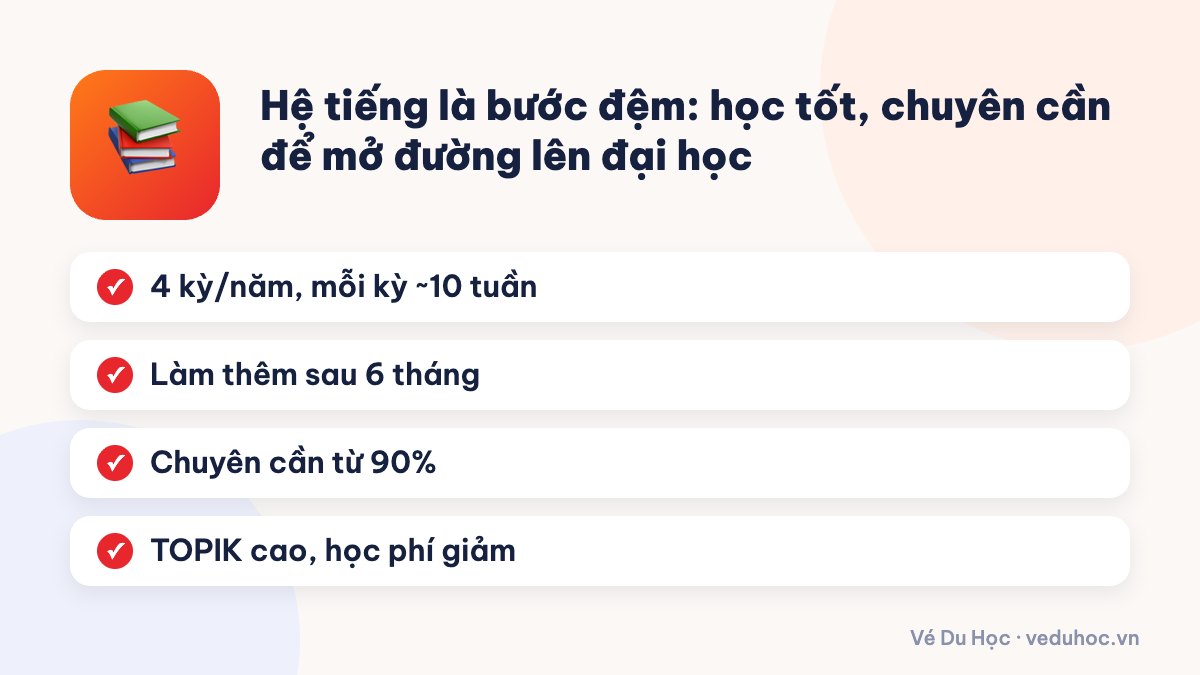
The language system (official Korean language course) is usually organized by the language institute of universities, including 4 semesters per year (spring, summer, fall, winter), each semester is about 10 weeks, about 20 hours of study/week. The learner holds a D-4-1 visa (language intern). After 1–2 years, students can apply to university, graduate school and switch to a D-2 visa.
The language system is suitable for those who do not have TOPIK, want to learn the foundation first, or want to enroll flexibly in many terms during the year. If you already have TOPIK 3–4 or higher, you can consider applying directly to university to save time. The differences between the two types of visas are explained in the article What is the difference between D-2 and D-4 Korean student visas?.
Cost of studying abroad in Korea
Language tuition varies significantly between schools in Seoul and schools in the province. The following table is a reference according to the popular framework, you need to check the official fee schedule of the school you plan to pay:
| Expenses | Reference level | Notes |
|---|---|---|
| Language tuition fees | Usually about 1.2–1.8 million won/10-week period | Top schools in Seoul are usually higher |
| Admission fees and textbooks | Several tens of thousands to several hundred thousand won | Depends on the school |
| Dormitory/rental room | Varies by region | Seoul is more expensive than Busan, Daegu, and other provinces |
| National health insurance | According to annual regulations | Required for long-term international students |
| Airplane tickets, initial costs | According to flight season | Before the March and September periods, it is often crowded |
When applying for a D-4 visa, you need to prove your finances according to the level set by the Korean Embassy at the time of application (usually with savings books and income documents). Read more Prove that you understand your finances for studying abroad correctly so you don't fail.
TOPIK scholarship and transfer scholarship
Scholarship at the language institute
Many language institutes award scholarships to students with the highest scores in the class, good attendance, or reduced tuition fees for studying multiple consecutive semesters. The amount is usually not large but helps reduce financial pressure.
Scholarship when transferring to university
This is a bigger opportunity. Schools often reduce first-semester tuition according to TOPIK level (for example, TOPIK 3, 4, 5–6 have increasing reductions), especially giving priority to students who have studied the language system at that school. In the following semesters, scholarships are considered based on GPA. Some schools also have scholarships for those who upgrade their TOPIK during their studies.
GKS Government Scholarship
If your academic performance is good, you can apply for GKS (1 year of free language learning is available). Details in the article GKS Korean study abroad scholarship (KGSP) and school scholarship.
Regulations for working part-time with D-4 visa
According to instructions compiled from regulations of the Korean Immigration Department (as of the time of updating this article), D-4-1 students:
- You can only apply for permission to work part-time after 6 months from receiving your residence status.
- Need an average attendance rate of about 90% or higher and confirmed by the school.
- Hour limit: about 10 hours/week if Korean language standards are not met; 20 hours/week if reaching TOPIK 2 (or equivalent); Can work up to 25 hours/week when preferential conditions are recognized.
- There are no exceptions to unlimited hours on weekends or vacations like D-2 students.
- Prohibit industries such as construction, delivery, tutoring, door-to-door sales, and intermediaries.
- Must have a license before starting work; Changing workplace requires re-approval.
Illegal part-time work can lead to fines, not being able to renew your visa or being forced to leave the country. See more comparisons between countries in the article Part-time work while studying abroad: hour limits, salary and notes.
Roadmap from language system to university
- Before going: learn elementary Korean in Vietnam, prepare academic and financial documents.
- Periods 1–2: focus on studying, stay diligent, get used to life.
- After 6 months: take TOPIK test, apply for legal part-time work if necessary.
- Sessions 3–4: choose a major, apply to university or graduate school, hunt for transfer scholarships.
- Change to D-2 visa when there is official admission.
The language admission period in March and September often has many international students flying at the same time, so ticket prices increase. VeDuHoc with more than 30 multi-carrier ticket booking Bookers will help you compare direct flights to Incheon, Busan, continue to monitor prices and refund the difference if you find a better price after you have paid. The team also provides luggage advice and sends flight notifications via Zalo to parents. Reference air tickets to study abroad and How long before starting school should I fly?.
Frequently asked questions
How many years to study Korean language system?
Normally about 2 years maximum, depending on the school and D-4 visa extension regulations. Many students study for 1–1.5 years and then transfer to university.
Can I get a part-time job right away when I arrive?
Are not. D-4 students need 6 months, good attendance and a license before working.
Does the language system have scholarships?
Yes, but usually small scholarships based on merit or attendance. Larger scholarships often come when transferring to university based on TOPIK.
Can I use the language system without TOPIK?
Okay. The language system is for beginners, but having a Korean background makes visa interviews and integration easier.
Studying abroad in the Korean language system is a solid stepping stone if you focus on studying, taking the TOPIK test early and working part-time according to the law. Once you have an admission letter, contact VeDuHoc via hotline/Zalo 090.1800.918 for support in booking tickets and preparing luggage.
Reference source
Booker HVSC gives a free quote in 15 minutes, Zalo reports take-off and landing for the whole family.
📚 Articles on the same topic
 Study abroad lifeWorking part-time while studying abroad: hour limits, salary and legal notes18/06/25 · 6 phút đọc
 Study abroad scholarshipScholarships to study in Korea: GKS (KGSP) and school scholarships15/02/24 · 7 phút đọc
 Study abroad scholarshipStudy in Australia economically: scholarships, part-time work and actual living expenses09/11/22 · 6 phút đọc
 Documents & student visaKorean student visa D-2 and D-4: what is the difference?24/08/22 · 6 phút đọc
 Study abroad lifeLearn the native language when studying abroad in a non-English speaking country02/09/20 · 6 phút đọc
 Study abroad scholarshipStudy abroad in Japan while studying and working: Japanese language school scholarships and costs26/03/16 · 9 phút đọc
🔥 Read a lot
- International checked baggage for international students: pieces or scales, 46kg and tips for packing suitcases
- Master's scholarships: strategies for choosing majors, choosing schools and contacting professors
- Why should study abroad centers have specialized airline ticket partners?
- Choosing a reputable dispatching company: signs to recognize and avoid scams
- Stipendium Hungaricum Scholarship: full study abroad in Hungary




 ▶
▶ ▶
▶ ▶
▶ ▶
▶ ▶
▶ ▶
▶ ▶
▶