
🔄 Cập nhật lần cuối: 08/10/26
Studying abroad in Japan while studying and working is a popular choice for many young Vietnamese people because Japan allows international students to legally work part-time and has many scholarships for language learners. However, part-time work should only be considered a living allowance, not a source of full tuition payment. The article below helps you understand Japanese language school costs, scholarships you can apply for, and overtime regulations to make a realistic plan.
Main content
Understand correctly the model of studying abroad in Japan while studying and working
The most common route is to study 1–2 years at a Japanese language school (nihongo gakko), then take the entrance exam to a specialized school (senmon gakko), college or university. During your studies, you have a "Student" residence status and are allowed to work limited hours if you apply for a permit to operate outside your residence status.
The key point to remember: the main purpose of the visa is to study. The Japanese Immigration Bureau considers your attendance rate, study results and compliance with working hours when you extend your residence status. Many cases were refused extensions or transfers because of overtime or too many absences from school. Therefore, reputable centers often advise families to prepare financially for at least the first year, instead of relying entirely on working.
If you are considering between studying abroad and working under the labor force, post Compare vocational study abroad and study abroad same article about Japanese technical intern trainee will help you clearly distinguish between the two paths.
Japanese language school and living expenses
According to the official website Study in Japan (operated by JASSO), first-year tuition and fees at Japanese language training facilities range from 610,000–1,900,000 yen, depending on the course and school. This number usually includes admission fees, tuition fees, and materials; Some schools charge additional fees for facilities or insurance.
| Expenses | Reference level | Notes |
|---|---|---|
| First year Japanese language school tuition | About 610,000–1,900,000 yen | According to Study in Japan; most schools fall in the low–middle end of this range |
| Housing (dormitory/share house) | Varies strongly by region | Tokyo and Osaka are much higher than other provinces |
| Eating, traveling, phone calls | Depends on lifestyle | Cooking yourself saves a lot of money |
| National health insurance, residence tax | According to local regulations | Compulsory insurance when residing for more than 3 months |
| Airline tickets, luggage, initial costs | According to flight season | Admissions in April and October are usually high prices |
In addition to tuition, when applying for status of residence (COE), you need to prove that the sponsor can afford to pay. The detailed process is in the article Japan student visa: COE and visa application process. To estimate the total family budget, see more Parents need to plan their study abroad budget.
Regulations on part-time work for international students
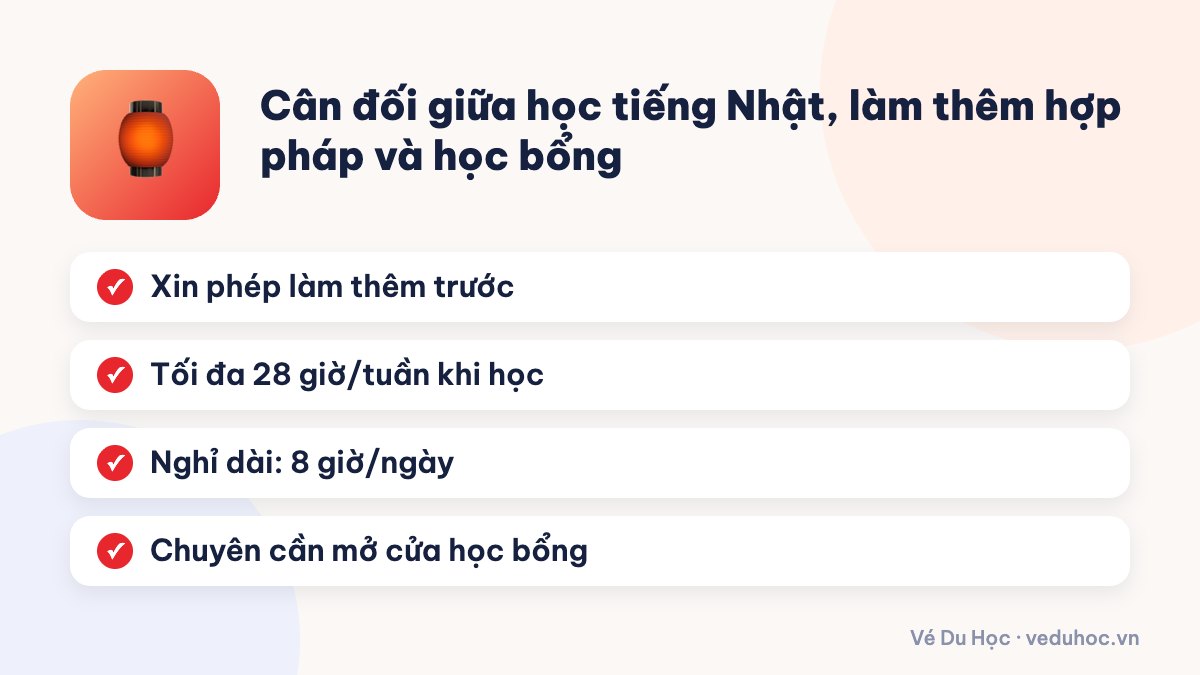
According to Japanese university guidelines based on immigration regulations, international students must apply for a permit to operate outside of their residence status before working. Permits are usually issued at the airport upon entry (if registered) or at the Regional Immigration Department, free of charge.
- During the semester: maximum 28 hours/week (calculated on every week, cumulative across all workplaces).
- Long vacation prescribed by the school: maximum 8 hours/day, 40 hours/week.
- Prohibited occupations: bars, nightclubs, adult entertainment establishments, including dishwashers or cleaning jobs in these places.
- Permit duration: tied to stay period, need to reapply when renewing visa.
The overtime salary depends on the minimum wage for each province, which is adjusted to increase annually; The national average has exceeded 1,000 yen/hour from fiscal 2023. With 28 hours/week, income can cover a large part of accommodation costs, but it is difficult to live and pay tuition if you do not have a Japanese language background. In the first months, when your language is still weak, finding a stable job also takes time. Read more about overtime limits and notes in different countries.
Scholarships for Japanese language school students
JASSO Honors Scholarship from the Japanese Ministry of Education
This is a scholarship for self-funded international students, managed by JASSO. According to the announcement on the JASSO website, the support level for undergraduate and postgraduate students is 48,000 yen/month and for Japanese language school students is 30,000 yen/month, for a period of 12 months (from April) or 6 months (from October). For Japanese language schools, students need to have the goal of continuing their studies at a formal level, have good achievements and character, and face financial difficulties. You do not apply directly to JASSO but are recommended by the school, and each school only has a limited number of places.
Scholarship granted by Japanese language school
Many Japanese language schools have internal scholarships in the form of tuition reductions or semester bonuses, based on attendance (usually very high requirements), periodic exam scores, and JLPT/EJU results. Levels and conditions are different for each school, so you need to ask clearly when choosing a school.
Private and local foundation scholarships
Some business foundations, associations, and local governments have scholarships for international students, but most are for people who have entered university or professional school. This is why studying well at a Japanese language school is important: high EJU and JLPT scores help you apply for tuition exemption at the next level. Overview of major scholarships is in the article MEXT, JASSO study abroad scholarships and corporate scholarships.
Financial planning and roadmap
- Prepare enough money for the first 6–12 months: first year tuition is usually paid before receiving COE; Living expenses for the first month should be available.
- Learn Japanese in Vietnam before going: achieving N5–N4 helps you integrate and find a part-time job faster.
- Choose a reasonable area: prefectures outside Tokyo have lower housing costs, although the minimum wage is also lower.
- Set a clear JLPT/EJU goal: to open the way for professional and university scholarships.
- Follow the admission schedule for April, July, October, and January: book tickets early to avoid peak season.
Regarding air tickets, the April and October admission periods often coincide with many international student groups, so prices easily increase. VeDuHoc's team of more than 30 Bookers compare prices of many airlines, continue to hunt for tickets even when prices are high, and if they find a better price after you have paid, HVSC will refund the difference. We also advise on optimal checked baggage for people carrying a lot of belongings and books, and send flight information via Zalo to parents. See more Study abroad air ticket service and Admission schedule and ticket booking time.
Frequently asked questions
Is it possible to fully pay for tuition fees by working part-time when studying abroad in Japan?
It's very difficult, especially in the first year when Japanese is still limited. With a limit of 28 hours/week, income is mainly enough to cover living expenses. Families should prepare the first year's tuition and a reserve fund.
Is it okay to work more than 28 hours/week?
This is a violation of immigration regulations, which can lead to refusal to extend visa, not being able to change status of residence or deportation in serious cases.
Can Japanese language school students apply for JASSO scholarships?
Yes, if the school is recommended and you have the goal of studying at a full-time level, with good achievements and attendance. The most recently announced rate is 30,000 yen/month; Please ask your school's international student support office.
Which admission period should I choose?
The April and October sessions have the most classes and options. April is favorable if you want to study for 2 years and then take the university entrance exam, while October is suitable for a 1.5 year schedule.
Studying abroad in Japan while studying and working is completely feasible if you have a realistic financial plan, adhere to working hours and focus on studying well to open the door for scholarships. Once you have the COE, please contact VeDuHoc via hotline/Zalo 090.1800.918 to get advice on the appropriate flight route and luggage for your departure date.
Reference source
Booker HVSC gives a free quote in 15 minutes, Zalo reports take-off and landing for the whole family.
📚 Articles on the same topic
 Study abroad lifeWorking part-time while studying abroad: hour limits, salary and legal notes18/06/25 · 6 phút đọc
 Study abroad scholarshipScholarships to study abroad in Japan: MEXT, JASSO and corporate scholarships19/07/24 · 6 phút đọc
 Documents & student visaJapan student visa: COE and visa application process03/05/24 · 6 phút đọc
 Study abroad scholarshipStudy in Australia economically: scholarships, part-time work and actual living expenses09/11/22 · 6 phút đọc
 Study abroad scholarshipStudy abroad in Korea: costs, TOPIK scholarships and part-time work04/07/22 · 6 phút đọc
 Study abroad lifeCost of studying abroad in different countries: comparison table of tuition and living expenses19/10/21 · 6 phút đọc
🔥 Read a lot
- Master's scholarships: strategies for choosing majors, choosing schools and contacting professors
- Hành lý ký gửi chặng quốc tế cho du học sinh: kiện hay cân, 40kg hay 2 kiện 23kg và mẹo đóng vali
- Why should study abroad centers have specialized airline ticket partners?
- Choosing a reputable dispatching company: signs to recognize and avoid scams
- Scholarships to study in Australia at high school and preparatory levels: opportunities for students in grades 10–12





 ▶
▶ ▶
▶ ▶
▶ ▶
▶ ▶
▶ ▶
▶ ▶
▶