
🔄 Cập nhật lần cuối: 08/10/26

Japanese technical intern training has long been the most popular way for Vietnamese workers to work in Japan. However, this program is entering a transition phase: Japan has legislated a new system “Employment to develop skills” (育成就労, Ikusei Shuro – also known in the press as “Education to Labor”) to replace it. This article summarizes the process, costs, transition path and important notes so you don't lose out.
What is a Japanese technical intern trainee?
The technical internship program (技能実習, Technical Intern Training Program) was established by Japan in 1993 with the nominal goal of transferring skills to developing countries. Interns work at Japanese enterprises according to the approved plan, divided into stages: No. 1 (first year), No. 2 (years 2–3) and No. 3 (years 4–5, with qualified enterprises). Interns are paid no less than the hourly minimum wage of each locality and are protected by Japanese labor law.
The major weakness of the program is that it is almost impossible to change jobs on your own, causing many people to fall into exploitation or flee. This is the reason Japan decided to replace it.
Switch to “Employment to develop skills” mode
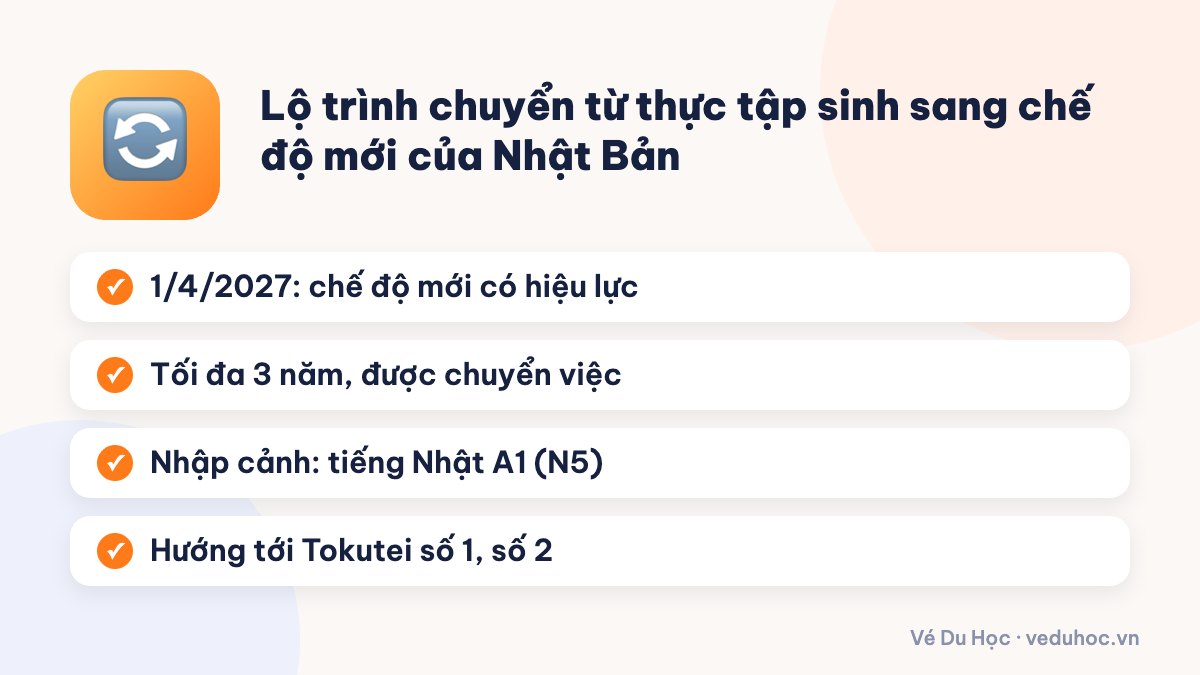
The law establishing the new regime was issued in June 2024. According to the Immigration Department of Japan and information provided by the Department of Overseas Labor Management (Vietnam), the "Job for skills development" regime will take effect from April 1, 2027. Main transition path:
| Mold | Content |
|---|---|
| From April 1, 2027 | Applications for approval of new skills internship plans are not accepted; New mode begins. |
| Until June 30, 2027 | People with internship plans submitted before April 1, 2027 can still enter the country under the old status. |
| Transition phase | Interns currently in Japan are allowed to continue; Completing number 1 can move to number 2; to number 3 only in limited cases (for example, having practiced number 2 for 1 year or more on April 1, 2027). Do not switch directly to a new area. |
| From April 1, 2030 | According to information from Vietnam, only the new regime remains. |
How is the new regime different from interns?
- The goal is clear: training and retaining human resources for labor-short industries, instead of “skill transfer.”
- Time: up to 3 years, then aim to move on Unique skill (Tokutei Ginou) number 1 With a residence period of up to 5 years, you can then move up to number 2.
- Job transfer: employees can volunteer transfer to another enterprise in the same field when meeting the conditions (working a certain amount of time, passing the Japanese language exam and vocational skills as required).
- Japanese language requirements step by step: upon entry, about level A1 (equivalent to JLPT N5) or take an equivalent Japanese course; To get to Tokutei No. 1, you need A2 (N4) or higher; To get to Tokutei number 2, you need B1 (N3) or higher.
- Fee control: Japan commits to providing a mechanism so that fees paid to sending organizations are not too high, combined with signing a memorandum of cooperation with sending countries.
Industry details, minimum time before changing jobs and specific fees are prescribed by Japanese guidance documents; Please compare the latest announcement from the Department of Overseas Labor Management and the Japanese Embassy.
Process of going to Japan as an intern
Whether it's an old visa in transition or a new one, the basic process is the same:
- Choose a dispatching business that is licensed and on the list recognized by the Japanese side.
- Recruitment exam: interview with Japanese business/management organization, test of skills, physical strength, health examination.
- Pre-departure training: learning Japanese, culture, labor discipline, legal knowledge; usually lasts several months.
- Sign a contract: the contract with the sending enterprise must be registered with the management agency; Read carefully salary, working hours, housing deductions, and insurance.
- Applying for status of residence (COE) and visa: the Japanese side submits the application, then applies for a visa at the Japanese Embassy/Consulate General.
- Departure and intensive training in Japan: about 1 month of intensive study before starting official work.
You can read more Prepare before flying to work abroad for the first time to have a checklist of documents and luggage.
What does the cost of an internship in Japan include?
According to the Law on Vietnamese Workers working abroad under contract (Law No. 69/2020/QH14), business service fees collected are limited to the number of months of salary (no more than 1 month's salary for every 12 months of work and up to 3 months' salary for contracts of 36 months or more). Amounts that employees usually pay themselves:
- Service fee (within the ceiling, only collected after signing the contract according to regulations).
- Learn Japanese and provide vocational training before leaving (if any).
- Health check, passport, visa, criminal record when required.
According to information fees published by the Department of Overseas Labor, the Japanese recipient pays many expenses such as pre-departure training fees, management, allowances during the month of intensive training and round-trip air tickets for interns. Therefore, if a unit charges additional money for "airline tickets", "fast flight fees", "anti-evasion fees" or other items not included in the contract, you need to request a written explanation.
Note to avoid risks
- Check license: Look up businesses on the website of the Department of Overseas Labor Management; Be wary of "touts" and individuals claiming to have the ability to move fast. See article Choose a reputable dispatching company.
- Learn real Japanese: with the new regime, Japanese is a condition for changing jobs and moving to Tokutei, directly deciding the opportunity to stay long-term.
- Keep your identification documents: no one can keep your passport or residence card.
- Do not run away: illegal workers can be deported, banned from entry and affect relatives. When you have problems, contact the Vietnamese representative agency or the organization supporting interns (OTIT) in Japan.
- Consider other options: If there are conditions for studying, Study abroad in Japan while studying and working or vocational study abroad is also a direction worth considering.
While working in Japan, you will need tickets to visit home, tickets for relatives to visit, or tickets to return home at the end of the contract. VeDuHoc's team of more than 30 Bookers hunts multi-carrier tickets for Japan - Vietnam routes, optimizes checked baggage and provides 24/7 support; If a better price is found after you have paid, HVSC will refund the difference. Reference Airline tickets for working people and post return home after the labor contract.
Frequently asked questions
Will the Japanese technical intern trainee program be abandoned?
Have. Japan has enacted legislation to replace it with an “Employment for Skills Development” regime effective from April 1, 2027, with a transition period for those who are interning or have plans submitted before then.
Can interns currently in Japan be transferred to the new regime?
According to the transition instructions, interns do not transfer directly to a new program but continue with their current program; After that, you can move towards specific skills if you meet the language and skill test conditions.
Can I change companies under the new regime?
Yes, workers can voluntarily transfer to another enterprise in the same field when they meet the conditions of working time, Japanese language and vocational skills as prescribed.
Do I have to buy my own plane ticket to do an internship?
According to information announced by the Vietnamese side, the interns' round-trip tickets are paid for by the Japanese recipient. Please check your contract for specifics.
Japanese technical intern trainees are ending to make way for a more transparent regime, with the right to change jobs and a clear long-term stay path. Choose a reputable unit, invest seriously in Japanese and always update official announcements. When you need tickets to visit home or return home, VeDuHoc is always ready via hotline/Zalo 090.1800.918.
Reference source
Booker HVSC gives a free quote in 15 minutes, Zalo reports take-off and landing for the whole family.
📚 Articles on the same topic
 International laborGoing to work in Taiwan: costs, contracts and benefits14/08/24 · 8 phút đọc
 International laborSpecified skills (Tokutei) Japan: conditions and opportunities04/11/23 · 10 phút đọc
 International laborPrepare before flying to work abroad for the first time22/04/21 · 7 phút đọc
 International laborChoosing a reputable dispatching company: signs to recognize and avoid scams24/11/19 · 7 phút đọc
 International laborKorean workers applying for EPS: Korean language exam and process02/06/18 · 9 phút đọc
 International laborWhat is vocational study abroad? Compare vocational study abroad and university study abroad07/03/25 · 8 phút đọc
🔥 Read a lot
- Master's scholarships: strategies for choosing majors, choosing schools and contacting professors
- International checked baggage for international students: pieces or scales, 46kg and tips for packing suitcases
- Why should study abroad centers have specialized airline ticket partners?
- Choosing a reputable dispatching company: signs to recognize and avoid scams
- Scholarships to study in Australia at high school and preparatory levels: opportunities for students in grades 10–12





 ▶
▶ ▶
▶ ▶
▶ ▶
▶ ▶
▶ ▶
▶ ▶
▶