
🔄 Cập nhật lần cuối: 08/10/26

Korean workers under EPS (Employment Permit System - Employment Permit Program) are the lowest-cost and most transparent channel to work in Korea today, directly organized by state agencies of the two countries. To participate, you must pass the EPS-TOPIK Korean exam and skill assessment rounds. This article summarizes the conditions, exam structure, costs and process from registration to exit.
What is the EPS program?
EPS is a Korean program to receive unskilled foreign workers (E-9 visa) based on an agreement between the two governments. On the Vietnamese side, the only unit that organizes recruitment and dispatching is the Center for Overseas Labor (Colab) - a public service unit, currently under the Ministry of Home Affairs. The Korean side is the Korean Human Resources Development Agency (HRD Korea), in charge of setting questions, marking exams and introducing documents to employers.
EPS workers work in the following industries: manufacturing, construction, agriculture, fishery, shipbuilding, services and forestry (depending on each opening). Because it is a state-owned program, workers do not have to go through a broker. Anyone who promises to "run the score" or "leave the country early" is a sign of fraud, as the Center for Overseas Labor has repeatedly reported in the press.
Conditions for participating in Korean labor under EPS
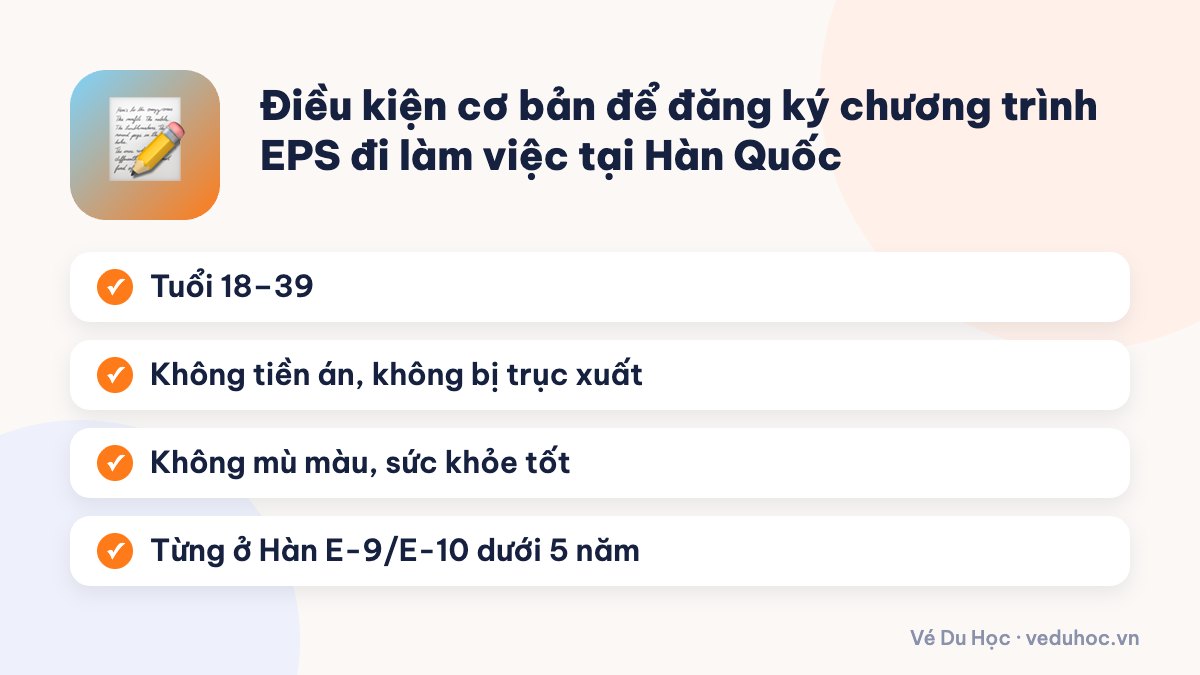
According to recently published recruitment notices of the Center for Overseas Labor, workers need to meet:
- Ages from 18 to 39 (calculated based on specific date of birth stated in each notice).
- No criminal record; not be expelled from Korea; Not subject to the ban on leaving Vietnam.
- If you were in Korea under an E-9 or E-10 visa, the total stay must be less than 5 years.
- Good health: no color blindness or color vision disorder, no diseases according to the exclusion list (syphilis, tuberculosis...), negative for drugs; Some deformities such as herniated discs and missing fingers can be eliminated.
- Some localities with a high rate of runaway workers may have their recruitment suspended - need to see the announcement periodically.
Usually no degree is required, but some specific industry recruitments (welding, molds, shipbuilding) require skills or vocational certificates.
EPS-TOPIK Korean language test and skills assessment
Exam structure
EPS-TOPIK currently takes a computer-based test (CBT), multiple-choice format, questions taken from HRD Korea's question bank based on the EPS-TOPIK standard curriculum.
| Exam section | Number of sentences | Point | Time |
|---|---|---|---|
| Read comprehension | 20 | 100 | 25 minutes |
| Listen and understand | 20 | 100 | 25 minutes |
| Total | 40 | 200 | 50 minutes |
Exam fees are announced in installments (usually about a few dozen USD, paid in VND). Exam results are valid for 2 years. The cut-off score to achieve varies by batch and industry; Some programs also add priority points (up to several dozen points) to people with a TOPIK level 3 certificate or higher or completing a recognized vocational training course.
Assess skills and competencies
In addition to Korean, most current batches have an additional skill test and interview (assessment of physical fitness, basic operations, communication ability). With recruitment rounds of skilled workers such as welding and molding, workers receive skills and Korean language training about 3 months before the exam. Note: passing the exam only allows the application to be sent to Korea - it does not guarantee that an employer will choose you.
Exam preparation tips
- Study according to the EPS-TOPIK standard curriculum (60 lessons), practice specialized vocabulary (labor safety, tools).
- Practice listening every day, take questions on the computer to get used to the CBT interface.
- Do not buy "recommendation" or "pass guarantee package" - this is a common scam.
Process from registration to exit
- Follow the announcement on the website of the Center for Overseas Labor (colab.gov.vn) and the local Department of Labor.
- Register for the exam according to the instructions (online and/or submit application), pay the fee with correct syntax.
- Korean language test, skills test; see results.
- Submit your application (with medical examination) for Colab to transfer to HRD Korea.
- Wait for the owner to choose and sign the contract; Track application status on eps.go.kr.
- Apply for a visa: prepare your criminal record card early because it takes a long time to issue a visa.
- Learn orientation before leaving the country, pay fees, deposit and exit according to the entry schedule arranged by the Korean side.
According to VnEconomy, late submission of visa documents can cause the contract to be canceled because of failure to enter the country on time and the application will be suspended for one year. HRD Korea also recommends not contacting the employer yourself to ask for an entry schedule because it may be considered through a broker.
Costs, margin and contracts
According to information quoted by Nhan Dan newspaper and VnEconomy from the Center for Overseas Labor:
- Dispatch fee: equivalent to about 630 USD (paid in VND), including management fee, orientation course, visa and return flight ticket.
- Deposit: 100 million VND at the Social Policy Bank; will be refunded when the employee returns home on time according to the contract. Employees covered by the policy can borrow capital to make a deposit.
- Korean language/skills training costs (if participating in the course) are paid by the employee themselves at a public rate.
Contract: maximum 3 years, can be extended for up to 1 year and 10 months if requested by the employer. Minimum basic salary applies to the Korean minimum wage (adjusted annually), excluding overtime. The Vietnam - Korea Social Insurance Agreement helps accumulate insurance payment time.
Be careful not to lose the opportunity
- Only pay according to official notice; Do not give money to individuals, "dealers" or centers claiming to be "affiliated with Colab".
- Keep your registration phone number active – orientation notifications are usually sent via text message 7–10 days in advance.
- Return home on time to have your deposit refunded and have the opportunity to re-enter the country under the program for workers returning on time.
To clearly understand how to identify real and fake sending units, see the article Choose a reputable dispatching company. If you want to compare with other markets, please refer Japanese specific skills good go to work in Taiwan. People who want to learn the language first can learn Study abroad in Korean language system.
When you need tickets to return home or tickets for your family, VeDuHoc has 30+ Bookers to hunt for multi-carrier tickets for the Korea - Vietnam route, continue to hunt even when the price is high and refund the difference if a better price is found after you pay. We provide 24/7 support and advise on optimal luggage when you bring your belongings home. See article return home after the labor contract or page Labor plane tickets.
Frequently asked questions
Is passing EPS-TOPIK guaranteed to go to Korea?
Are not. Passing the exam is only a condition for the application to be introduced to Korea. Whether or not you leave depends on whether the employer chooses your profile within the validity period or not.
How long are EPS-TOPIK exam results valid?
According to notices from the Center for Overseas Labor, exam results are valid for 2 years from the date of publication.
Can a deposit of 100 million VND be returned?
Yes, the deposit and interest are refunded when the employee completes the contract and returns home on time. Violations (escape, illegal residence) will have the deposit handled according to regulations.
Should I pay money to the center that promises "parking fee" and "fast exit"?
Are not. The EPS program is not brokered; All revenues are announced publicly. The promise of "coverage" is a sign of fraud.
EPS is a good opportunity for workers who want to go to Korea at a reasonable cost, if you persevere in learning the language and closely follow official announcements. Wishing you good exam preparation - and when you need tickets to visit home, call VeDuHoc via hotline/Zalo 090.1800.918.
Reference source
Booker HVSC gives a free quote in 15 minutes, Zalo reports take-off and landing for the whole family.
📚 Articles on the same topic
 International laborGoing to work in Taiwan: costs, contracts and benefits14/08/24 · 8 phút đọc
 International laborSpecified skills (Tokutei) Japan: conditions and opportunities04/11/23 · 10 phút đọc
 International laborPrepare before flying to work abroad for the first time22/04/21 · 7 phút đọc
 International laborChoosing a reputable dispatching company: signs to recognize and avoid scams24/11/19 · 7 phút đọc
 International laborJapanese technical intern trainees: process, costs, notes and new replacement regime18/10/16 · 9 phút đọc
 International laborReturning home after the labor contract: booking tickets, luggage and procedures29/07/22 · 7 phút đọc
🔥 Read a lot
- Master's scholarships: strategies for choosing majors, choosing schools and contacting professors
- International checked baggage for international students: pieces or scales, 46kg and tips for packing suitcases
- Why should study abroad centers have specialized airline ticket partners?
- Choosing a reputable dispatching company: signs to recognize and avoid scams
- Scholarships to study in Australia at high school and preparatory levels: opportunities for students in grades 10–12





 ▶
▶ ▶
▶ ▶
▶ ▶
▶ ▶
▶ ▶
▶ ▶
▶