
🔄 Cập nhật lần cuối: 08/10/26

Preparing before flying to work abroad for the first time is more than just packing a suitcase. That is a whole list of documents, money, health, legal knowledge and psychology to make the first days in a foreign country go smoothly. This article is a practical checklist for first-time workers in Japan, Korea, Taiwan, Europe or any other market.
Documents need to be prepared before flying to work abroad
Please prepare the original documents below in your handbag and save scanned copies on your phone/email:
- Passport with long validity (should be longer than the contract term or at least sufficient according to the requirements of the destination country) and visa/entry permit.
- Labor contract (Vietnamese and local language versions), contract for sending workers to work abroad signed with the enterprise.
- Documents according to market requirements: COE (Japan), invitation letter, work permit...
- Health certificate, foreign language certificate, vocational certificate, diploma (may be needed when applying for a residence card or changing status later).
- Certificate of completion of necessary knowledge training course before departure.
- Contact information: officials of the sending enterprise, foreign receiving/brokering company, Embassy or Vietnamese Labor Management Board in the destination country.
You should take a photo of your passport, visa, and contract and send a copy to a relative. A more detailed list of documents when flying is in the article Documents needed to carry with you when flying.
Knowledge and psychology before leaving
Necessary knowledge training course
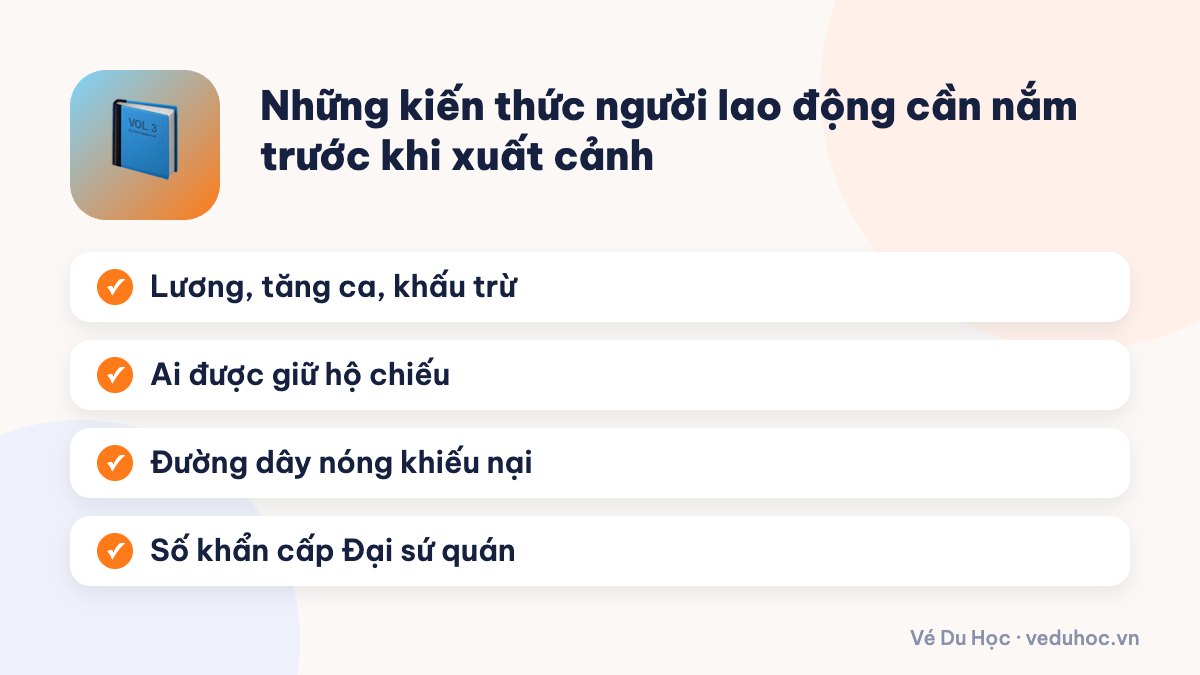
According to the Law on Vietnamese Workers working abroad under contract, workers must be trained in necessary knowledge before going: laws of the receiving country, customs and traditions, labor discipline, labor safety, and how to handle situations. Don't consider this a "gift procedure" - take careful notes, especially emergency phone numbers.
Understand your rights
- Basic salary, overtime calculation, deductions (food, accommodation, taxes, insurance).
- Who keeps the passport? (In most countries, employers cannot keep passports against the employee's will.)
- Complaint channel: hotline of host country, Vietnamese labor management officials.
Prepare mentally
The first months are often difficult: homesickness, language barrier, high work intensity. Maintain regular contact with your family, connect with a healthy Vietnamese community, stay away from gambling, payday loans, and illegal "part-time jobs". Independent skills in the lesson Independent skills required Also very useful for working people.
Money: how much to bring and how to bring it
You need enough money for about the first month (before the first pay period): food, transportation, phone SIM, essential items. Note the regulations when leaving the country:
| Currency type | Must declare customs upon exit |
|---|---|
| Foreign currency cash | Over 5,000 USD (or equivalent) |
| Vietnamese Dong in cash | Over 15,000,000 VND |
According to Circular 15/2011/TT-NHNN (guided by Tuoi Tre), carrying more than the above limit must declare to customs and present a confirmation from an authorized bank. In fact, working people rarely need to carry that much. You should exchange some foreign currency at the bank and bring an international card if you have one. More details in the article Exchange foreign currency, bring cash and cards.
Luggage: what to bring, what not to bring
Should bring
- Clothes suitable for the climate (warm clothes if going to Japan, Korea, Taiwan in winter), protective shoes if required by the business.
- Common personal medications with prescriptions, spare eyeglasses (see more Regulations on bringing drugs abroad).
- Converted socket, backup charger (put in hand luggage).
- A few dried spices, sealed – but check the destination country's regulations.
Cannot or should not be worn
- Meat and meat products (rolls, sausages, sausages, pork floss...), eggs, fresh fruits, seeds: many countries such as Taiwan, Japan, and Korea quarantine very strictly, fines can be very high.
- Drugs containing narcotics, drugs of unknown origin, herbal medicine in powder form without labels.
- Counterfeit goods, prohibited goods, goods brought on behalf of strangers.
Carefully check the checked baggage standards on the ticket: many tickets only have 20–23kg, if you bring a lot of items you should buy extra weight in advance - much cheaper than paying excess fees at the airport. Reference international checked baggage.
Flight day: procedures at the airport
- Be at the international airport at least 3 hours before flight time; Go in a group if organized by the business.
- Check in at the airline counter, check in your luggage, and receive your boarding pass.
- Go through security check and exit (or use automatic gate if eligible).
- If in transit: follow the "Transfer/Transit" sign, do not leave the transit area without a visa - see article first transit flight.
- Upon arrival: declare immigration and customs truthfully; Meet the receptionist of the receiving company.
If you book your own tickets or a business needs to book tickets for a group, VeDuHoc has 30+ Bookers to hunt for multi-carrier tickets, advise on purchasing reasonable extra luggage, check transit visas, support 24/7 and issue VAT invoices. If a better price is found after the customer has paid, HVSC will refund the difference. View page Labor plane tickets.
Frequently asked questions
Can I bring food from Vietnam to work?
Sealed, labeled dried goods are usually allowed, but meat, eggs, meat products and fresh fruit are banned in many countries. Look up the quarantine regulations of the destination country or ask the sending business.
How much money should I bring when I first arrive?
Enough to spend about the first month depending on the cost of living of the destination country. No need to bring too much cash; If it exceeds 5,000 USD or 15 million VND, it must be declared to customs.
Do I need to buy travel insurance when going to work?
Workers are often covered by insurance according to the host country's regulations after entering the country. Please ask clearly when it takes effect to decide whether additional insurance is needed for the first period or not.
What if I lose my passport abroad?
Immediately notify the receiving company, report to the local police and contact the Vietnamese Embassy/Consulate General to receive replacement documents.
Preparing carefully once will help you feel secure throughout the journey. Wishing you a smooth journey - and if you need tickets or luggage advice, please contact VeDuHoc via hotline/Zalo 090.1800.918. At the end of the contract, post return home after the labor contract will help you prepare for your return trip.
Reference source
Booker HVSC gives a free quote in 15 minutes, Zalo reports take-off and landing for the whole family.
📚 Articles on the same topic
 Study abroad lifeFirst day at school: orientation and things to do20/12/24 · 6 phút đọc
 International laborGoing to work in Taiwan: costs, contracts and benefits14/08/24 · 8 phút đọc
 Study abroad handbookDocuments to bring with you when flying to study abroad (no deposit)26/12/23 · 6 phút đọc
 International laborSpecified skills (Tokutei) Japan: conditions and opportunities04/11/23 · 10 phút đọc
 International laborReturning home after the labor contract: booking tickets, luggage and procedures29/07/22 · 7 phút đọc
 Study abroad handbookWhat should parents prepare when their children study abroad?13/06/21 · 7 phút đọc
🔥 Read a lot
- International checked baggage for international students: pieces or scales, 46kg and tips for packing suitcases
- Master's scholarships: strategies for choosing majors, choosing schools and contacting professors
- Why should study abroad centers have specialized airline ticket partners?
- Choosing a reputable dispatching company: signs to recognize and avoid scams
- Stipendium Hungaricum Scholarship: full study abroad in Hungary




 ▶
▶ ▶
▶ ▶
▶ ▶
▶ ▶
▶ ▶
▶ ▶
▶