
🔄 Cập nhật lần cuối: 08/10/26

A small bag of medicine can help you overcome fever and stomach pain in the early days before you can register with a doctor. But bringing medicine when studying abroad doesn't mean you just have to "put it in your suitcase and be done with it": each country has its own quantity limits, paperwork requirements and list of banned active ingredients. This article helps you prepare a reasonable medicine cabinet, get the correct prescriptions and avoid trouble with customs.
General principles when bringing medicine abroad
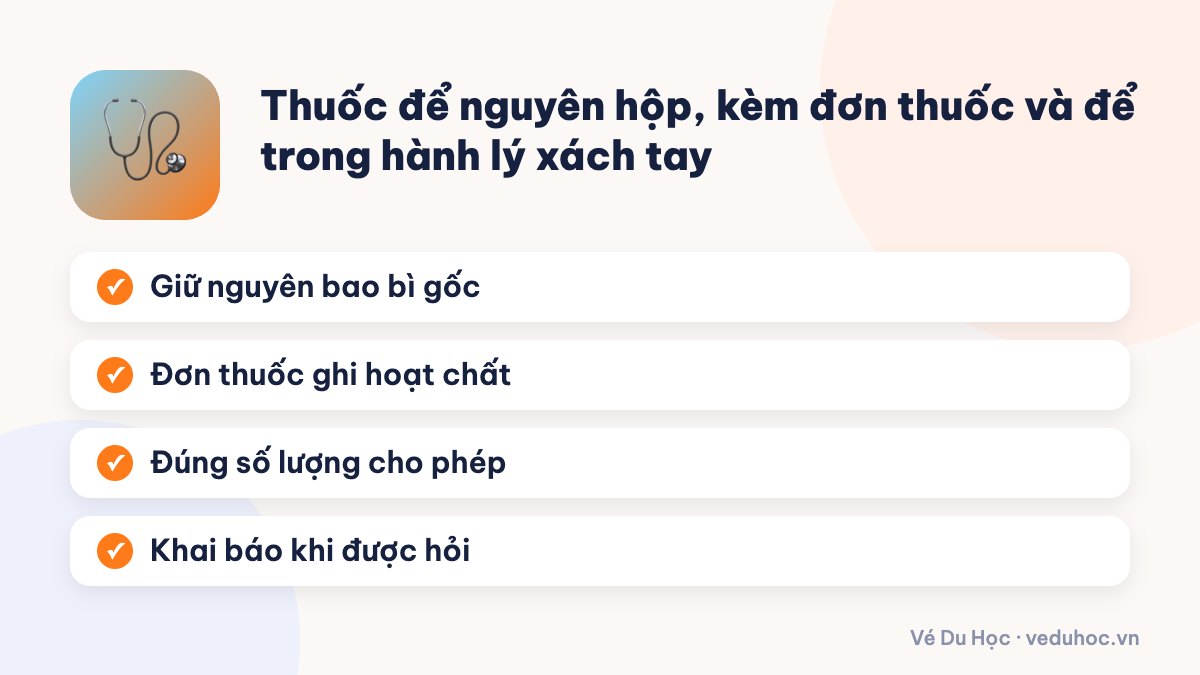
- Only bring medicine for personal use, not for personal use, not to sell or give to others.
- Keep the original packaging with the active ingredient name and content printed on it. Medicines that are peeled off blister packs and put into plastic bags are easy to suspect.
- Keep your current medication in your carry-on baggage in case your checked suitcase is lost. Carry-on liquid medications must comply with liquid regulations. Medicines needed for the journey are usually accepted but should be accompanied by a prescription.
- Declare truthfully when the immigration declaration asks about drugs. Declaration does not mean confiscation; Hiding and not telling is a big risk.
- Do not bring home-made herbal medicine or Chinese medicine or animal products of unknown origin - many countries such as Australia and New Zealand control it very tightly.
List of prohibited items and items that must be declared in popular countries is in the article Enter Australia, USA, Canada: customs declaration.
List of basic medications you should bring
The goal is to have enough for minor illnesses in the first 1–2 months, not having to carry "the whole pharmacy". Before buying, ask your pharmacist or doctor, especially if you have underlying medical conditions or drug allergies.
| Group | For example | Note |
|---|---|---|
| Reduce fever, reduce pain | Paracetamol | Choose a single substance, avoid a combination containing codeine |
| Digestion | Probiotics, oresol, anti-diarrheal medicine, stomach pain medicine | Use as directed, see a doctor if it persists |
| Allergy | Common antihistamines | Avoid combinations containing pseudoephedrine |
| Cold, cough, sore throat | Lozenges, physiological saline | Check the ingredients if going to Japan |
| First aid | Bandages, gauze, antiseptic solution, wound cream | Sharp tools in checked baggage |
| Long-term treatment medication | Prescription medications (asthma, cardiovascular, thyroid, psychiatric...) | Prescription required, correct quantity limit |
You should not buy antibiotics to "protect yourself": self-using antibiotics is both dangerous and may be questioned upon entry. If your doctor prescribes it for you, bring it with you.
Prescription and doctor's letter
For prescription medications, ask your doctor to treat:
- Prescription or confirmation letter in English states full name (matches passport), diagnosis, active ingredient name (generic name, not just brand name), content, dosage, and treatment duration.
- Information, signature and stamp of the doctor/hospital.
- If necessary, notarized translation - see article Notarized translation of study abroad documents.
A doctor's letter also helps doctors abroad to prescribe an equivalent prescription when you run out of medicine. Include a summary medical record if you have a chronic illness.
Regulations on bringing medicine when studying abroad according to the destination country
Below are some typical regulations according to the most recent announcements of the country's authorities. Regulations are subject to change; Always check the official site or ask the embassy before flying.
Japan
According to the instructions of the Japanese Embassy (citing regulations of the Japanese Ministry of Health, Labor and Welfare), individuals are allowed to bring drugs for a maximum of about 1 month prescription of use, over-the-counter drugs for a maximum of about 2 months, and external drugs for a maximum of 24 products of each type. Carrying more than the required amount requires an import certificate (Yunyu Kakunin-sho) before the trip. In particular, drugs containing stimulants and some cold medications containing pseudoephedrine and codeine are banned; Psychotropic and addictive drugs require a license.
Australia
The Australian Therapeutic Goods Administration (TGA) allows passengers to bring their own medication, usually for a maximum of three months' supply, with a prescription or doctor's letter. Some controlled drugs require a separate license. Must declare medication on immigration card when asked.
America, Canada, Europe
Personal medications are generally allowed in reasonable amounts (usually no more than about 3 months), in original packaging and with a prescription. Controlled drugs (sedatives, narcotic pain relievers, ADHD medications...) have stricter requirements. In the Schengen area, narcotic/psychotropic drugs may require a separate certificate.
Korea, China, Taiwan and other countries
Each has its own quantity limit and prohibited list; Look it up on the embassy or customs office's website or ask your school. Absolutely do not accept to carry "medicine" for strangers.
Once there: buy medicine and get medical examination
Once you arrive, check in with your general practitioner (GP) or school health department as soon as possible, and find out what your insurance covers – see article Medical insurance for studying abroad and Open a bank account, buy insurance, register with a doctor. In many countries, antibiotics and many common drugs in Vietnam are only sold by prescription, so don't be surprised when pharmacies refuse to sell them. If you have mental health problems, you can refer to the article Take care of your mental health while studying abroad.
Về hành lý, túi thuốc và dụng cụ y tế cần được sắp xếp hợp lý giữa xách tay và ký gửi. Booker của Vé Du Học có thể tư vấn chọn hãng có hành lý ký gửi 40kg hoặc 2 kiện 23kg, hướng dẫn cách khai báo dụng cụ y tế đặc biệt với hãng và kiểm tra yêu cầu quá cảnh. Xem thêm bài Study abroad luggage: list of things to bring and item question about luggage.
Frequently asked questions
Do I need to translate the prescription into English?
Highly recommended. Vietnamese prescriptions are difficult for customs officers and foreign doctors to understand. The most important thing is to write down the name of the active ingredient and the dosage.
Is there a limit to bringing supplements and functional foods?
Maybe. Many countries limit quantities or check ingredients, especially products of animal or herbal origin. Should bring a moderate amount, with intact packaging.
Can liquid medicine be portable?
Medicines needed for travel are often allowed to exceed the liquid limit if presented at the screening point, so a prescription should be included. Liquid medicine should be kept as a deposit.
What if the customs keep drugs?
Cooperate, explain the purpose of use and present the prescription. If the drug is prohibited, the drug may be withheld; Please contact your destination doctor for a replacement prescription.
Preparing medicine properly helps you study with peace of mind and avoid unnecessary trouble at the border gate. Need advice on luggage and study abroad flight schedule, please contact VeDuHoc via hotline/Zalo 090.1800.918.
Reference source
Booker HVSC gives a free quote in 15 minutes, Zalo reports take-off and landing for the whole family.
📚 Articles on the same topic
 Study abroad handbookExit procedures at Vietnam airport for international students28/03/26 · 6 phút đọc
 Study abroad handbookDocuments to bring with you when flying to study abroad (no deposit)26/12/23 · 6 phút đọc
 Study abroad handbookWhat is the difference between airline ticket classes: Business, Premium Economy, Economy, Eco, Deluxe?01/10/26 · 2 phút đọc
 Study abroad handbookSim, eSIM and internet when you first arrive abroad09/07/26 · 7 phút đọc
 Study abroad handbookTeach your children financial skills before studying abroad25/02/22 · 6 phút đọc
 Study abroad handbookFlying in transit for the first time: a step-by-step guide for international students18/03/23 · 6 phút đọc
🔥 Read a lot
- Master's scholarships: strategies for choosing majors, choosing schools and contacting professors
- Hành lý ký gửi chặng quốc tế cho du học sinh: kiện hay cân, 40kg hay 2 kiện 23kg và mẹo đóng vali
- Why should study abroad centers have specialized airline ticket partners?
- Choosing a reputable dispatching company: signs to recognize and avoid scams
- Scholarships to study in Australia at high school and preparatory levels: opportunities for students in grades 10–12




 ▶
▶ ▶
▶ ▶
▶ ▶
▶ ▶
▶ ▶
▶ ▶
▶