
🔄 Cập nhật lần cuối: 08/10/26

Customs declaration when entering Australia, the US, and Canada is a step that many Vietnamese international students neglect. Consequences can be confusion of items, fines, and even affecting visas. All three countries have tight controls on food, animal and plant products, and cash. This article helps you understand what to declare, what not to bring, and how to handle it at the border gate.
General principles when declaring customs
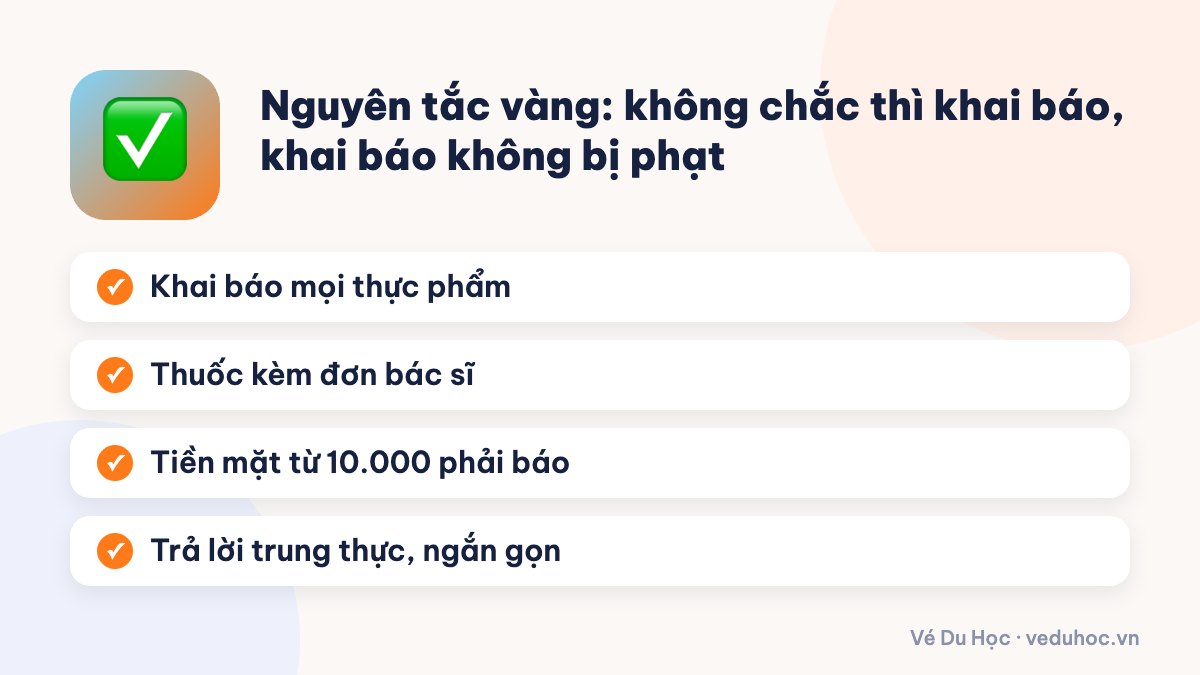
- If you're not sure, declare it. The Canada Border Services Agency (CBSA) also advises that if you are unsure whether an item is declared, declare it to an officer. If you declare and then have your items kept, you will not be fined; If you do not declare, you will be punished if you are discovered.
- Declare truthfully on the declaration form (paper or electronic, depending on the country and airport) and when asked directly.
- Know clearly what's in the suitcase: pack the suitcase yourself; If a family member helps, check again. “Mom let it in without you knowing” is not an acceptable reason.
- Keep declared items in an easily accessible place to open for officers to quickly check.
Customs declaration for entry to Australia, USA, Canada
| Content | Australia | the USA | Canada |
|---|---|---|---|
| How to declare | According to the current passenger declaration form (Incoming Passenger Card or declaration number) | Customs declaration or electronic declaration/kiosk depending on the airport | Automated kiosk, pre-declaration on official application (if applicable) or E311 declaration |
| Food, animal and plant products | Quarantine is very strict; Fresh fruit and homemade food are in the no-carry group | Must declare; Meat, fresh fruit, and seeds are often prohibited or limited | All food, plants, animals and related products must be declared |
| Medicine | Prescription drugs must be declared; There are limits and conditions | Bring in original packaging, with prescription; Some controlled drugs | Take appropriate amount for personal use, with prescription |
| Cash | From 10,000 AUD (or equivalent foreign currency) or more must be reported | Over 10,000 USD (or equivalent) must be reported | From 10,000 CAD (or equivalent) or more must be declared |
| Consequences of false declaration | Confiscation and fines; Serious violations may affect your visa | Confiscation and fines | Confiscation, fine from 25–70% of value of goods; may be prosecuted |
The levels and forms of declaration may change. Always check the official site: Australian Border Force, U.S. Customs and Border Protection, Canada Border Services Agency.
Australia: biological quarantine is the top priority
Australia is famous for its strict biosecurity. According to ABF, fresh fruits such as apples, tangerines, oranges and homemade foods (dishes, home-made cakes) are in the "do not bring" group; Prescription drugs fall into the “must be declared” category. Luggage is often screened and inspected by sniffer dogs. See more Australian student visa subclass 500.
US: cash and agricultural products
Cash and monetary instruments over $10,000 are reportable, not prohibited. Agricultural products such as meat, fruits, and fresh vegetables are strictly controlled. In addition to customs, F-1 students need to present their passport, visa, and I-20 at immigration. See F-1 US student visa.
Canada: declare all foods
CBSA requires declaration of all food, plants, animals and related products. Newly arrived international students must also complete procedures to receive a study permit at the border gate with a letter of introduction (POE letter). See Canadian study permit.
Food, medicine: which items often cause problems?
- Often banned or restricted: meat (fresh, dried, sausages, sausages, sausages), raw eggs and egg products, fresh fruits and vegetables, seeds, homemade foods, unpasteurized dairy products.
- Need to declare, usually allowed if industrial packaging: instant noodles (note seasoning packages containing meat), candy, tea, coffee, dried spices. Specific regulations vary from country to country.
- Medicine: bring your prescription medication in its original packaging, with a prescription or doctor's letter in English. Oriental medicine, drugs with animal ingredients or controlled substances are easily detained. See Bring medicine when studying abroad.
- Other: counterfeit goods, counterfeit goods, wildlife products (ivory, leather), weapons, pepper spray.
At the border gate: how to answer?
- Answer briefly, honestly, in simple English: purpose (study), school, place of residence, study time.
- Prepare documents: passport, visa, admission letter, CoE/I-20/recommendation letter, accommodation confirmation, financial proof.
- If you are selected to check your luggage: cooperate, stay calm, do not argue.
- If you do not understand the question, politely ask to repeat it (Could you repeat, please?).
Preparing your belongings from the beginning helps you avoid trouble. See Study abroad luggage: what to bring and what to buy.
Frequently asked questions
Can I bring instant noodles and candy into Australia?
Industrially packaged foods are usually allowed but must be declared; Products containing meat (including seasoning packets) may be withheld. The safest way is to declare everything.
Will bringing $10,000 in cash be confiscated?
Not prohibited, but must be reported according to the regulations of the destination country. Failure to report is a violation. It's best to use bank transfer or card for large amounts.
Will I be fined if I declare?
Are not. If the item is not permitted, officers will keep it or destroy it. Penalties only apply for non-declaration or false declaration.
What effect does it have on whoever packs the suitcase?
You remain responsible for everything in your luggage. Always check yourself before flying.
Declaring correctly is the fastest way to cross the border smoothly. Remember the rule "If you're not sure, declare" and bring enough documents in your carry-on luggage. Wishing you a smooth start to your study abroad journey.
Reference source
Booker HVSC gives a free quote in 15 minutes, Zalo reports take-off and landing for the whole family.
📚 Articles on the same topic
 Study abroad handbookExchange foreign currency, bring cash and cards when studying abroad09/12/16 · 8 phút đọc
 Study abroad handbookWhen children encounter problems abroad: what parents need to do28/05/24 · 7 phút đọc
 Study abroad handbookDocuments to bring with you when flying to study abroad (no deposit)26/12/23 · 6 phút đọc
 Study abroad handbookExit procedures at Vietnam airport for international students28/03/26 · 6 phút đọc
 Study abroad handbookPick up at the airport and accommodation in the first days: prepare before flying18/09/17 · 6 phút đọc
 Study abroad handbookSending money for your child to study abroad: legal ways to transfer money13/09/18 · 7 phút đọc
🔥 Read a lot
- Hành lý ký gửi chặng quốc tế cho du học sinh: kiện hay cân, 40kg hay 2 kiện 23kg và mẹo đóng vali
- Master's scholarships: strategies for choosing majors, choosing schools and contacting professors
- Why should study abroad centers have specialized airline ticket partners?
- Choosing a reputable dispatching company: signs to recognize and avoid scams
- Stipendium Hungaricum Scholarship: full study abroad in Hungary




 ▶
▶ ▶
▶ ▶
▶ ▶
▶ ▶
▶ ▶
▶ ▶
▶