
🔄 Cập nhật lần cuối: 08/10/26
Preparing luggage to study abroad is a balancing act between "bringing enough" and "not being overweight". Many people stuff two suitcases and then discover that most of their belongings can be bought abroad at reasonable prices. Meanwhile, things you really need, such as paperwork, medicine, and electronics, are left in the wrong place. The article provides a checklist by group and suggests which items to buy in the destination country.
Hand luggage: things that must always be with you
- Papers: passport, visa, admission letter, CoE/I-20/CAS, insurance, financial proof, accommodation documents, transcripts and original degrees. See Documents needed to carry with you when flying to study abroad.
- Money and cards: some foreign currency cash, international card. See Exchange foreign currency, bring cash and cards.
- Electronics: laptop, phone, charger, adapter, headphones. Backup chargers and removable lithium batteries are required to be kept in carry-on baggage and cannot be checked in.
- Medicine used daily for the first few days, with prescription.
- A spare set of clothes in case your checked baggage is lost. See Missed flight, lost luggage.
- Light jacket, scarf (planes and airports are often cold).
According to US Federal Aviation Administration (FAA) guidelines, lithium-ion batteries up to 100Wh do not require approval; Type 101–160Wh requires company approval and a maximum of 2 spare batteries. Each company can have stricter regulations on the number of backup chargers.
Checked luggage for studying abroad: checklist by group
| Group | Should bring | Notes |
|---|---|---|
| Clothing | Daily wear for 1–2 weeks, underwear, a smart outfit (interview, event) | Thick winter coats can be purchased on site, suitable for the climate and light on the suitcase |
| Medicine and health | Prescription medicine enough for a period of time (with English prescription), basic common medicines, spare glasses | See regulations for each country at Bring medicine when studying abroad |
| Personal belongings | Small toiletries for the first few days, towels | Buy fully after stabilization |
| Study | Pocket calculator of the type allowed by the school, some specialized books that are hard to find | Textbooks often have electronic versions and libraries |
| Electrical appliances | Split sockets and adapters conform to the standard of incoming water and electricity outlets | The US and Canada use about 120V electricity; Check if the device supports a wide voltage range |
| Kitchen | Some industrially packaged dry spices (if destination country allows), a small knife (checked) | Must declare food when entering Australia, New Zealand... |
| Celebrate | Family photos, small gifts with Vietnamese identity to give to friends or homestays | Choose snacks, not food |
Electrical sockets in some countries
- USA, Canada: flat pin (type A/B), voltage about 120V.
- Australia, New Zealand: oblique flat pin (type I), about 230V.
- UK: 3 square feet (type G), about 230V.
- Most of Europe: round pin (type C/F), about 230V.
Things should be bought abroad
- Blankets, pillows, bed sheets: bulky, heavy; Hostels often have affordable bedding packages or supermarkets.
- Winter coats, snowshoes: items sold on site are more suitable for the climate.
- Large household appliances: rice cooker (note the voltage), pans, dishes.
- Bulk toiletries: shampoo, shower gel, toothpaste.
- Stationery: easy to buy, many schools have their own stores.
- Phone SIM: buy on the spot or use eSIM. See SIM, eSIM and internet when you first arrive abroad.
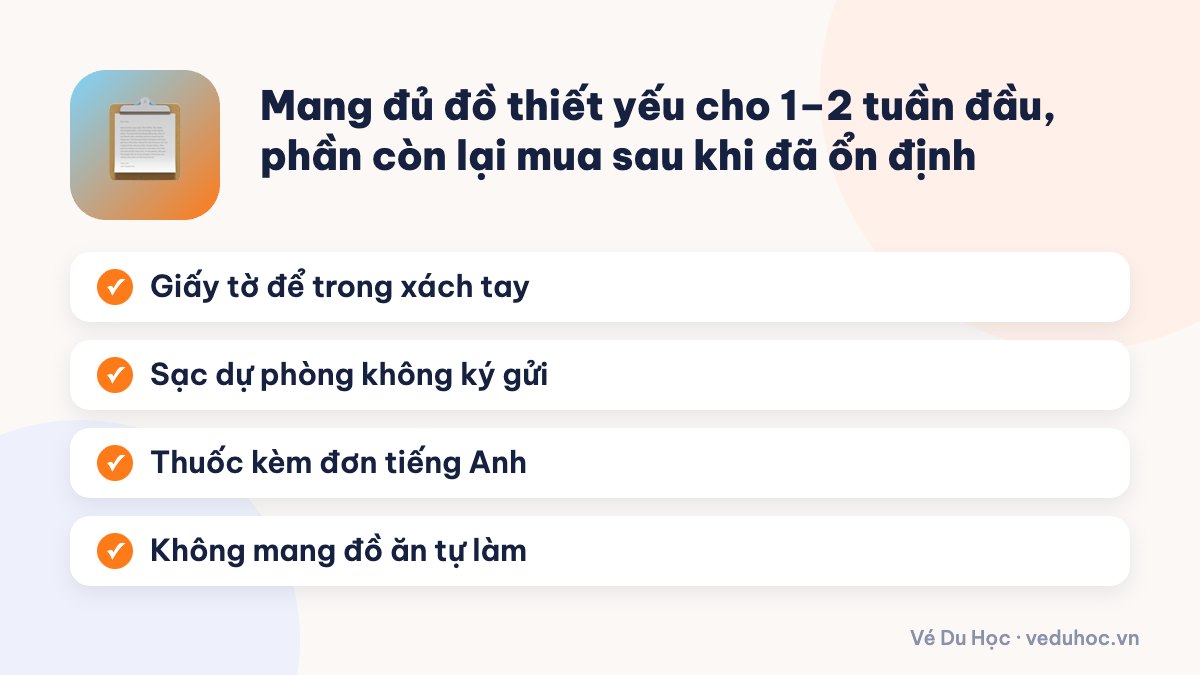
Principle: bring enough essential items for the first 1–2 weeks. The rest, buy after knowing how large the room is and what is really missing.
Things you shouldn't or shouldn't bring
- Homemade food, fresh fruit, meat, eggs, seeds: The Australian Border Force (ABF) classifies fresh fruit and homemade foods as “do not carry”. Many other countries such as the US, Canada, and New Zealand also strictly control it. See Enter Australia, USA, Canada: customs declaration.
- Liquids over 100ml in carry-on baggage, sharp objects, flammable aerosols.
- Drugs of unknown origin, oriental medicine with controlled animal or plant ingredients.
- Counterfeit and imitation goods: may be confiscated.
- Cash exceeds the threshold without declaration.
To properly pack your suitcase, read on Packing a 46kg study abroad suitcase: tips for packing things neatly and with the right weight.
Frequently asked questions
Should I bring a rice cooker from Vietnam?
If you go to the US or Canada (about 120V), the 220V pot from Vietnam will not work properly without a transformer. It's often more convenient to buy on the spot. With water using electricity of about 230V, you can carry it but it takes up space and weight.
How much medicine is enough?
Prescription drugs: bring enough for the initial period according to the limits allowed by each country, with a prescription. Common medicines: only need a little, because they can be purchased at pharmacies in the destination country.
Can I bring instant noodles and spices?
Many countries allow industrially packaged food but require declaration, especially Australia. Products containing meat (including seasoning packets containing meat) are often restricted. When in doubt, report it.
Should a laptop be carried or checked in?
Should be carried by hand to avoid collision and loss. The lithium battery in the device should be carried with you.
Neat luggage makes the first flight easier. Make a list early, weigh your suitcase before the flight, and ask VeDuHoc for advice on the ticket class with suitable luggage via hotline/Zalo 090.1800.918.
Reference source
Booker HVSC gives a free quote in 15 minutes, Zalo reports take-off and landing for the whole family.
📚 Articles on the same topic
 Documents & student visaChecklist of complete study abroad documents: documents need to be prepared in each stage09/08/25 · 6 phút đọc
 Study abroad handbookStudy abroad air tickets: when to book, where to book and how to save28/08/16 · 6 phút đọc
 Study abroad handbook9 experiences in booking air tickets to study abroad that parents need to know08/09/26 · 3 phút đọc
 Study abroad handbookAir tickets to Tet for international students: experience in ticket hunting23/06/19 · 6 phút đọc
 Study abroad handbookMonitor and support your child remotely while studying abroad29/06/23 · 7 phút đọc
 Study abroad handbookWhat is the difference between airline ticket classes: Business, Premium Economy, Economy, Eco, Deluxe?01/10/26 · 2 phút đọc
🔥 Read a lot
- Master's scholarships: strategies for choosing majors, choosing schools and contacting professors
- Hành lý ký gửi chặng quốc tế cho du học sinh: kiện hay cân, 40kg hay 2 kiện 23kg và mẹo đóng vali
- Why should study abroad centers have specialized airline ticket partners?
- Choosing a reputable dispatching company: signs to recognize and avoid scams
- Scholarships to study in Australia at high school and preparatory levels: opportunities for students in grades 10–12

 ▶
▶ ▶
▶ ▶
▶ ▶
▶ ▶
▶ ▶
▶ ▶
▶