
🔄 Cập nhật lần cuối: 08/10/26

Changing foreign currency to study abroad is a seemingly simple task, but if done wrong, it can cause you to be fined when leaving the country, lose money due to unfavorable exchange rates, or fall into a "money jam" in your first days abroad. This article helps international students and parents understand the rules for carrying cash, how to legally buy foreign currency at banks, and how to combine cash with cards safely and economically.
Regulations on bringing cash when leaving Vietnam
According to Circular 15/2011/TT-NHNN of the State Bank, individuals exiting or entering through Vietnam's international border gates carrying over 5,000 USD (or other foreign currency of equivalent value) or over 15,000,000 VND in cash must declare to customs at the border gate. This level applies according to the most recent announcement at the time of updating the article; You should check with customs or your bank before your flight date.
- Carrying below or equal to the above level: not required to declare.
- Carrying excess: fill out the customs declaration and present it when checking in. If the amount of money exceeds the limit allowed to be taken abroad, you need to add a confirmation of carrying foreign currency issued by a licensed bank.
- Bank cards, traveler's checks, and savings books do not count towards the cash limit.
Failure to declare or false declaration may result in administrative sanctions; Cases of illegal transportation of large amounts of money can also be criminally prosecuted. So don't "hide" money in a suitcase or share it with someone else. The airport check-in process is described in more detail in the article Exit procedures at Vietnam airport for international students.
Where to exchange foreign currency to study abroad, what documents are needed?
According to Circular 20/2022/TT-NHNN, individuals are allowed to buy, transfer, and bring foreign currency abroad for the purposes of study, medical treatment, work, tourism... at licensed banks. For the purpose of studying abroad, the amount of foreign currency purchased is based on the cost announcement of the foreign training institution (tuition, living expenses and related expenses). The bank can also sell the destination country's currency; If not available, other freely convertible foreign currencies can be sold.
Records are often requested
- Passport (and visa if applicable) of the international student.
- Admission letter or tuition notice, documents showing costs such as CoE, I-20, CAS... (see article What are CoE, I-20, CAS).
- Documents proving relationship if the parent buys/transfers money to the child.
Each bank has its own forms and document requirements, so call ahead to ask. Don't buy foreign currency at unlicensed "black market" locations: in addition to the risk of counterfeit money, this transaction can also be sanctioned.
Exchange rates and fees
Cash exchange rates are often worse than transfer rates. For large amounts like tuition fees, transferring international money directly to the school's account is often cheaper and safer than bringing cash. You should compare the exchange rates and fees of 2–3 banks, and avoid exchanging money at foreign airports because the exchange rates are often the worst. Legal ways to transfer money to children are analyzed in the article Send money for your children to study abroad.
Declare money when entering the destination country
In addition to Vietnam's regulations, destination countries also have their own declaration thresholds. Declaring does not mean being taxed – it is just a procedure to make the source of money transparent. Popularity thresholds as announced by competent authorities of different countries:
| Water comes | Declaration threshold (cash & equivalent instruments) | Notes |
|---|---|---|
| the USA | Over 10,000 USD | Declare to CBP (FinCEN form 105) |
| Australia | From 10,000 AUD or more | Declare to ABF/AUSTRAC |
| Canada | From 10,000 CAD or more | Report to CBSA |
| UK, EU countries | From 10,000 GBP / 10,000 EUR or more | Applies when entering from outside the area |
Thresholds can be adjusted, check the official page before flying. In fact, international students rarely need to bring that much cash. Other items that need to be declared upon entry are summarized in the article Enter Australia, USA, Canada: customs declaration.
Cash, card or transfer: how should it be allocated?
The safety rule is not to keep all your money in one place or form. Suggested allocation:
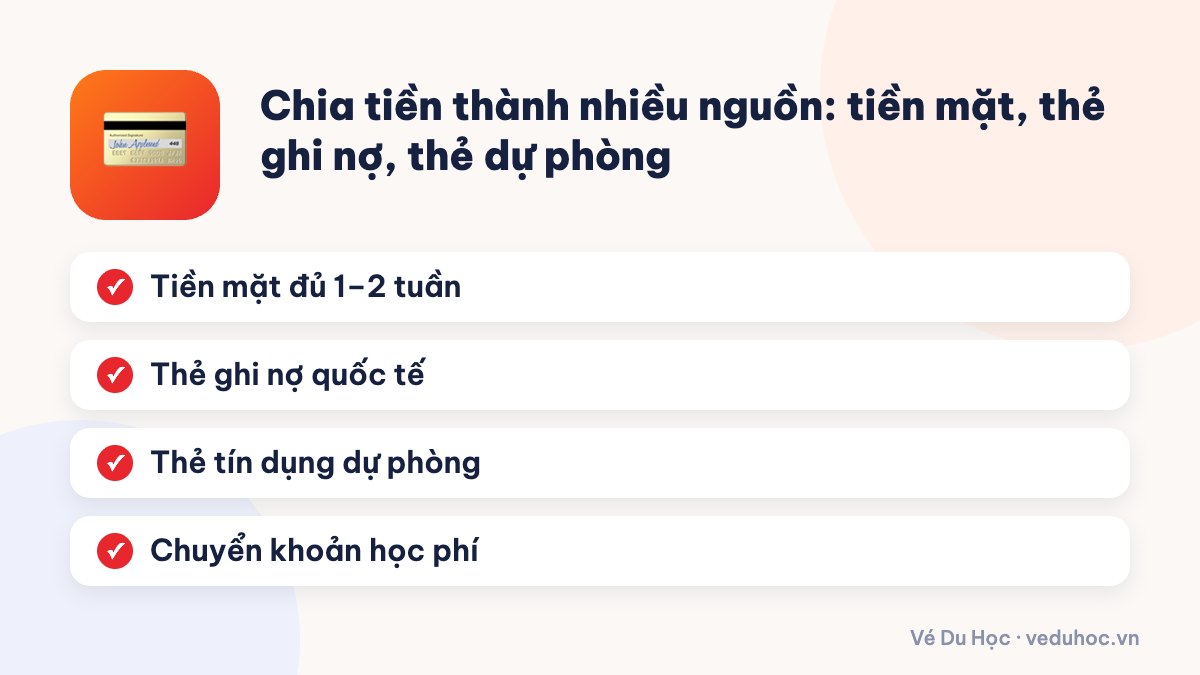
- Local cash enough for the first 1–2 weeks: take a taxi/train from the airport, buy a SIM, basic appliances, small deposit. Usually a few hundred to about 1,000 units of the destination currency is enough, depending on the city.
- International debit card (Visa/Mastercard debit) linked to a foreign currency or VND account: used for daily expenses until a local bank account is opened.
- Backup credit card (can be a parent's secondary card): used for emergency situations such as booking a hotel or buying a change ticket.
- Transfer money for tuition, housing, dormitory deposits.
Note when using the card abroad
- Tell your bank the schedule or turn on international payment mode on the app so your card is not locked.
- Ask clearly about foreign currency conversion fees (usually calculated as a percentage of the transaction) and foreign ATM withdrawal fees.
- When the POS asks to pay in VND or local currency, you should choose the local currency to avoid unfavorable dynamic conversion rates.
- Store the emergency card lock hotline number in a separate place from your wallet.
Once settled, open a bank account in your home country to receive money and pay cheaper living expenses - see article Open a bank account, buy insurance, register with a doctor. To plan spending each month, article Personal financial management for international students will be helpful.
Keep your money safe on the fly
Cash, cards, and passports should always be in your hand luggage, especially when transiting through multiple airports. Some practical experiences:
- Take a photo of the front of the card (cover the CVV number) and save the bank hotline number on your personal email.
- At transit airports, currency exchange is limited; Only buy essential items with a card.
- Be careful of strangers asking to pawn items or "change money for you".
- Parents should know how much money their children bring and how to contact them in case of an incident.
Một chuyến bay được lên kế hoạch tốt cũng giúp bạn đỡ phát sinh chi phí ngoài dự kiến. Đội ngũ hơn 30 Booker của Vé Du Học so sánh giá nhiều hãng, tối ưu hành lý ký gửi 40kg hoặc 2 kiện 23kg và kiểm tra yêu cầu visa quá cảnh trước khi xuất vé; nếu sau khi bạn đã thanh toán mà tìm được giá tốt hơn, HVSC chuyển khoản hoàn lại phần chênh lệch. Bạn có thể tham khảo dịch vụ air tickets to study abroad or read more Transit experience when flying to study abroad.
Frequently asked questions
Does carrying $5,000 in cash have to be declared?
According to Circular 15/2011/TT-NHNN, only when carrying over 5,000 USD (or equivalent) is required to declare. Carrying exactly 5,000 USD is not required, but you should check current regulations before flying.
Should we bring tuition fees in cash to school?
Shouldn't. Tuition fees should be transferred directly to the school via bank for documents, better exchange rates and more safety.
Can domestic debit cards be used abroad?
Domestic cards usually cannot be used. You need a card with Visa, Mastercard, JCB logo... with international payment enabled.
Is it beneficial to exchange money at foreign airports?
Usually not, because the exchange rates and fees at airport money exchange counters are often poor. You should only exchange a small amount if absolutely necessary.
Preparing your finances clearly is as important a step as booking tickets and applying for a visa. If you need advice on flight schedules, luggage or documents, please contact VeDuHoc via hotline/Zalo 090.1800.918 or see more section Frequently asked questions about studying abroad.
Reference source
- LuatVietnam – Procedures for bringing cash when entering and exiting the country (Circular 15/2011/TT-NHNN)
- Monetary and Financial Market – Limit of foreign currency allowed to be carried abroad by individuals
- USA.gov – How much money can you bring into and out of the U.S.
- AUSTRAC – Moving money across international borders
Booker HVSC gives a free quote in 15 minutes, Zalo reports take-off and landing for the whole family.
📚 Articles on the same topic
 Study abroad handbookSim, eSIM and internet when you first arrive abroad09/07/26 · 7 phút đọc
 Documents & student visaChecklist of complete study abroad documents: documents need to be prepared in each stage09/08/25 · 6 phút đọc
 Study abroad handbookEntering Australia, USA, Canada: customs declaration and things not allowed to bring03/08/21 · 6 phút đọc
 Study abroad handbookWhat should parents prepare when their children study abroad?13/06/21 · 7 phút đọc
 Study abroad lifeIndependent skills are needed before studying abroad03/11/18 · 6 phút đọc
 Study abroad handbookPick up at the airport and accommodation in the first days: prepare before flying18/09/17 · 6 phút đọc
🔥 Read a lot
- Master's scholarships: strategies for choosing majors, choosing schools and contacting professors
- Hành lý ký gửi chặng quốc tế cho du học sinh: kiện hay cân, 40kg hay 2 kiện 23kg và mẹo đóng vali
- Why should study abroad centers have specialized airline ticket partners?
- Choosing a reputable dispatching company: signs to recognize and avoid scams
- Scholarships to study in Australia at high school and preparatory levels: opportunities for students in grades 10–12


 ▶
▶ ▶
▶ ▶
▶ ▶
▶ ▶
▶ ▶
▶ ▶
▶