
🔄 Cập nhật lần cuối: 08/10/26

Flying in transit for the first time is a worry for many international students: the airport is large, the signs are all in foreign languages, the connecting time is short, and traveling alone. The good news is that the transit process at international airports is quite similar. If you prepare in advance, you will find it much simpler. This article provides step-by-step instructions, from booking a ticket to boarding the next flight.
Before flight: 4 things to check
1. Transit visa
This is the most important thing. Each country has its own regulations, depending on your nationality, whether you leave the transit area, and the visas you hold:
- USA: there is no “no-entry” international transit zone. Passengers connecting flights in the US must go through immigration control, so they need a suitable visa (transit visa or other valid US visa).
- UK: there are two types of transit visa without border control (Direct Airside Transit) and transit visa with border crossing, leaving the UK within 48 hours (Visitor in Transit). Some documents such as ETA or valid visit visa may be waived. Check by nationality on GOV.UK.
- Canada, Schengen area and other connecting points: regulations vary by nationality and documents. Some places require an airport transit visa, some places exempt people with valid visas from some countries.
See more Transit when flying to study abroad and the papers section on the page Q&A.
2. Connection time
Minimum connecting time (MCT) is determined by each airport. For first-time flyers, you should choose an itinerary with a comfortable connection time, usually 2-3 hours or more for international flights, especially when you have to go through immigration or change stations.
3. One ticket or two separate tickets?
You should book one ticket (one booking code) for the entire journey. At that time, if the first leg is late, the airline is responsible for arranging a replacement flight. With two separate tickets, you do so at your own risk and often have to pick up and return your luggage yourself.
4. Can luggage be delivered directly?
When checking in in Vietnam, ask the baggage staff if you can transfer directly (through check-in) to the final destination, and check the airport code on the luggage tag. Note: when connecting to the US or Canada, you usually have to pick up your luggage at the first airport of entry, go through customs and then send it back.
First transit flight: step by step at the connecting airport
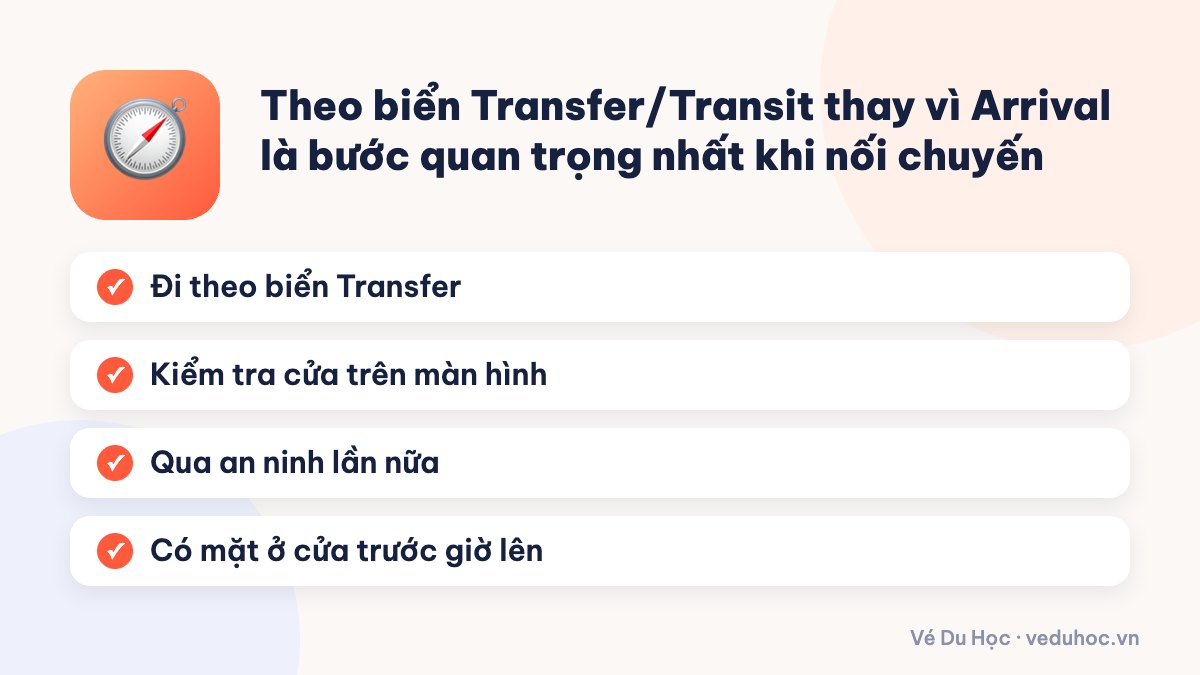
- Landing and getting off the plane: bring enough carry-on baggage and documents. Check your seat again before leaving the plane.
- Follow the "Transfer", "Transit" or "Connecting Flights" signs, do not follow the "Arrival", "Baggage Claim" signs (unless entry is required, like in the US).
- View the flight information screen: find the next flight number to know the gate and boarding time. Doors may change, so check back a few times.
- Pass through transit security check: prepare to put laptop and liquids on the tray. Note that liquids purchased at duty-free shops in the previous leg may be retained if they are no longer properly sealed.
- Receive your boarding pass at the transfer counter if it has not been printed from Vietnam.
- Arrive at the plane gate at least 30–45 minutes before boarding time. Large airports may require internal trains between terminals.
| Signboard | Meaning |
|---|---|
| Transfer / Connecting Flights | Aisle for connecting passengers |
| Arrivals / Immigration | Enter that country |
| Baggage Claim / Reclaim | Baggage claim conveyor |
| Gate/Boarding | Airplane gate, boarding time |
| Transfer Desk | Support counter for connecting flights, printing boarding passes, and changing flights |
When the first flight is late or misses a connecting flight
- Notify the flight attendant before landing; Many companies will support first-in priority or announce new doors.
- Go immediately to the airline's Transfer Desk to get an alternative flight (if it's the same ticket).
- Ask about luggage: can it be transferred to a new flight or must it be returned?
- Notify your family and the person picking you up; Save invoices for incurred accommodation expenses.
See details Missed flight, lost luggage when studying abroad.
Tips for international students traveling alone
- Take screenshots of tickets, boarding passes, connecting airport diagrams (save offline).
- Bring a pen to fill out the immigration declaration, if the destination country still uses paper declarations.
- Fully charge your phone, bring a spare charger (keep it in your carry-on), pre-install airport wifi or eSIM. See SIM, eSIM when arriving abroad.
- Ask staff wearing airline or airport uniforms when in doubt; Don't ask strangers to hold things.
- Drink water and do light exercise when connecting on a long flight. See How to prevent fatigue when flying long distances.
Parents can track their child's journey according to the instructions at Parents track flights via Zalo. Young students see more First time flying alone to study abroad.
Frequently asked questions
Does transit require a visa?
Depending on the transit country, nationality and documents you have. The US requires immigration so you need a suitable visa; UK, Canada, Schengen have their own regulations. Always check before booking.
Is it possible to make a connecting flight in 1 hour?
If the ticket is the same and the airport allows it, the airline has calculated the minimum connection time. But for those flying for the first time and carrying a lot of hand luggage, you should choose more time.
Can I go outside the airport during a long transit?
Only if you are eligible to enter that country (visa or visa-free) and have enough time to return to complete the procedure. International students should not take risks.
Is carry-on baggage checked again?
Have. Most airports have security checks again during transit, so comply with liquid regulations from the start.
Your first transit flight will be easy if you prepare carefully and choose a reasonable itinerary. If you need advice on flights and transit visas, please send a request on this page air tickets to study abroad.
Booker HVSC gives a free quote in 15 minutes, Zalo reports take-off and landing for the whole family.
📚 Articles on the same topic
 Study abroad handbookExit procedures at Vietnam airport for international students28/03/26 · 6 phút đọc
 Study abroad lifeFirst day at school: orientation and things to do20/12/24 · 6 phút đọc
 Study abroad lifePersonal financial management for international students: create a monthly budget08/09/24 · 6 phút đọc
 Study abroad lifeStaying in touch with family while studying abroad: tools and habits21/01/24 · 6 phút đọc
 Study abroad handbookOne-way or round-trip tickets when studying abroad: cost analysis30/11/23 · 6 phút đọc
 Study abroad lifeSafety when studying abroad: avoiding scams and common risks19/08/23 · 8 phút đọc
🔥 Read a lot
- International checked baggage for international students: pieces or scales, 46kg and tips for packing suitcases
- Master's scholarships: strategies for choosing majors, choosing schools and contacting professors
- Why should study abroad centers have specialized airline ticket partners?
- Choosing a reputable dispatching company: signs to recognize and avoid scams
- Stipendium Hungaricum Scholarship: full study abroad in Hungary




 ▶
▶ ▶
▶ ▶
▶ ▶
▶ ▶
▶ ▶
▶ ▶
▶