
🔄 Cập nhật lần cuối: 08/10/26

Flying alone to study abroad for the first time is a big milestone for both students and parents. The child was excited but also worried, and the parents stayed up watching each flight. Most anxiety comes from "not knowing what will happen". This article helps both sides prepare specifically for a safe and smooth first flight.
What do parents need to do before the flight?
Choose an itinerary suitable for your child's age and experience
- Few connections: direct flights or just one connection, comfortable connection time.
- Landing during the day: easy to find your way, easy to contact the person picking you up.
- One ticket for the entire journey: supported by the airline if you miss your connection.
- Check the policy for children traveling alone: each airline has a mandatory age or optional minor (unaccompanied minor) service, and may limit some connections. See Book air tickets for international students under 18 years old.
Prepare documents and finances
- Sort of one profile cover Put in your child's backpack: passport, visa, admission letter, CoE/I-20/CAS, insurance, accommodation confirmation, pick-up information. Students under 18 years old bring additional guardianship documents (see Study abroad documents for students under 18 years old).
- Scan all documents, save to the cloud and share with both parties.
- A little foreign currency cash and an activated international payment card.
Practice with your child
Look at the diagram of the transit and arrival airports with your child, and read out important signs (Transfer, Arrival, Baggage Claim). Role play answering the immigration officer's questions: where to study, where to stay, who will pick you up. These little things help your child calm down a lot.
What do students need to know when flying alone to study abroad for the first time?
| Time | Things to do |
|---|---|
| At Vietnam airport | Show up early, check in, ask if your luggage will be transferred directly, go through immigration and security. See Immigration procedures at Vietnam airport |
| On the plane | Keep your documents with you, drink enough water, sleep according to your destination, fill out the immigration declaration (if any) |
| Transit | Follow the Transfer sign, check the boarding gate, and be there early. See first transit flight |
| Entry | Answer briefly and honestly; Correct customs declaration. See Immigration to Australia, USA, Canada |
| Go to arrival hall | Meet the pick up person at the meeting point; If you haven't seen it yet, stay in the airport area and don't follow strangers offering it |
"Small but powerful" skills
- Know how to ask for help in simple English; Priority should be given to staff wearing uniforms.
- Do not accept to hold other people's luggage or leave your belongings unattended.
- Know how to use airport wifi and have an eSIM or SIM card available.
- Write down the emergency phone number on paper in case your phone runs out of battery.
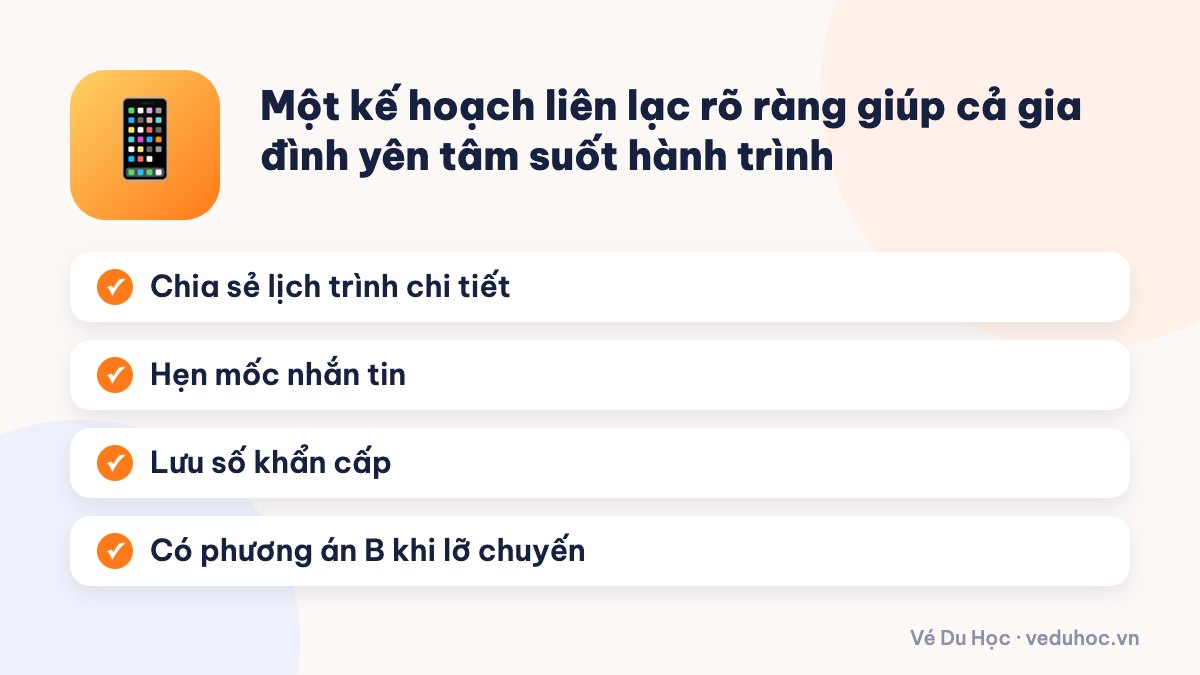
Communication plan on the day of the flight
- Unify message milestones: after exiting the country, when landing at the transit point, when arriving at the next flight gate, when landing at the final destination, when meeting the pick-up person.
- Parents can track flights via the airline's app or website; reference Parents track flights via Zalo.
- Agree in advance: if there is no news after X hours, who will the parents contact (airline, pick-up person, school).
- Save the numbers of the pick-up person, school, homestay, citizen protection hotline of the Ministry of Foreign Affairs and the Vietnamese Embassy in the destination country.
Handling problems when encountering problems
- Missed connection: go to the airline's Transfer counter and immediately text your family and the person picking you up.
- Lost luggage: declare at the lost baggage counter before leaving the airport, keep the receipt. See Missed flight, lost luggage.
- Lost passport or wallet: report to airport staff or police, contact Vietnam Embassy.
- No pick-up person: in the public area of the airport, call the pick-up person and the school; Don't get into a stranger's car.
- Sick on the plane: notify the flight attendant immediately.
Parents who want to be more prepared can read What should parents prepare when their children study abroad?.
Frequently asked questions
Can a 16 year old child fly internationally on their own?
Many companies allow it, but age and conditions vary, some companies require additional documents or recommend using support services. Please check before booking.
Can parents see their children off at the door of the plane?
Usually no, parents just drop off at the check-in area. With the unaccompanied child service, airline staff will guide the handover process.
Should I choose a night or day flight?
Flying at night helps you sleep on the plane, but daytime landing time at the final destination should be prioritized.
Should I buy travel insurance for my flight?
You should check the effective date of your study abroad insurance. If your itinerary is not covered, you can consider additional travel insurance for risks such as delayed flights and lost luggage.
The first solo flight is an important step in your child's maturity. With a clear plan and a trustworthy companion, the whole family can rest assured. Submit a request on the page air tickets to study abroad for advice on suitable itineraries.
Reference source
Booker HVSC gives a free quote in 15 minutes, Zalo reports take-off and landing for the whole family.
📚 Articles on the same topic
 Study abroad handbookExit procedures at Vietnam airport for international students28/03/26 · 6 phút đọc
 Study abroad handbookHelp your child choose a major and a suitable country to study abroad10/02/25 · 7 phút đọc
 Study abroad lifeFirst day at school: orientation and things to do20/12/24 · 6 phút đọc
 Study abroad lifePersonal financial management for international students: create a monthly budget08/09/24 · 6 phút đọc
 Study abroad handbookWhen children encounter problems abroad: what parents need to do28/05/24 · 7 phút đọc
 Study abroad lifeStaying in touch with family while studying abroad: tools and habits21/01/24 · 6 phút đọc
🔥 Read a lot
- Master's scholarships: strategies for choosing majors, choosing schools and contacting professors
- International checked baggage for international students: pieces or scales, 46kg and tips for packing suitcases
- Why should study abroad centers have specialized airline ticket partners?
- Choosing a reputable dispatching company: signs to recognize and avoid scams
- Scholarships to study in Australia at high school and preparatory levels: opportunities for students in grades 10–12




 ▶
▶ ▶
▶ ▶
▶ ▶
▶ ▶
▶ ▶
▶ ▶
▶