
🔄 Cập nhật lần cuối: 08/10/26

What is vocational study abroad and should I choose vocational study abroad instead of studying abroad at university? This is a question many families ask when considering costs, time and job opportunities abroad. The article explains the nature of vocational study abroad, compares it in detail with studying abroad at university, and points out the risks you need to know so you can make a conscious decision.
What is vocational study abroad?
Vocational study abroad is a form of going abroad to study a vocational education and training program to obtain a certificate or vocational degree recognized in that country, instead of a bachelor's degree. The program focuses on practical skills for a specific profession such as nursing, mechanical, electrical, restaurant - hotel, chef, child care, applied information technology.
Need to distinguish clearly: vocational study abroad still go to school, participants have trainee/student status with a training visa or study visa. It is different from labor export or technical intern trainee programs, where the main purpose is to work under a contract (see article Japanese technical intern trainee and Tokutei special skills to see the difference).
Popular vocational study abroad models
Germany: dual vocational training (Ausbildung)
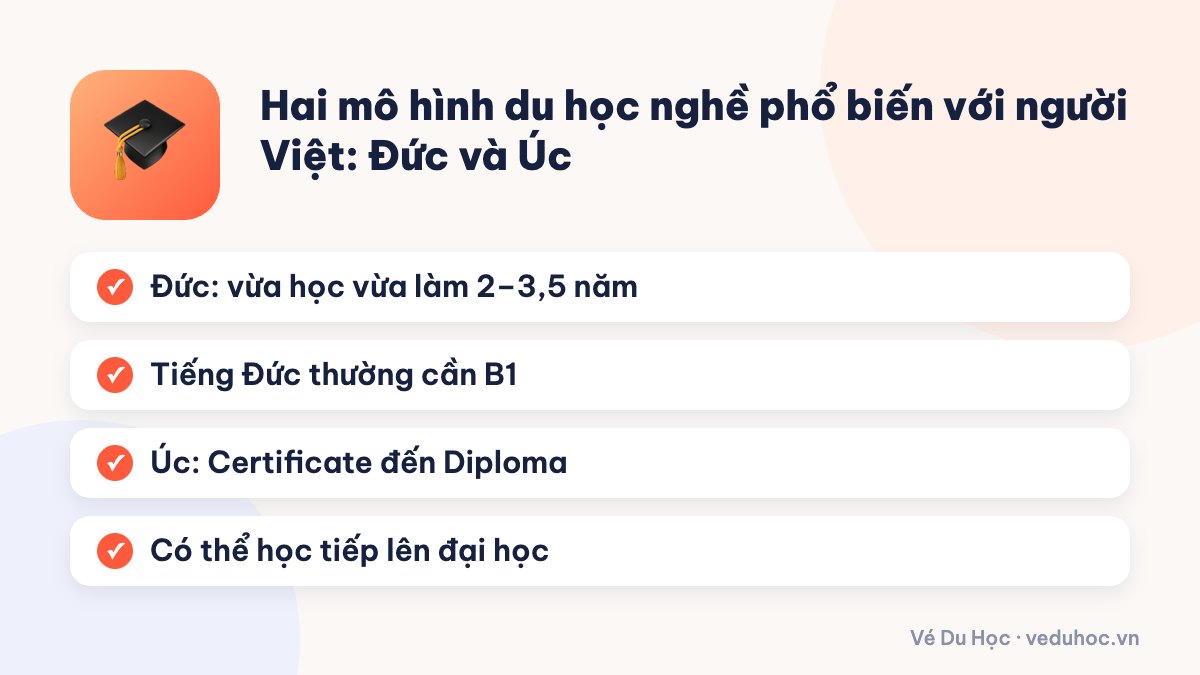
In Germany, a popular model is dual vocational training: students both study theory at vocational schools and work at enterprises that have signed training contracts, usually lasting 2–3.5 years. According to the official portal Make it in Germany, applicants for a vocational training visa usually need a good level of German B1 (unless the business has self-assessed its language capacity) and demonstrated sufficient finances; For in-company training, the training allowance must meet the minimum level prescribed by Germany each year. The big advantage is that students have a monthly allowance, but the actual amount received after taxes and insurance is significantly lower than the "brutto" amount on the contract. See article for details European labor: Germany, Poland, Hungary and German student visa.
Australia: VET and TAFE systems
Australia has a vocational education system (VET) with Certificate I–IV, Diploma and Advanced Diploma levels. According to Study Australia, Certificate III usually takes about 1 year, Diploma 18–24 months, Advanced Diploma 24–36 months. Training units include public TAFE institutes, private training establishments (RTOs) and "dual system" universities. Diploma and Advanced Diploma degrees can be recognized as credits when continuing to university. See more Vocational study abroad in Australia (VET).
Other countries
Canada has a college system that trains vocationally oriented certificates and diplomas; Japan has specialized schools (senmon gakko) after learning the language; Korea, Finland, Netherlands... also have vocational training programs for foreigners with their own language conditions.
Compare vocational study abroad and university study abroad
| Criteria | Vocational study abroad | Study abroad at university |
|---|---|---|
| Target | Practical skills for a specific profession | Foundational knowledge, academics, research |
| Time | A few months to about 3.5 years depending on the country/level | Bachelor's degree usually lasts 3–4 years |
| Input | Usually graduated from high school, average foreign language level (eg B1 German) | Good academic performance, higher IELTS/foreign language, may require preparation |
| Cost | Lower; Some models (German) have training subsidies | International university tuition fees are often higher |
| Practice | A lot, tied to business | Depending on the industry, usually through internship |
| Degree | National vocational certificate/diploma | Bachelor's degree, can go straight to master's degree |
| Opportunity to return home | Good if the profession has a need; Occupational degrees are sometimes little known | University degrees are more easily recognized |
There is no absolute “better” option. Studying abroad saves time and money, bringing you into the labor market quickly; Studying abroad at university expands long-term career options and makes it easier to continue studying. You can refer Cost of studying abroad in other countries to compare budgets.
Who is suitable for vocational study abroad, who should study at university?
You should consider studying abroad if you are interested
- Prefers manual, hands-on work over theoretical research.
- Have clearly identified the profession you want to pursue (nursing, mechanical engineering, restaurant - hotel...).
- Want to be financially independent soon, family budget is limited.
- Be ready to study foreign languages seriously before leaving (especially German and Japanese).
You should choose to study abroad at university if you
- If you want to pursue a major, you need a bachelor's degree or higher (medicine, law, engineering, research...).
- Have good academic performance and have the ability to hunt for scholarships.
- Want to keep many career options or study for a master's or doctorate.
Risks you need to be wary of when studying abroad
Vocational study abroad has many real opportunities, but it is also a land of brokers who lack transparency. A VnExpress report on vocational study abroad in Germany cited research showing that many Vietnamese students pay thousands to tens of thousands of euros in brokerage fees, are falsely advertised about their income, face difficulties because their German is weaker than the certificate level, and do not know their rights. Points to note:
- Unusual brokerage fees: Find out reasonable costs and ask for clear contracts and invoices. See article How to choose a reputable company.
- Real foreign language ability: don't just study to get a certificate; Weak language is the leading reason why students drop out.
- Understand income correctly: calculate housing, insurance, and transportation costs compared to actual benefits received.
- Know your rights: save the contact number of the Vietnamese representative agency, trade union or labor support organization in the host country.
Once you have a visa, you should book tickets through a clear unit with a VAT invoice instead of letting a broker "package" the tickets at an unclear price. VeDuHoc's team of more than 30 Bookers hunts for multi-carrier tickets, optimizes checked baggage of 40–46kg for long-term travelers, checks transit visas and provides 24/7 support; If a better price is found after you have paid, HVSC will refund the difference. Reference Airplane tickets to work or study abroad.
Frequently asked questions
Is studying abroad a labor export?
Are not. Vocational study abroad means going to school to get a vocational degree, participants bring a training/study abroad visa. However, in a dual model like Germany, students both study and work at the enterprise, so it is easy to get confused.
Does studying abroad in Germany require financial proof?
Have. For in-company training, the training allowance must meet the minimum threshold; With school training, it often has to be proven by a blocked account, scholarship or guarantee commitment. Specific levels change every year, please check the official page.
After completing vocational training, can I continue studying at university?
Usually yes. In Australia, Diploma and Advanced Diploma degrees can be recognized as credits when transferring to a bachelor's degree; In Germany, people with vocational degrees and experience also have a path to university according to each state's regulations.
Is a foreign vocational degree in Vietnam valid?
Value depends on the profession and employer. Practical skills and foreign languages are often highly appreciated by FDI enterprises, but you should learn about market needs before choosing a career.
Vocational study abroad is an option worth considering if you are clear about the career you want and are willing to seriously invest in foreign languages. Please research carefully from official sources, choose a transparent unit, and when ready to travel, contact VeDuHoc via hotline/Zalo 090.1800.918 for advice on appropriate tickets and luggage.
Reference source
Booker HVSC gives a free quote in 15 minutes, Zalo reports take-off and landing for the whole family.
📚 Articles on the same topic
 Study abroad handbookHelp your child choose a major and a suitable country to study abroad10/02/25 · 7 phút đọc
 Study abroad scholarshipVocational study abroad in Germany (Ausbildung): salary, free tuition - is it a "scholarship"?08/06/22 · 7 phút đọc
 International laborChoosing a reputable dispatching company: signs to recognize and avoid scams24/11/19 · 7 phút đọc
 International laborSpecified skills (Tokutei) Japan: conditions and opportunities04/11/23 · 10 phút đọc
 International laborReturning home after the labor contract: booking tickets, luggage and procedures29/07/22 · 7 phút đọc
 International laborAirport handbook for workers and trainees going to Japan, Korea, and Taiwan for the first time03/10/26 · 2 phút đọc
🔥 Read a lot
- International checked baggage for international students: pieces or scales, 46kg and tips for packing suitcases
- Master's scholarships: strategies for choosing majors, choosing schools and contacting professors
- Why should study abroad centers have specialized airline ticket partners?
- Choosing a reputable dispatching company: signs to recognize and avoid scams
- Stipendium Hungaricum Scholarship: full study abroad in Hungary




 ▶
▶ ▶
▶ ▶
▶ ▶
▶ ▶
▶ ▶
▶ ▶
▶