
🔄 Cập nhật lần cuối: 08/10/26

Vocational study abroad in Germany Ausbildung is often introduced as a "paid, tuition-free scholarship". This name is easy to understand but not entirely accurate: Ausbildung is a vocational training contract between you and a German business, in which you are paid a monthly training allowance. The article helps you understand the correct mechanism, conditions, actual costs and points to be wary of.
What is Ausbildung? Is it a scholarship?
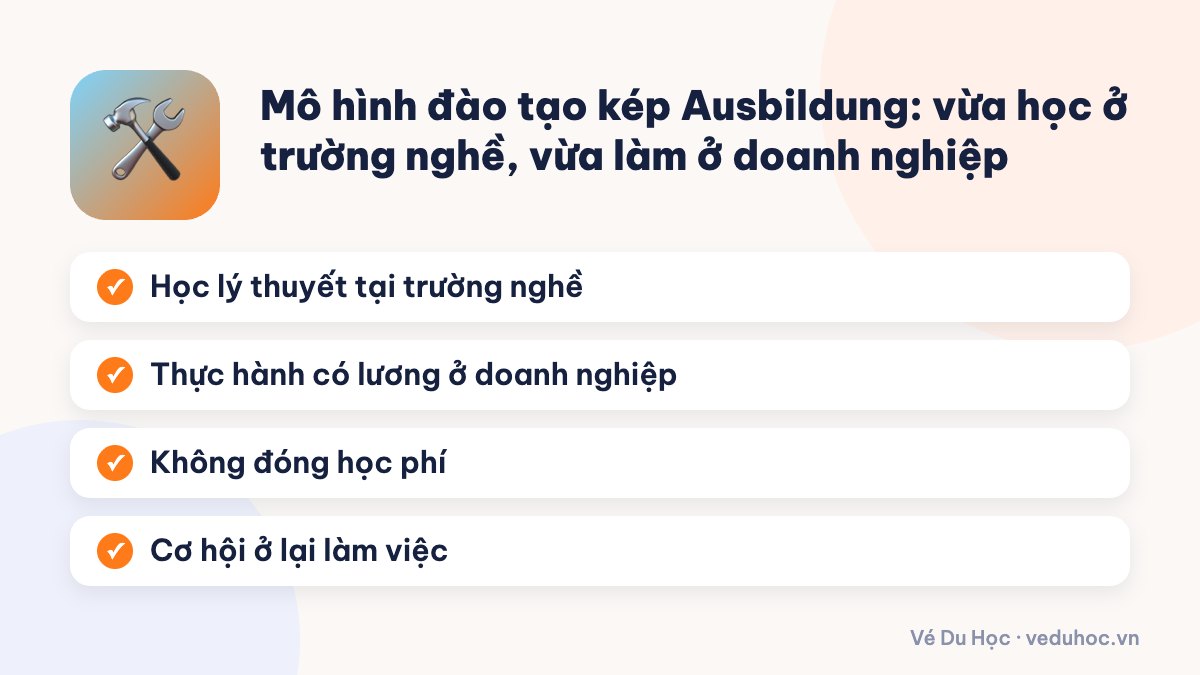
Ausbildung is Germany's vocational training system, the most popular is the dual training model (dual Ausbildung): you study theory at a vocational school (Berufsschule) part of the time, and the rest of the time you work and practice at an enterprise. The training period is usually from 2 to 3.5 years depending on the profession, ending with an exam before the industry-commerce department, craft department or competent agency.
Because public vocational schools do not charge tuition and businesses pay training allowances, many people call this a "scholarship". In fact, you are not considered for a scholarship Sign a training contract with a business, it's like applying for a job. In addition to the dual model, there is also Ausbildung at school (schulische Ausbildung), some of these occupations do not have allowances, and there are even private schools that charge fees. Understanding this difference helps you avoid false expectations. For overall comparison, see further articles What is vocational study abroad and how is it different from studying abroad at university?.
Vocational training salary and tuition fees: actual numbers
Germany has regulations on minimum training allowances (Mindestausbildungsvergütung) for training according to the Vocational Training Law. According to the Federal Institute of Vocational Training (BIBB), with the contract starting in 2026, the minimum level for the first year is 724 euros/month and gradually increases in the following years. Many industries have salary agreements so the actual level is higher, for example nursing, mechanical engineering, and electrical work often pay higher than the floor level. Note that this is before taxes and insurance.
| Item | Reality needs to be known |
|---|---|
| Tuition fees for public vocational schools | No tuition fees |
| Training allowance | According to the contract; not lower than the legal minimum level (with training under the Vocational Training Law) |
| Social and health insurance | Deducted from the allowance, the enterprise pays its share |
| Living expenses | Housing, meals, and transportation are paid by yourself; In big cities costs are significantly higher |
| Initial costs in Vietnam | Learn German, take certification exams, translate documents, visas, and airline tickets |
According to the German Government's Make it in Germany page, with in-company training, vocational training salaries reaching a certain threshold (announced for 2026 about 1,048 euros gross or 822 euros net/month) are considered sufficient financial proof; If it is lower, you must make up the difference with a blocked account or guarantee commitment. This number is adjusted annually. Learn more in the article German student visa and blocked account.
Conditions for vocational study abroad in Germany Ausbildung
- German: usually requires about level B1; Some industries such as nursing or specific businesses may have higher requirements.
- High school degree suitable to the requirements of the profession; Vietnamese high school diplomas are often accepted for many majors.
- Training contract with an enterprise or confirmation of a place to study at a vocational school.
- Proof of finances as described above.
- Valid health insurance when traveling to Germany.
Vocational training visas do not have a fixed age limit on the Make it in Germany page, but the visa to Germany to find a vocational training place applies to people under 35 years old. During your apprenticeship, you can work up to 20 hours/week in other jobs, independent of training.
Process from Vietnam to Germany
- Learn German up to B1 (usually 8–12 months if studying intensively) and take recognized certificates such as Goethe, telc, ÖSD.
- Choose a profession: nursing, restaurant - hotel, mechatronics, construction, logistics... should choose according to capacity and market demand. See suggestions here Choose a study abroad major with job opportunities.
- Find a business and interview: through the job portal of the German Federal Labor Agency, Make it in Germany or a reputable intermediary.
- Translation and legalization of documents at the request of the Embassy. Refer to the article Translation and notarization of study abroad documents.
- Submit your vocational training visa application at the German Embassy or Consulate General; For in-company training, the Federal Labor Agency will approve it internally.
- Book tickets, prepare luggage and enroll on the date stated in the contract.
Important notes and risks
- Be wary of "visa protection" commitments or the package cost is too high. No one can guarantee visa results. Read more Signs of a reputable dispatching company.
- Read the training contract carefully: allowance level, probationary period, working hours, days off.
- Psychological preparation: practical work from the beginning, cold climate, specialized language more difficult than level B1 in class.
- After graduating, you can stay for up to 18 months to find a suitable job according to current regulations, and have the opportunity to apply for permanent residence if you meet the conditions.
VeDuHoc has a team of more than 30 Bookers hunting for multi-carrier tickets to Germany, optimally supporting checked baggage of 40–46kg for people carrying a lot of belongings for the first year, checking transit regulations and sending itinerary information via Zalo to the family. You can refer to the service Labor plane tickets, vocational study abroad.
Frequently asked questions
Do I have to pay tuition to study abroad in Germany?
Public vocational schools in the dual training model do not charge tuition. However, you pay your own preparation costs in Vietnam and living in Germany; Some private vocational schools charge fees.
Is the Ausbildung apprenticeship salary enough to live on?
In many industries, allowances are enough to cover expenses if spent reasonably, especially in small cities. In big cities, rent is high so you need to calculate carefully. If the allowance is lower than the prescribed threshold, additional finances must be provided when applying for a visa.
What level of German is needed?
Normally around B1; Nursing industry or some businesses may require B2. Please check the specific requirements in the contract.
Can I stay in Germany after Ausbildung?
Have. According to current regulations, you can stay and look for a job and switch to a work permit when there is a job suitable to the profession you have studied.
Ausbildung is a practical path for people who want to learn a profession and earn income right from studying. Prepare your German well, choose a reputable unit and have a clear financial plan. When you need flight tickets to Germany, contact VeDuHoc via hotline/Zalo 090.1800.918.
Reference source
Booker HVSC gives a free quote in 15 minutes, Zalo reports take-off and landing for the whole family.
📚 Articles on the same topic
 International laborWhat is vocational study abroad? Compare vocational study abroad and university study abroad07/03/25 · 8 phút đọc
 Study abroad scholarshipScholarships to study abroad in Spain and Portugal: new options in Southern Europe27/04/20 · 7 phút đọc
 Study abroad scholarshipScholarships to study in the Netherlands: Orange Knowledge (ended), NL Scholarship (Holland Scholarship) and school scholarship25/09/26 · 5 phút đọc
 Study abroad scholarshipScholarship interview: 30 frequently asked questions and how to score answers31/12/22 · 7 phút đọc
 Study abroad scholarshipScholarships to study in Canada at college level: co-op program and scholarships28/07/17 · 6 phút đọc
 Study abroad scholarshipRejected scholarship: analyze the reasons and prepare for the next round10/02/20 · 7 phút đọc
🔥 Read a lot
- International checked baggage for international students: pieces or scales, 46kg and tips for packing suitcases
- Master's scholarships: strategies for choosing majors, choosing schools and contacting professors
- Why should study abroad centers have specialized airline ticket partners?
- Choosing a reputable dispatching company: signs to recognize and avoid scams
- Stipendium Hungaricum Scholarship: full study abroad in Hungary





 ▶
▶ ▶
▶ ▶
▶ ▶
▶ ▶
▶ ▶
▶ ▶
▶