
🔄 Cập nhật lần cuối: 08/10/26

Vocational Education and Training in Australia (VET) - Vocational Education and Training - is a short-term, practical learning path that helps you have skills recognized according to Australia's national qualifications framework and can transfer to university. The article helps you understand the VET system, majors of interest, the roadmap from Vietnam to graduation and policy changes to keep in mind.
What is VET vocational study abroad in Australia?
VET is Australia's vocational education system, with competency-based training: students are evaluated based on what they can do, not just theoretical test scores. According to the Australian Government's Study Australia site, VET is taught by three types of institutions:
- TAFE – a public institution, is the largest VET system in Australia.
- Registered Private Training Institution (RTO).
- Dual sector university - both vocational training and university training.
All VET facilities must meet RTO standards and are monitored by quality regulator ASQA. For international students, the course must be CRICOS registered to be eligible for a student visa. If you are still confused between vocational training and university study, read the article Compare vocational study abroad and study abroad.
VET certification levels
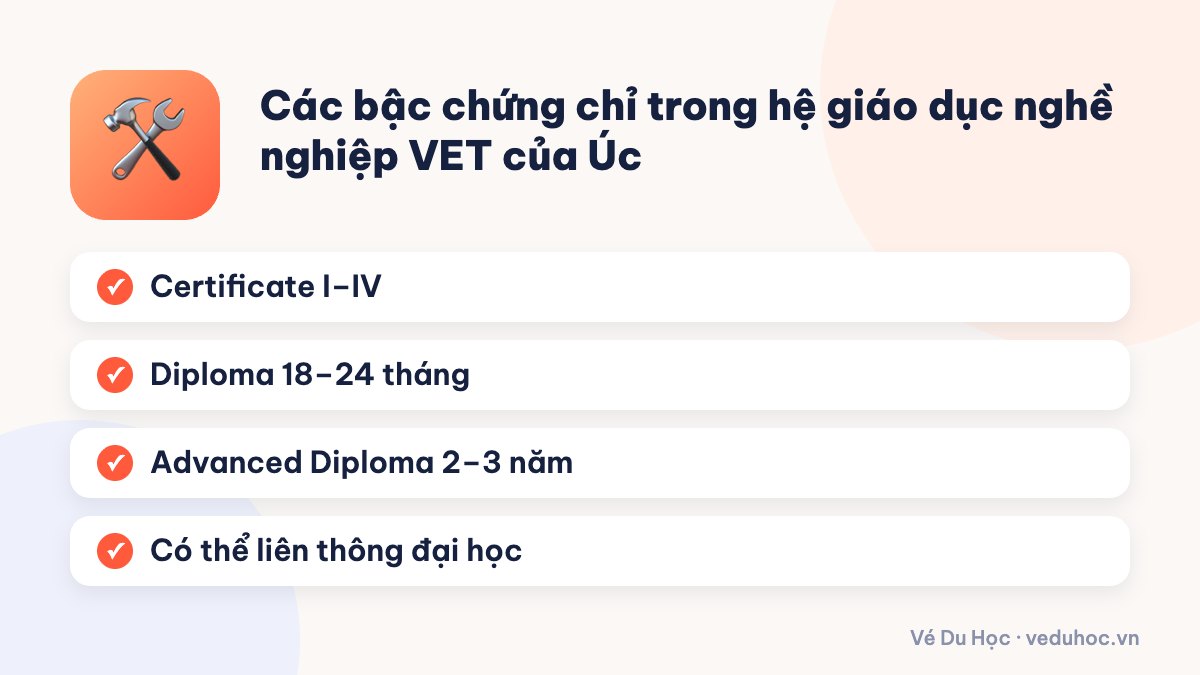
| Tier | Typical time | Career output |
|---|---|---|
| Certificate I | 4–6 months | Basic operation |
| Certificate II | About 1 year | Advanced operations |
| Certificate III | About 1 year | Skilled workers / technicians |
| Certificate IV | 12–18 months | Supervision |
| Diploma | 18–24 months | Semi-professional |
| Advanced Diploma | 24–36 months | Grassroots level management |
Source: Study Australia. International students often study from Certificate III or higher, many schools package 2-3 consecutive courses (eg Certificate III + IV + Diploma) to have enough study time and practice experience.
Hot industry when studying abroad in Australia
A "hot" industry is an Australian industry that has a persistent shortage of human resources, as shown by skills lists and labor market reports of Jobs and Skills Australia. Groups often chosen by international students:
- Care for the elderly and people with disabilities (Certificate III/IV in Individual Support / Aging Support): great demand due to aging population.
- Cooking - restaurant (Certificate III/IV in Commercial Cookery, Diploma of Hospitality Management): mandatory internship in commercial kitchen.
- Technician - construction: electrical, carpentry, plumbing, auto mechanics, welding - occupations that require a certificate and license to practice.
- Child care (Certificate III / Diploma of Early Childhood Education and Care).
- Information technology, business, accounting: usually Diploma level to transfer to university.
Note: the list of shortage occupations and settlement policies change each year. Don't choose an industry just because it's "easy to settle in" - choose an industry you can work in for a long time. Article Choose a major to study abroad that has job and settlement opportunities will help you consider more carefully. As for the health sector, please refer to Study nursing in Australia.
Australian vocational study abroad roadmap from A to Z
- Determine your goals and choose a major (6–12 months before admission). VET admission terms are quite flexible, many schools have 3–4 terms/year.
- English preparation: IELTS (or equivalent) required depending on course and whether ELICOS English course is included or not; The Australian Department of Home Affairs has increased the English requirement for student visas from 2024.
- Submit application, receive invitation letter and CoE after paying first installment of tuition and purchasing OSHC insurance.
- Apply for a student visa subclass 500: proof of finances, meeting Genuine Student criteria. See details at Australian student visa subclass 500.
- Book tickets, prepare luggage and enter the country 1–2 weeks before the first day of school.
- Study and practice: many courses have mandatory practice hours at businesses (work placement).
Costs, visas and overtime
- Tuition: VET is usually lower than university; There are large differences between TAFE and private RTOs and between sectors. Please request the official tuition schedule from the school.
- Proof of finances: The Australian Department of Home Affairs stipulates a minimum living allowance for one year (which has increased many times in recent years), plus first-year tuition and travel expenses.
- Subclass 500 visa fees: increased significantly from 2024–2025; Check current rates on immi.homeaffairs.gov.au.
- Work more: according to current regulations, students are allowed to work a maximum of 48 hours every 2 weeks during the semester and unlimited during vacations. See more work part-time while studying abroad.
After graduation: transfer and work visa
Diploma and Advanced Diploma can be exempted from credits when continuing to university. With a post-study temporary residence visa (subclass 485), the Post-Vocational Education Work category for vocational trainees requires: age 35 or under, have studied in Australia for at least 2 years (92 weeks) with a CRICOS course, a degree related to an occupation on the skills list, have English proficiency and have a skills assessment; submitted within 6 months after completing the course. The visa duration for this category is shorter than that for university graduates.
VeDuHoc has 30+ Bookers to hunt for multi-carrier tickets to Australia, continue to monitor prices even when prices are high and refund the difference if a better price is found after you pay. We optimize checked baggage of 40–46kg, check transit visas and send flight information to parents via Zalo. View page air tickets to study abroad for a quote.
Frequently asked questions
Does studying abroad in Australia require a high school diploma?
Most Certificate III courses and above require high school graduation (or equivalent) and 18 years of age; Specific conditions are determined by each school.
Is it better to study TAFE or private school?
TAFE has good reputation and facilities, tuition fees are usually stable; Private schools are more flexible about schedules. Whichever school you choose, check it has CRICOS registration and a history of compliance.
Can I settle down after studying VET?
VET can be a step on the settlement route if the industry is on the skills list and you meet the skills visa conditions. However, policies change frequently, no one can guarantee results.
Can I study and work at the same time to cover expenses?
You can work part-time within the allowed hours, but do not expect the part-time income to be enough to pay all tuition and living expenses.
Vocational study abroad in Australia is suitable for young people who like to practice and want to have a solid career soon. Plan your itinerary early, choose a reputable school - and when you have a visa, call VeDuHoc via hotline/Zalo 090.1800.918 for ticket advice.
Reference source
Booker HVSC gives a free quote in 15 minutes, Zalo reports take-off and landing for the whole family.
📚 Articles on the same topic
 International laborPrepare before flying to work abroad for the first time22/04/21 · 7 phút đọc
 International laborWhat is vocational study abroad? Compare vocational study abroad and university study abroad07/03/25 · 8 phút đọc
 International laborJapanese technical intern trainees: process, costs, notes and new replacement regime18/10/16 · 9 phút đọc
 International laborAirport handbook for workers and trainees going to Japan, Korea, and Taiwan for the first time03/10/26 · 2 phút đọc
 International laborChoosing a reputable dispatching company: signs to recognize and avoid scams24/11/19 · 7 phút đọc
 International laborSpecified skills (Tokutei) Japan: conditions and opportunities04/11/23 · 10 phút đọc
🔥 Read a lot
- International checked baggage for international students: pieces or scales, 46kg and tips for packing suitcases
- Master's scholarships: strategies for choosing majors, choosing schools and contacting professors
- Why should study abroad centers have specialized airline ticket partners?
- Choosing a reputable dispatching company: signs to recognize and avoid scams
- Stipendium Hungaricum Scholarship: full study abroad in Hungary





 ▶
▶ ▶
▶ ▶
▶ ▶
▶ ▶
▶ ▶
▶ ▶
▶