
🔄 Cập nhật lần cuối: 08/10/26
Unlike many countries, the process of applying for a student visa in Japan includes two separate steps: first is the Certificate of Eligibility (COE) issued by the Japanese immigration agency, then the visa is issued by the Japanese Embassy or Consulate General in Vietnam. Understanding these two steps helps you calculate time and prepare documents properly.
What is COE?
COE (Certificate of Eligibility – 在留資格認定証明書) is a certificate that you meet the conditions of the residence status “Study Abroad” (留学). According to the Japanese Immigration and Residency Administration, the COE application is submitted at the immigration bureau of the area where you intend to reside or where there is a reception facility; The submitter may be a foreign national or representative such as an employee of the receiving facility. For international students in Vietnam, Japanese schools (Japanese language schools, vocational schools, universities) often pay on their behalf.
Some points to know:
- Standard review time: about 1–3 months.
- Electronic COE: from March 17, 2023, COE can be sent via email; You present the electronic or printed copy when applying for a visa.
- Validity: COE is usually valid for 3 months from the date of issue, you need to enter Japan within this period.
- COE does not guarantee visas: according to the Japanese Ministry of Foreign Affairs, COE helps speed up visa processing and immigration checks, but does not guarantee visa issuance.
You can compare Japan's COE with Australia's CoE (completely different nature) in the article What are CoE, I-20, CAS.
Procedure for applying for a student visa in Japan
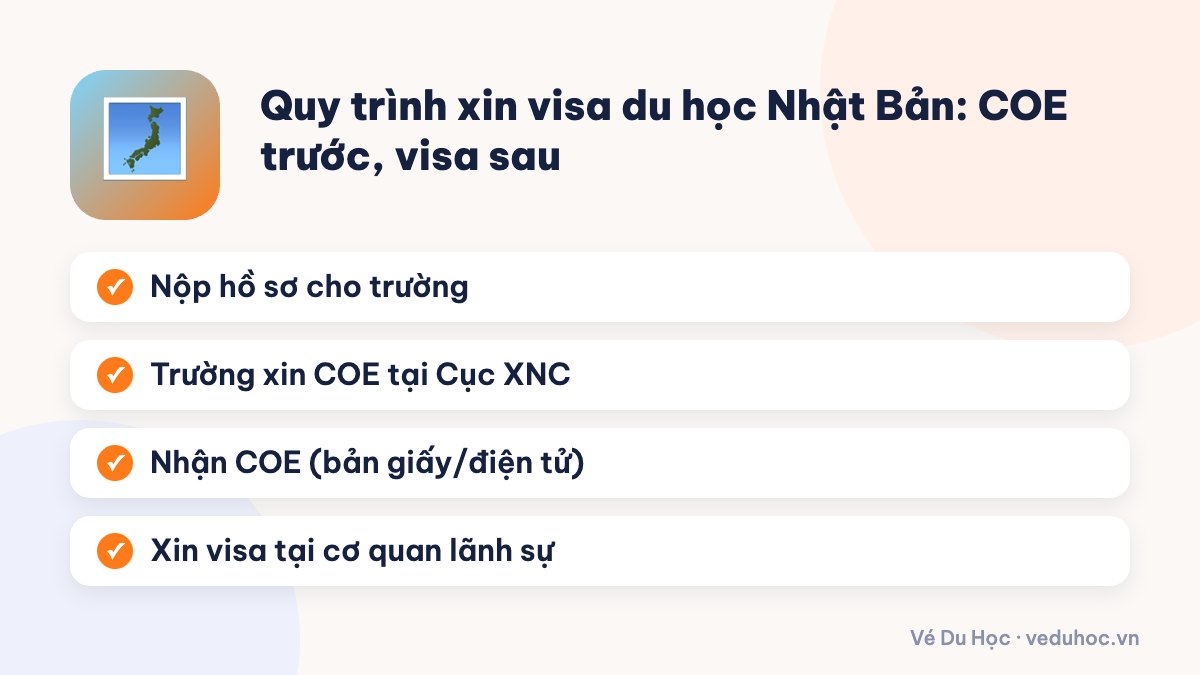
| Step | Content | Reference time |
|---|---|---|
| 1. Choose a school, submit your application | Submit personal, academic, and financial documents to the school; Interview, Japanese language test if any | About 5–8 months before admission |
| 2. School applies for COE | The school submits applications at the regional immigration department | Consider about 1–3 months |
| 3. Receive COE results, pay tuition | The school sends COE (paper or electronic) after you pay the required tuition | After getting the results |
| 4. Apply for a visa | Submit your passport, application, photo, COE to the Japanese consulate or designated agent | Usually a few working days if the documents are complete |
| 5. Immigration | Enter within the COE validity period, receive a residence card at major airports | Before admission day |
Japanese language schools usually have 4 admission terms (January, April, July, October), of which the April and October terms are the most popular. The application deadline is set by each school, usually much earlier than the admission date; see more Study visa processing time for different countries to plan. Refer to the general schedule in the article Admission schedule and ticket booking time.
What does a COE application usually include?
Specific requirements are prescribed by the school and the immigration department, but documents for Vietnamese international students usually include:
- Personal documents: admission application, passport, photo, birth certificate, residence documents.
- Educational records: diploma, transcript or transcript, Japanese language certificate (JLPT, NAT-TEST, J-TEST...) or confirmation of Japanese language study hours.
- Financial records: guarantee letter of the payer, confirmation of savings balance, confirmation of income, professional and business documents of the guarantor. See Proof of finances for studying abroad.
- Reason for studying abroad: study and career plans after graduation.
The integrity and consistency of records are important. Incorrectly declared information can cause the COE to be rejected and affect future submissions. If you plan to study while working, read more Study abroad in Japan while studying and working to have realistic expectations, or learn about funding sources in the article Scholarship to study abroad in Japan MEXT, JASSO.
After getting a visa: enter the country and work part-time
- Entry: bring passport with visa, COE (paper or electronic copy according to instructions). At major airports, you will be issued a residence card (在留カード).
- Register your address at the local administrative office within the prescribed period after obtaining a residence, and participate in national health insurance.
- Part-time work: international students need a permit to operate outside their status of residence (資格外活動許可), which is usually applied for at the airport upon entry. The general limit is 28 hours/week during school term and up to 8 hours/day during long scheduled school holidays; Do not work at prohibited entertainment establishments.
- Attendance: low attendance rate directly affects the extension of residence status.
Vietnam - Japan routes have many direct flight options, but during the admission season in April and October, ticket prices often increase. More than 30 VeDuHoc Bookers hunt for multi-carrier tickets, optimize checked baggage for international students, provide 24/7 support and send flight information to parents via Zalo. If a better price is found after you have paid, HVSC will refund the difference. See air tickets to study abroad.
Frequently asked questions
How are COE and Japanese student visa different?
COE is issued by the Japanese immigration agency, confirming your eligibility to study abroad. Visa is issued by the Japanese consulate in Vietnam, based on COE, allowing you to enter the country.
After having COE, are you sure you will get a visa?
Uncertain. COE helps the visa processing process faster, but the consulate still has the right to refuse if problems are detected in the application.
How long is the COE valid?
Normally 3 months from date of issue. You need to apply for a visa and enter the country during this time; If the deadline is over, the procedure must be repeated.
How many overtime hours can Japanese international students work?
According to general regulations, maximum 28 hours/week during the semester when you have a permit to operate outside your residence status; During long vacations according to the school schedule, you can work a maximum of 8 hours/day.
Visa to study in Japan is not difficult if you prepare honest documents and clearly understand the COE timeline. Work closely with the school and check the information on the Japanese consulate website. Once you have a visa, contact VeDuHoc via hotline/Zalo 090.1800.918 to book tickets.
Reference source
Booker HVSC gives a free quote in 15 minutes, Zalo reports take-off and landing for the whole family.
📚 Articles on the same topic
 Documents & student visaWhat are CoE, I-20, CAS? "Key" documents to apply for a visa12/03/24 · 5 phút đọc
 Study abroad scholarshipStudy abroad in Japan while studying and working: Japanese language school scholarships and costs26/03/16 · 9 phút đọc
 Documents & student visaChoosing a school to study abroad: rankings, majors and costs08/08/20 · 6 phút đọc
 Documents & student visaMedical examination for student visa: process and notes02/07/17 · 6 phút đọc
 Documents & student visaTime to consider student visas for different countries: how long in advance should you apply?25/12/18 · 7 phút đọc
 Documents & student visaStudying abroad after college while working: documents need to be prepared07/07/16 · 6 phút đọc
🔥 Read a lot
- International checked baggage for international students: pieces or scales, 46kg and tips for packing suitcases
- Master's scholarships: strategies for choosing majors, choosing schools and contacting professors
- Why should study abroad centers have specialized airline ticket partners?
- Choosing a reputable dispatching company: signs to recognize and avoid scams
- Stipendium Hungaricum Scholarship: full study abroad in Hungary




 ▶
▶ ▶
▶ ▶
▶ ▶
▶ ▶
▶ ▶
▶ ▶
▶