
🔄 Cập nhật lần cuối: 08/10/26

Should you study abroad on your own or through a counseling center is a question that most families consider at the beginning. Doing it yourself is proactive and saves service fees but takes a lot of effort. Going through the center is easier, but you need to choose the right trustworthy unit. This article analyzes the pros and cons of each method so you can decide what is right for your situation.
Correct understanding of "self-funded study abroad" and "through the center"
"Self-funded study abroad" is often understood in two senses: the family pays the costs themselves (no government scholarships), or prepares the application themselves without going through a consulting unit. In this article, we discuss the second meaning, that is, who makes the records.
- Do it yourself: students or parents find the school themselves, apply on the admission portal, prepare their own finances and visa documents.
- Through the center: the study abroad consulting unit (usually the school's admission representative) supports school selection, application submission, visa application and accompanying services.
In Vietnam, studying abroad consulting service business is a conditional profession. According to current regulations (Decree 125/2024/ND-CP), organizations must be granted a certificate of business registration for study abroad consulting services by the Department of Education and Training, and this information is publicly announced.
Compare studying abroad on your own or through a center
| Criteria | Make your own profile | Through the consulting center |
|---|---|---|
| Service costs | No service fees, only application fees, visa fees... | Many centers are free with partner schools (due to receiving commission from the school); There are places that charge a package fee or a service-based fee |
| School selection | There is no limit, you can submit yourself to any school | May be biased towards partner schools |
| Time, effort | A lot: researching, writing essays, filling out forms, keeping track of deadlines | Save money, have someone remind you of your schedule and check your records |
| Visa experience | You have to learn for yourself, it's easy to make mistakes the first time | Good units have experience with many types of records |
| Control information | Completely proactive | Depends on the level of transparency of the center |
| Risk | Errors due to lack of experience | If you encounter an unreliable unit that makes false promises, keep the original documents |
Advantages of doing it yourself
- Deep understanding of your own profile is very beneficial when interviewing for a visa.
- Forging independent skills, research and communicate in foreign languages, skills that need to be used immediately when going abroad.
- Suitable for scholarship, postgraduate and transparent online application applications (USA, Germany, Netherlands...).
Advantages of going to the center
- Save time for busy parents or young students.
- Support for "difficult" steps: applying for CoE, arranging guardianship, homestay for students under 18 years old.
- Some schools, especially high schools or some markets like Australia, work mainly through admissions representatives.
When should you do it yourself, when should you ask for advice?
Should do it yourself if
- You have a master's degree, a doctorate, or are already working and have good foreign language skills (see Study abroad after college while working).
- You hunt for government scholarships like Chevening, Fulbright, DAAD. This application requires a personal essay, which cannot be written by anyone else. See Scholarship hunting roadmap from A to Z.
- You have time and like to do your own research.
Should seek advice if
- Students under 18 years of age need to arrange guardianship and accommodation (see Study abroad documents for students under 18 years old).
- The profile has complicated points: visa failure, long study gap, change of major.
- Parents do not have time and are not familiar with foreign languages.
Combined plan
Many families choose to do their own research, choose a school and write an essay, then ask an expert to check their visa documents or only use services for individual parts such as translation, air tickets, etc. airport pick up. This maintains control while reducing the risk of errors.
How to choose a reputable study abroad consulting center
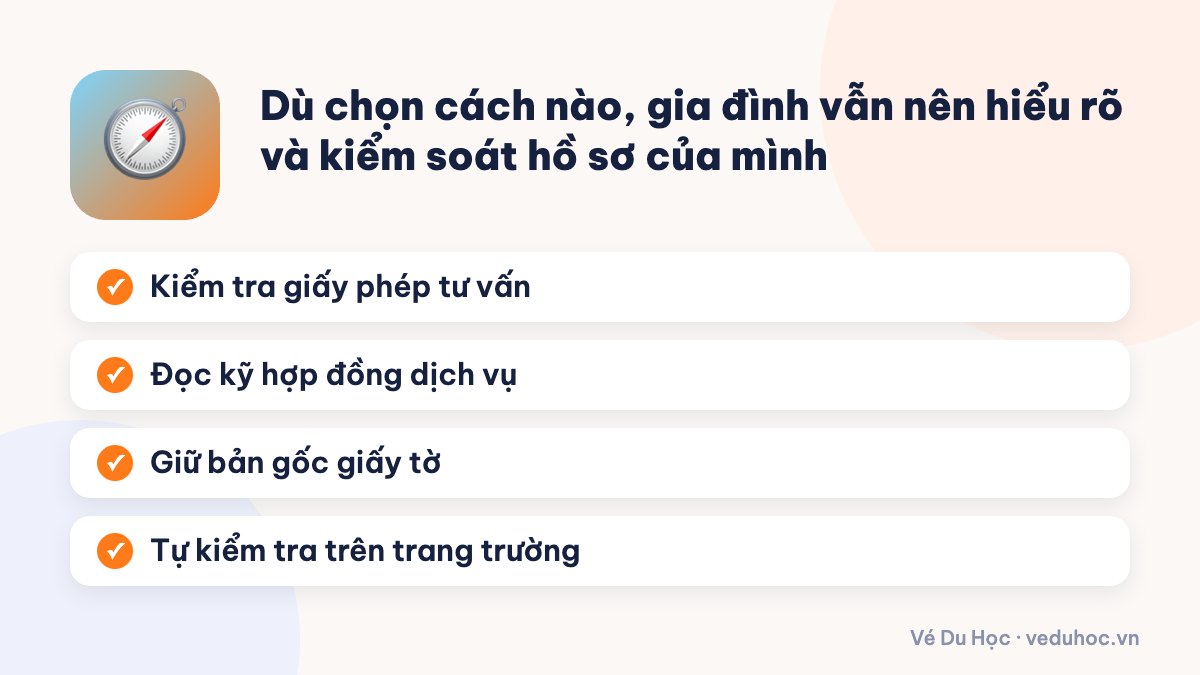
- Check the business registration certificate for study abroad consulting services issued by the Department of Education and Training.
- Verify representative status: many schools post a list of official admission representatives on their websites. You can also email directly to the international admissions office.
- Read the contract carefully: scope of services, fees, refund conditions in case of visa failure, who keeps the original documents.
- Be wary of the "visa guarantee" commitment: the visa decision belongs to the consulate, no unit can guarantee it.
- Do not agree to falsify or "beautify" documents: the consequence is rejection and possibly a ban from applying for many years. See more Reasons for student visa failure.
- Log in to the school's portal to check application status, invitation letters and tuition invoices. Always pay tuition directly into the school account if possible.
Once you have a visa, you can refer to it Experience in booking airline tickets to study abroad or send a request right on the page air tickets to study abroad.
Frequently asked questions
Does going through the center have a higher visa approval rate?
There is no basis to confirm. The center has experience to help limit errors, but visa results depend on real documents and your own testimony.
Why are many consulting centers free?
Many schools pay commissions to admissions representatives when students enroll. This is legal, but you should know so you can evaluate the level of objectivity when being introduced to schools.
How long does it take to make your own study abroad application?
It usually takes 6–12 months from the time you start looking for a school until you get your visa. With scholarship applications, the time may be longer.
Should I give original documents to the center to keep?
Maximum restrictions. Usually only a notarized copy is needed. If you must send originals, ask for a receipt that clearly lists each document.
There is no right choice for every family. It's important that you understand and control your profile. Choose the method that suits your time, capacity and complexity of the application, then let VeDuHoc accompany you on the last leg, the flight.
Reference source
Booker HVSC gives a free quote in 15 minutes, Zalo reports take-off and landing for the whole family.
📚 Articles on the same topic
 Documents & student visaChecklist of complete study abroad documents: documents need to be prepared in each stage09/08/25 · 6 phút đọc
 Documents & student visaTranslating and notarizing study abroad documents: how to do it correctly and economically04/10/24 · 7 phút đọc
 Documents & student visaOffer Letter is conditional and unconditional25/01/23 · 5 phút đọc
 Documents & student visaPassport for international students: renewal, extension and notes when studying abroad14/12/20 · 8 phút đọc
 Documents & student visaStudent visa failure: common causes and how to reapply08/11/17 · 8 phút đọc
 Documents & student visaStudy abroad documents for students under 18 years old: guardianship and accommodation29/01/17 · 7 phút đọc
🔥 Read a lot
- International checked baggage for international students: pieces or scales, 46kg and tips for packing suitcases
- Master's scholarships: strategies for choosing majors, choosing schools and contacting professors
- Why should study abroad centers have specialized airline ticket partners?
- Choosing a reputable dispatching company: signs to recognize and avoid scams
- Stipendium Hungaricum Scholarship: full study abroad in Hungary





 ▶
▶ ▶
▶ ▶
▶ ▶
▶ ▶
▶ ▶
▶ ▶
▶