
🔄 Cập nhật lần cuối: 08/10/26

Finding a job after graduating abroad is the goal of many international students, both to recover investment costs and to accumulate international experience. Each country has its own post-study work visa with its own terms and conditions, and these regulations change quite often. The article summarizes the main points according to the most recent publication and how to prepare early.
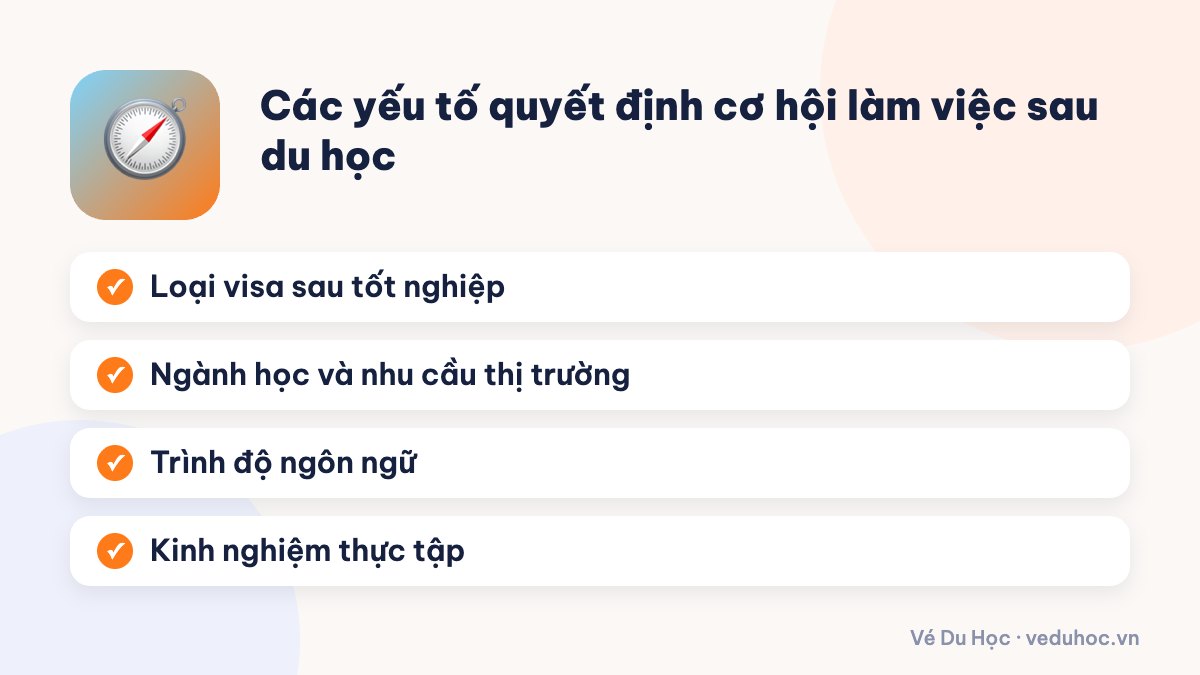
What is a post-graduation work visa?
This is a type of visa (or permit) that allows international graduates to stay for a period of time to look for work and work, usually without employer sponsorship. After this time, if you want to stay long term, you often have to switch to a sponsored work visa or skilled immigration status. Understanding this roadmap should start from now choose to study abroad.
Comparison table of post-graduation visas by country
The table below is for reference only, compiled from government and university websites at the time of updating the article.
| Country | Visa/permit name | Reference period | Outstanding conditions |
|---|---|---|---|
| You | Graduate Route | Bachelor, Master: 2 years; reduced to 18 months with applications submitted from January 1, 2027. Doctorate: 3 years | Complete the course with a Student visa, submitted while still in the UK |
| Australia | Temporary Graduate (subclass 485) | Postgraduate branch: usually 2–3 years depending on degree; Career branch: maximum 18 months | Have held a student visa in the last 6 months, with CRICOS keywords, age limit (usually 35 or under, with exceptions), English language requirement |
| Canada | PGWP | Depends on program duration, maximum 3 years | Submit within 180 days; Language requirement Club 7 (university) or Club 5 (college); Some programs must be in shortage industries |
| the USA | OPT (F-1) | 12 months for each level of study; STEM majors can extend further | Recommended by the school, USCIS issues the EAD card; then need a work visa like H-1B |
| Germany | Residence permit to find a job after graduation | Maximum 18 months | Graduated in Germany, proof of finance and insurance |
| Japanese, Korean | Converting work visa; job search visa | Depends on type | Have a contract appropriate to the field of study; South Korea has a D-10 job search visa |
Note by country
You
The Graduate Route does not require employer sponsorship, allowing for most jobs. According to the British government's announcement, the deadline for bachelor's and master's degrees is reduced from 2 years to 18 months for applications submitted from January 1, 2027, and doctoral degrees remain 3 years. After that, most people who want to stay switch to the Skilled Worker visa with salary requirements and a sponsoring employer.
Australia
Visa 485 has many branches: post-vocational training, post-graduate and a second branch for people studying and living in regional areas. You must select the branch when submitting and cannot change afterwards. English language requirements, insurance and health checks need to be prepared before the student visa expires. See more context in the article Australian student visa subclass 500.
Canada
PGWP is an open work permit. From November 1, 2024, applicants must meet language requirements, and for many programs other than bachelor's, master's, and doctorate, the field of study must be on the long-term labor shortage list. Online study from outside Canada may be deducted from the PGWP term.
the USA
OPT can be used before or after graduation; STEM students can apply for an extension. To work long-term, most need an H-1B visa according to the selection mechanism and costs borne by the employer, which has had many policy changes in recent years. Keep an eye on the USCIS site and the international student office.
Germany, Japan, Korea
Germany allows graduates to stay for up to 18 months to find a job that matches their qualifications. In Japan and Korea, you often switch from a student visa to a work visa when you have a contract; Native language is a huge advantage. Article Learn the local language when studying abroad have suggestions for you.
Preparation roadmap from final year
- 12–18 months before graduation: carefully research post-graduation visa conditions, determine required documents (language certificate, insurance, confirmation of course completion).
- Accumulate experience: internship, co-op, project. See article Internship and co-op while studying abroad.
- Complete your job application according to local standards, reference Make a job application in English.
- Monitor student visa expiration date to submit post-graduation applications on time and avoid overstaying. Detailed procedures are in the article Extend student visa and post-graduation work visa.
- Have a backup plan: If you haven't found the job you want, consider returning home and reading the article return home or stay after studying abroad.
The transition period after graduation often has many schedule changes: visiting home between two visas, returning to take a job, or returning completely. VeDuHoc supports booking ticket back home and return tickets with 30+ Bookers, multi-company price hunting, optimal checked baggage of 40–46kg when moving things back, 24/7 support and VAT invoice when you need it.
Frequently asked questions
Does a post-graduation work visa require employer sponsorship?
Most visas such as Graduate Route (UK), 485 (Australia), PGWP (Canada) are open visas, no sponsorship required. However, to stay long-term then often need sponsorship or settlement conditions.
Can I get a visa after studying for a 1-year master's degree?
Usually yes, but the duration may be shorter depending on the country (e.g. PGWP Canada depends on program length). Check specific regulations before choosing a lock.
Will the rules change after I enroll?
Maybe. Many changes apply according to application submission date or student visa submission date. Please keep an eye on government pages and school announcements.
Should I return home while waiting for my post-graduation visa?
Depending on each country's regulations. Some visas must be submitted and waited in the host country. Check with the international student office before booking.
Early preparation is the key to not missing out on the opportunity to work after studying abroad. Need advice on flight schedule suitable for visa plan, contact VeDuHoc via hotline/Zalo 090.1800.918.
Reference source
Booker HVSC gives a free quote in 15 minutes, Zalo reports take-off and landing for the whole family.
📚 Articles on the same topic
 Study abroad scholarshipMaster's scholarship in the UK for 1 year: is it worth the investment?23/06/24 · 6 phút đọc
 Documents & student visaExtend student visa and post-graduation work visa23/09/21 · 6 phút đọc
 Study abroad scholarshipScholarships to study in Canada at college level: co-op program and scholarships28/07/17 · 6 phút đọc
 Study abroad lifeInternships and co-ops when studying abroad: benefits and how to find them04/02/21 · 7 phút đọc
 Study abroad lifeWorking part-time while studying abroad: hour limits, salary and legal notes18/06/25 · 6 phút đọc
 Study abroad lifeTraveling while studying abroad: student transportation card and buying a car09/10/18 · 7 phút đọc
🔥 Read a lot
- Master's scholarships: strategies for choosing majors, choosing schools and contacting professors
- International checked baggage for international students: pieces or scales, 46kg and tips for packing suitcases
- Why should study abroad centers have specialized airline ticket partners?
- Choosing a reputable dispatching company: signs to recognize and avoid scams
- Scholarships to study in Australia at high school and preparatory levels: opportunities for students in grades 10–12




 ▶
▶ ▶
▶ ▶
▶ ▶
▶ ▶
▶ ▶
▶ ▶
▶