
🔄 Cập nhật lần cuối: 08/10/26

Internships and co-ops while studying abroad are opportunities for you to turn classroom knowledge into real work experience, build a network of relationships and increase competitiveness when graduating. However, each country has its own regulations regarding the work rights of international students. This article helps you understand popular internship types, visa regulations you need to know and how to find a suitable position.
What is the difference between internship, co-op, and placement?
- Internship: short-term work, usually a few weeks to a few months, may or may not be paid; There are mandatory credit-counting types, there are voluntary types.
- Co-op (cooperative education): popular in Canada and some American schools, alternating semesters with full-time paid work periods, organized and evaluated by the school.
- Placement/sandwich year: common in the UK and Australia, students work for a semester or year as an official part of the program.
- Work-integrated learning (WIL): a general term in Australia for work-related learning activities such as internships and corporate projects.
Benefits of internships and co-op when studying abroad
For international students, work experience in the host country is especially valuable because international employers often appreciate candidates who are familiar with the local working environment.
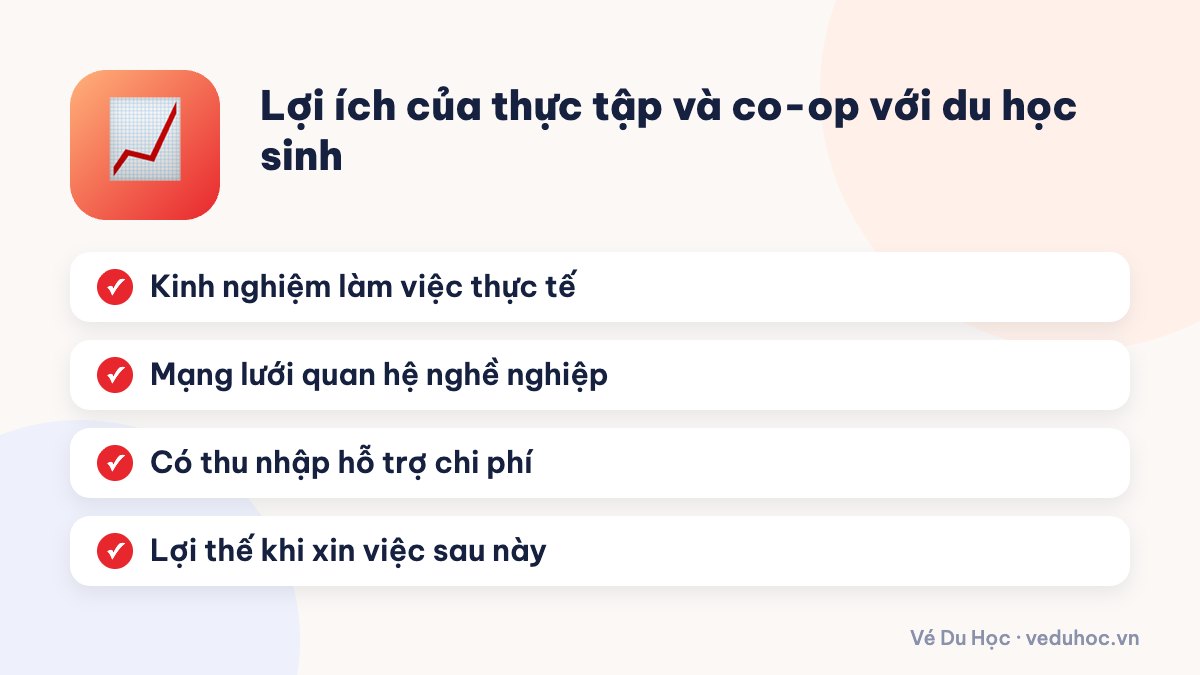
- Understand local office culture: how to communicate, write emails, work in groups.
- Career orientation: try out a position before making a long-term commitment.
- Relationship network: Instructors and colleagues can write letters of recommendation or job referrals. See more articles Make friends and build a network of relationships while studying abroad.
- Income: many paid co-op terms, helping to reduce financial pressure.
- Stepping stone for employment after graduation: many students receive official job offers from internships.
Regulations on working under visas in different countries
This is the most important part. Working illegally can seriously affect your visa status. The table below summarizes according to the most recent published information; regulations are subject to change, always check the government page and your school's international student office.
| Country | Form | Main point |
|---|---|---|
| Canada | Co-op and internship are mandatory in the program | Effective April 1, 2026, IRCC allows eligible post-secondary students to participate in the program's required internship without applying for a separate co-op work permit, with a school-approved employer (DLI) |
| the USA | CPT, OPT | CPT for internships is an integral part of the program, licensed by the school. OPT maximum 12 months for each level of study, can be used before or after graduation; STEM majors can extend further. Using full-time CPT for 12 months or more will result in loss of OPT rights |
| Australia | Placement, WIL | Student visa is limited to 48 hours/2 weeks while the course is in progress, unlimited during vacations. Work that is an official, registered part of the course does not count towards this limit |
| You | Placement, sandwich year | Placement is a required, assessed part of the course that is usually allowed; Other overtime working hour limits apply separately by educational level |
For part-time work outside the study program, the hour limit is detailed in the article Part-time work while studying abroad: hour limits, salary and notes. If you are interested in a co-op program right from the time you choose a school, refer to the article Scholarships to study in Canada at college level and co-op programs.
How to find effective internship positions
1. Start at the school's career center
Career center/co-op office is the most important source: internal job portal, job fairs, business introduction sessions, CV editing and free interview practice. With co-op programs, schools often have their own selection process and specific deadlines.
2. Prepare documents according to local standards
CVs, cover letters and LinkedIn profiles need to be written in the home country's style, concise, and focused on results. Article Make a job application in English when studying abroad detailed instructions.
3. Plan according to recruitment season
- Many large corporations recruit summer internships from the fall of the previous year.
- Small and medium-sized enterprises recruit closer to the start time and are more flexible.
- Create a tracking table: location, deadline, status, contact person.
4. Actively connect
- Attend industry events, specialized clubs, and alumni associations.
- Ask for a short informational interview with someone in the industry.
- Ask faculty about research projects or corporate partners.
5. Be wary of fraudulent “internships”.
Don't pay a fee to get an internship, don't provide banking information before a clear contract is in place, and check out the business through the school. Unpaid internships in some countries are also subject to local labor laws.
When your internship or co-op schedule changes, your flight itinerary also changes. VeDuHoc's team of more than 30 Bookers supports bookings ticket back home and return-to-school tickets, multi-company price hunting, flexible ticket exchange conditions consultation and 24/7 support when there are urgent changes.
Frequently asked questions
Do unpaid internships require a work permit?
There may be. In many countries, unpaid internships are still considered “work” under immigration law. Check with the international students office before accepting.
Can I do an internship in first year?
Some programs allow it, but many require completion of a certain number of semesters, especially with CPT in the US. The first year should focus on studying well, joining clubs and volunteering.
Does an internship help you stay in the workforce after graduation?
Internships strengthen a resume and can lead to a job offer, but legal stay still depends on the type of work visa. See article post-graduation jobs abroad.
Should I choose a co-op program from the beginning?
If the goal is practical experience and employment, a program with co-op is worth considering. Note that study time may be longer.
Internships and co-ops are a worthy investment of time for your career. Be proactive early, understand visa regulations and take advantage of all the school's support sources. Need advice on flight schedules, contact VeDuHoc via hotline/Zalo 090.1800.918.
Reference source
Booker HVSC gives a free quote in 15 minutes, Zalo reports take-off and landing for the whole family.
📚 Articles on the same topic
 Study abroad handbookExit procedures at Vietnam airport for international students28/03/26 · 6 phút đọc
 Study abroad lifeFirst day at school: orientation and things to do20/12/24 · 6 phút đọc
 Study abroad lifePersonal financial management for international students: create a monthly budget08/09/24 · 6 phút đọc
 Study abroad lifeStaying in touch with family while studying abroad: tools and habits21/01/24 · 6 phút đọc
 Study abroad handbookOne-way or round-trip tickets when studying abroad: cost analysis30/11/23 · 6 phút đọc
 Study abroad lifeSafety when studying abroad: avoiding scams and common risks19/08/23 · 8 phút đọc
🔥 Read a lot
- Hành lý ký gửi chặng quốc tế cho du học sinh: kiện hay cân, 40kg hay 2 kiện 23kg và mẹo đóng vali
- Master's scholarships: strategies for choosing majors, choosing schools and contacting professors
- Why should study abroad centers have specialized airline ticket partners?
- Choosing a reputable dispatching company: signs to recognize and avoid scams
- Stipendium Hungaricum Scholarship: full study abroad in Hungary





 ▶
▶ ▶
▶ ▶
▶ ▶
▶ ▶
▶ ▶
▶ ▶
▶