
🔄 Cập nhật lần cuối: 08/10/26

International students who are pregnant, married or want to bring their families while studying abroad need to understand each country's dependent visa regulations, because this is the policy area that has changed the most in recent years. The UK, Canada and Australia have all significantly narrowed the right to sponsor spouses and accompanying children. This article summarizes the basic regulations up to the time of update, along with what to do when you are pregnant or married while studying abroad.
Overview: What is a dependent visa?
Dependents (dependant/dependent, family member, secondary applicant) are usually spouse or partner recognized by the law of that country and minor children of international students. Parents, siblings are usually not in this category; If they want to visit, they must apply for a separate tourist/visit visa (see article Parents visit their children studying abroad).
Before planning, determine: whether the course is eligible to bring your family, whether accompanying people can work or go to school, and how much additional finance and insurance must be proven.
Regulations for bringing families to each country vary
United Kingdom
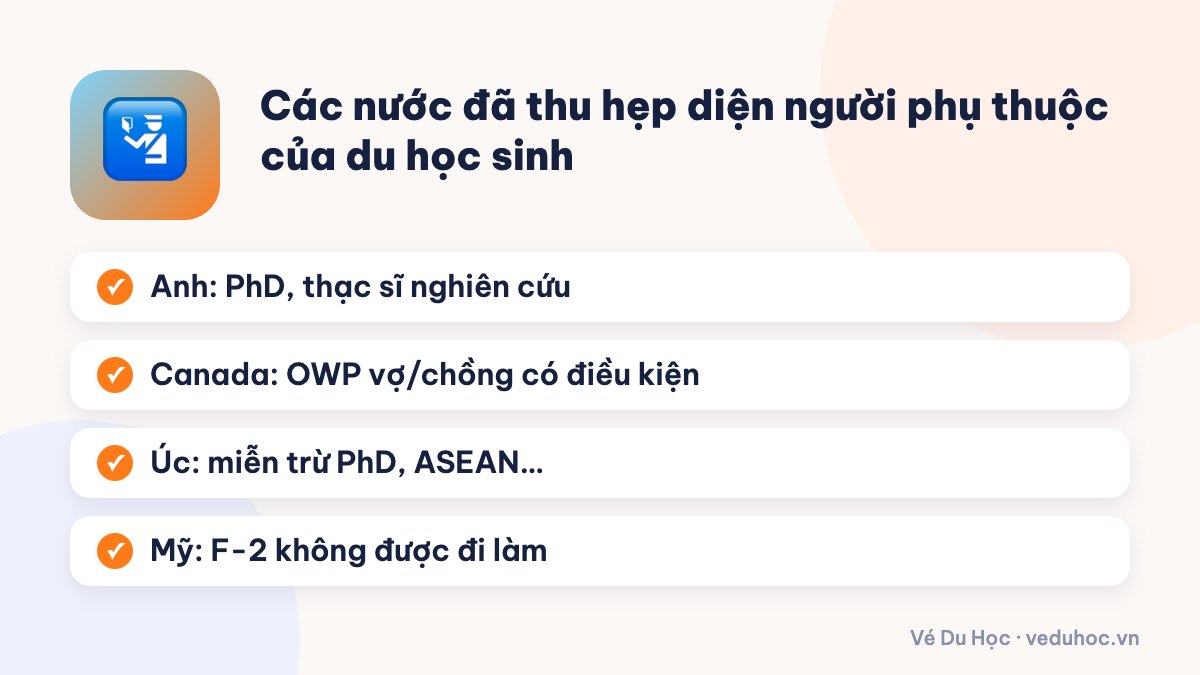
According to the official GOV.UK page, only two Student visa groups are allowed to bring dependents: government-sponsored students studying courses of more than 6 months, and full-time postgraduate students whose courses starting from January 1, 2024 must be doctoral (PhD / doctorate) or research masters. Taught master's students such as MSc and general MBA are no longer allowed to bring their spouses and children. Dependents must prove their own finances (according to the rate announced by GOV.UK, calculated by month and different between London and outside London) and pay health insurance premiums (IHS).
Canada
From January 21, 2025, IRCC will only issue open work permits to expectations of students studying for a master's degree of 16 months or more, a doctorate or some listed professional programs. Dependent children are no longer eligible for open work permits under this category. Spouses of students outside the above groups can still apply for a tourist visa or separate study permit if eligible, but cannot work as a family.
Australia
Australia is a country that has seen major changes recently. According to the Australian Department of Home Affairs (Home Affairs), student visa applicants (subclass 500) are generally no longer allowed to accompany their spouses and children, except for the following exemptions: PhD students, students sponsored by DFAT or the Department of Defense, students with foreign government scholarships, and eligible students from Pacific and ASEAN countries - a group that includes Vietnam. According to published legal documents, this regulation applies to applications submitted from October 2, 2026; Previously submitted documents are considered according to the old law.
Notably: additional relatives are no longer allowed after the visa has been issued (subsequent entrants), even for exempt groups. Therefore, if you are eligible to be accompanied by family, you need to declare and submit at the same time from the beginning, and everyone in the application must be in the same place (in or outside Australia) when submitting. For accompanying people, the customary right to work is a maximum of 48 hours/2 weeks, with no limit if the main student is studying for a master's or doctoral degree. The Australian government has also announced its intention to tighten the dependents of the 485 graduate visa but there is no applicable document at the time of update.
the USA
Spouses and unmarried children under 21 years of age of F-1 students can apply for an F-2 visa. According to Study in the States (US Department of Homeland Security), F-2 people are not allowed to work; The spouse can only study part-time, but if he wants to study full-time, he must transfer to F-1; Children under 18 years old are allowed to attend high school. The school will issue a separate I-20 for dependents when you demonstrate additional finances.
| Country | Who gets to bring their family over? | Can chaperones work? |
|---|---|---|
| You | Government sponsored students; PhD/master of research | Normally employed (subject to visa conditions) |
| Canada | Family work permit: spouse Master's student ≥16 months, PhD, listed program | Yes, if subject to an open work permit |
| Australia | PhD, government scholarship, eligible ASEAN/Pacific students (application from October 2, 2026) | Yes, 48 hours/2 weeks or unlimited depending on level of study |
| the USA | F-1 student (F-2 visa) | No |
Asian countries such as Japan and Korea also have family visas for relatives of international undergraduate/postgraduate students with their own financial conditions; Please ask directly at the Embassy or your school's international department before making plans.
International students become pregnant and give birth abroad
Pregnancy does not disqualify you as an international student, but you need to proactively handle some issues:
- Health insurance: Check if the mandatory insurance package (OSHC in Australia, school insurance in the US, IHS in the UK) covers maternity, has a waiting period or not. Some private plans only pay maternity benefits after 12 months of participation. See more articles Medical insurance for studying abroad.
- Study: contact the student support office to request deferral, leave of absence. Note that reservations may affect your visa, so you must ask the school's visa consulting department first.
- Child's nationality: in the UK and Australia, children are not automatically born with that country's nationality. GOV.UK instructs you to apply for a dependent visa for your child if you want to enter or exit the UK; In Australia, children are generally considered to have the same visa category as their parents. Nationality regulations based on place of birth in some other countries may vary, please check with the official authority.
- Vietnamese documents: register your child's birth at a Vietnamese representative agency in the host country (or upon returning home) and make a passport for your child before booking a ticket.
- Flying during pregnancy: many airlines require a doctor's certificate from around week 28 and limit flying at the end of pregnancy; Each company has different regulations.
Getting married while studying abroad: what to do?
Getting married while on a student visa is legal in most countries, but marriage does not automatically give your spouse the right to move in with you. Things to do:
- Notify change of status with school and immigration authorities if required by regulations (Australia requires updating change of circumstances with Home Affairs).
- Note on marriage in Vietnam: marriage abroad requires procedures to be recorded in the civil status book in Vietnam to be fully recognized.
- Check your sponsorship status: if the course is not eligible to bring your family over (such as taught master's in the UK, or non-exempt students in Australia), the spouse can only come on a short-term visit visa or their own visa.
- Avoid false declaration: Failure to fully declare relatives in the visa application can be considered as providing false information, affecting future applications. See more articles international students and host country laws.
Prepare finances and travel for the whole family
Each accompanying person significantly increases financial proof requirements, visa fees, insurance and living expenses. In Australia, school-age children often must have confirmation of admission to high school and pay tuition. Set a realistic budget from the beginning (refer to the article Financial management for international students) and prepare enough accommodation for the whole family (see article Find housing while studying abroad).
For family trips with young children, choose a flight with few stops, reasonable transit time and check transit visa requirements for each member. VeDuHoc's team of more than 30 Bookers hunts for multi-carrier tickets for the whole family, checks transit visas, optimizes checked baggage (baby items, strollers), and if a better price is found after you have paid, HVSC transfers the difference to be refunded. You can start at the page air tickets to study abroad or see more International checked baggage regulations.
Frequently asked questions
Can I bring my spouse to study for a master's degree in the UK?
For courses starting from 1 January 2024, only research masters or PhDs (or government-funded students) can bring dependents. Master's degree courses are not normally possible.
Can Vietnamese international students come to Australia with their families?
According to information from Home Affairs, qualified students from ASEAN countries belong to the exemption group, but must meet specific conditions and submit their families right in the initial application because there are no additional categories later. Please check the official site before submitting.
Will pregnancy while studying abroad result in visa cancellation?
Pregnancy itself is not a reason to cancel a visa. Risks lie in unsatisfactory studies, incorrect reservation procedures or lack of insurance; Please work with the school early.
Dependent rules change quickly, so always check with your immigration agency's website and your school's visa counseling department before making any big decisions. When documents are ready, VeDuHoc supports ticket booking for the whole family 24/7 via hotline/Zalo 090.1800.918.
Reference source
Booker HVSC gives a free quote in 15 minutes, Zalo reports take-off and landing for the whole family.
📚 Articles on the same topic
 Study abroad lifeFind housing while studying abroad: dormitory, homestay or shared rental29/09/25 · 6 phút đọc
 Documents & student visaChecklist of complete study abroad documents: documents need to be prepared in each stage09/08/25 · 6 phút đọc
 Study abroad lifeWorking part-time while studying abroad: hour limits, salary and legal notes18/06/25 · 6 phút đọc
 Study abroad lifePersonal financial management for international students: create a monthly budget08/09/24 · 6 phút đọc
 Documents & student visaWhat are CoE, I-20, CAS? "Key" documents to apply for a visa12/03/24 · 5 phút đọc
 Study abroad handbookDocuments to bring with you when flying to study abroad (no deposit)26/12/23 · 6 phút đọc
🔥 Read a lot
- International checked baggage for international students: pieces or scales, 46kg and tips for packing suitcases
- Master's scholarships: strategies for choosing majors, choosing schools and contacting professors
- Why should study abroad centers have specialized airline ticket partners?
- Choosing a reputable dispatching company: signs to recognize and avoid scams
- Stipendium Hungaricum Scholarship: full study abroad in Hungary



 ▶
▶ ▶
▶ ▶
▶ ▶
▶ ▶
▶ ▶
▶ ▶
▶