
🔄 Cập nhật lần cuối: 08/10/26

Every year, international students get into trouble just because they "don't know the rules": working overtime, lending their bank accounts to friends, bringing food without declaring it, or driving with an invalid license. Understanding the laws of your host country not only helps you avoid fines but also protects your visa, your studies and your future. This article summarizes what international students absolutely should not do and how to handle it if they get into trouble.
General rule: “ignorance of the law” is not an excuse
In most countries, ignorance of the regulations does not absolve you from liability. For international students, the consequences are even more severe because a criminal record or violation of visa conditions can lead to visa cancellation and affect future visa applications for other countries. Three principles to remember:
- When in doubt, check with the international student office or government site before doing so.
- Don't do what “everyone else does”: many violations common in the community are still violations.
- Keep documents, contracts, and evidence for all important transactions.
Violation of visa conditions
This is the group of violations that most directly affects your right to stay.
| Behaviors to avoid | Why is it dangerous? |
|---|---|
| Working overtime beyond the hour limit or working "under the table", receiving unreported cash salary | Violation of visa conditions; For example, in Australia, a student visa is limited to 48 hours/2 weeks while the course is in progress |
| Work before the course starts (in Australia) | Not allowed under visa conditions |
| Dropping out of school, not ensuring attendance and progress | The school has a reporting obligation, which may lead to visa cancellation |
| Failure to notify the school of the new address on time | Many places require short-term updates (e.g. 7 days in Australia). |
| Let the mandatory health insurance expire | Violation of visa conditions in countries such as Australia and South Korea |
| Overstay your visa | May be banned from entry for many years |
Details of working hour limits for each country are in the article Part-time work while studying abroad: hour limits, salary and notes. In addition, violations of academic integrity such as plagiarism and exam cheating can also lead to suspension from school, leading to visa consequences; see article studying abroad and how to avoid plagiarism.
Money and bank accounts
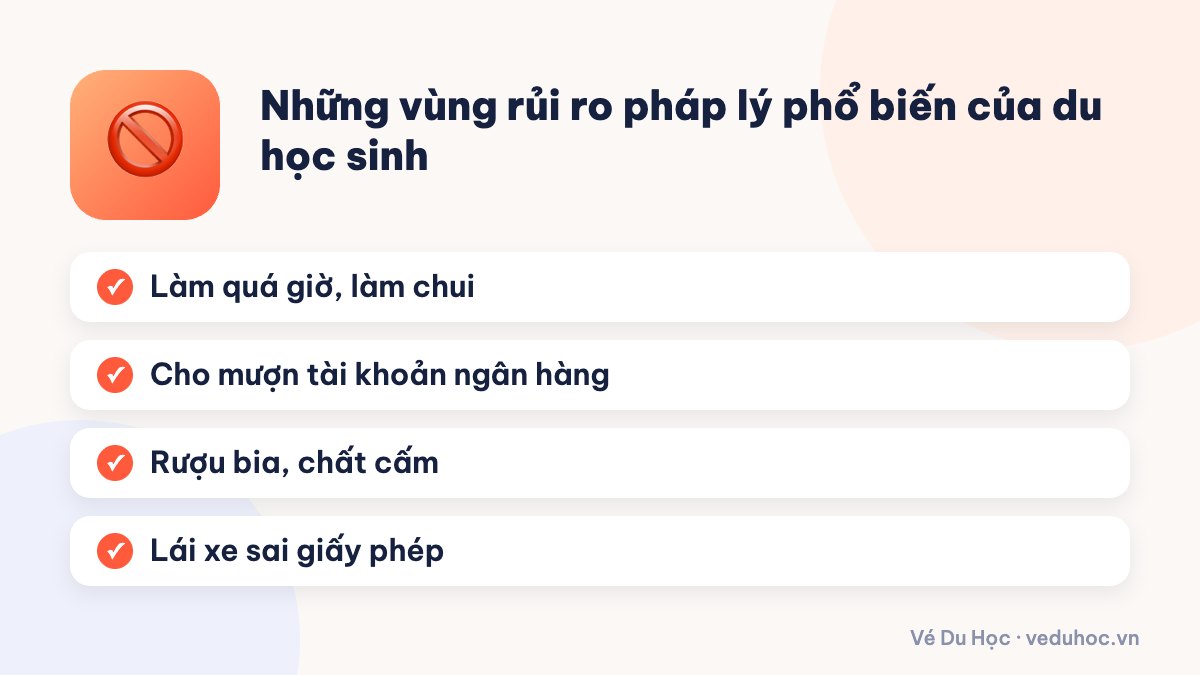
- Do not lend, rent or sell bank accounts, cards, or login information. Thieves can use your account to receive and transfer money fraudulently; You may be investigated as a money launderer.
- Do not accept "light, high-paying jobs" like receiving money and then transferring or receiving goods on your behalf.
- Do not carry luggage or parcels for others when you do not know what is inside, especially when traveling by plane.
- Do not let anyone else keep your passport, including your landlord or employer.
Specific scam techniques are included in the article Safety when studying abroad: avoiding scams.
Alcohol, banned substances, traffic and life
Alcohol
The legal age to buy and drink alcohol varies between countries: in the US it is 21 years old, in the UK and Australia it is 18 years old. Many places prohibit drinking alcohol in public places, and driving under the influence of alcohol is severely punished.
Prohibited substances
Laws regarding marijuana and other drugs vary widely from country to country, and even state to state. Even where it has been legalized at the local level, use can still have consequences for visa applications or entry to other countries. The safest option is to avoid it altogether. Absolutely do not bring banned substances across the border.
Medicines and food
Some popular drugs in Vietnam may be controlled in other countries. Food, meat, eggs, and seeds must be declared upon entry. See article Bring medicine when studying abroad and Customs declaration upon entry.
Traffic
Driving with an invalid license, riding a train without a ticket, or riding a bicycle without a hat in mandatory places can all be fined. Read more articles travel while studying abroad.
Life's rules are easily overlooked
- Classify waste according to regulations (especially strict in Japan, Korea, and Germany).
- Making noise at night in a residential area can result in neighbors reporting you to the police.
- Downloading pirated movies and software: many countries take copyright infringement seriously.
- Filming or taking photos of others without permission, posting offensive content online.
- Smoking and e-cigarettes in prohibited areas; Regulation of e-cigarettes is particularly tight in some countries.
- Internet regulation: for example many international services are blocked in China; Please learn and comply with local regulations.
What to do if you encounter legal trouble?
- Calmly and politely cooperate with the police; You have the right to request an interpreter and a lawyer.
- Don't sign documents you don't understand.
- Contact the international student office; Many schools offer free legal advice or legal aid referrals.
- Report to the Vietnamese Embassy/Consulate General if detained, to receive support for citizen protection.
- Notify family. Parents refer to the article when you encounter problems abroad.
When you need to change your flight schedule urgently due to legal, health or family reasons, the VeDuHoc team supports 24/7, advising on options to change tickets or book new tickets that best suit the situation.
Frequently asked questions
Does a traffic fine affect your visa?
A small fine for which a fine has been paid usually does not have a direct impact, but a serious violation or failure to pay a fine can have legal consequences. Please handle it on time.
Where cannabis is legal, can international students use it?
Even if local laws allow it, use can still cause problems when applying for a visa or entering another country. The safest way is not to use it.
Is it okay if you ask to receive money into your account?
Very risky. If the money comes from fraudulent sources, your account may be investigated and your account blocked. Please refuse politely.
If I am arrested, can I call the Embassy?
According to international consular practice, detained foreign citizens often have the right to request notification to their country's consular office. Be proactive in asking.
Respecting host country laws is the best way to protect your study abroad journey. Need flight support, contact VeDuHoc via hotline/Zalo 090.1800.918.
Reference source
Booker HVSC gives a free quote in 15 minutes, Zalo reports take-off and landing for the whole family.
📚 Articles on the same topic
 Study abroad handbookExit procedures at Vietnam airport for international students28/03/26 · 6 phút đọc
 Study abroad lifeFirst day at school: orientation and things to do20/12/24 · 6 phút đọc
 Study abroad lifePersonal financial management for international students: create a monthly budget08/09/24 · 6 phút đọc
 Study abroad lifeStaying in touch with family while studying abroad: tools and habits21/01/24 · 6 phút đọc
 Study abroad handbookOne-way or round-trip tickets when studying abroad: cost analysis30/11/23 · 6 phút đọc
 Study abroad lifeSafety when studying abroad: avoiding scams and common risks19/08/23 · 8 phút đọc
🔥 Read a lot
- Master's scholarships: strategies for choosing majors, choosing schools and contacting professors
- International checked baggage for international students: pieces or scales, 46kg and tips for packing suitcases
- Why should study abroad centers have specialized airline ticket partners?
- Choosing a reputable dispatching company: signs to recognize and avoid scams
- Scholarships to study in Australia at high school and preparatory levels: opportunities for students in grades 10–12




 ▶
▶ ▶
▶ ▶
▶ ▶
▶ ▶
▶ ▶
▶ ▶
▶