
🔄 Cập nhật lần cuối: 08/10/26

Sending their children to study abroad early from high school is a decision that more and more families are considered, with the expectation that their children will be good at foreign languages, familiar with the international environment and easily enter good universities abroad. But studying abroad at the age of 14–17 also poses major psychological, legal and cost challenges. The article analyzes the pros and cons and what parents need to check before deciding.
Advantages of sending your child to study abroad early from high school level
- Natural foreign language: language exposure in adolescence helps children speak, reflect and think in foreign languages better.
- Adapting to the education system: children are used to active learning, writing essays, giving presentations, doing projects - a big advantage when going to university.
- Stronger college profile: academic records, programs (such as A-Level, IB, AP) and extracurricular activities in the host country are well understood by universities. Article scholarships for high school students Get more information about financial opportunities.
- Independence: children learn to manage their time, money and relationships early on.
Disadvantages and risks
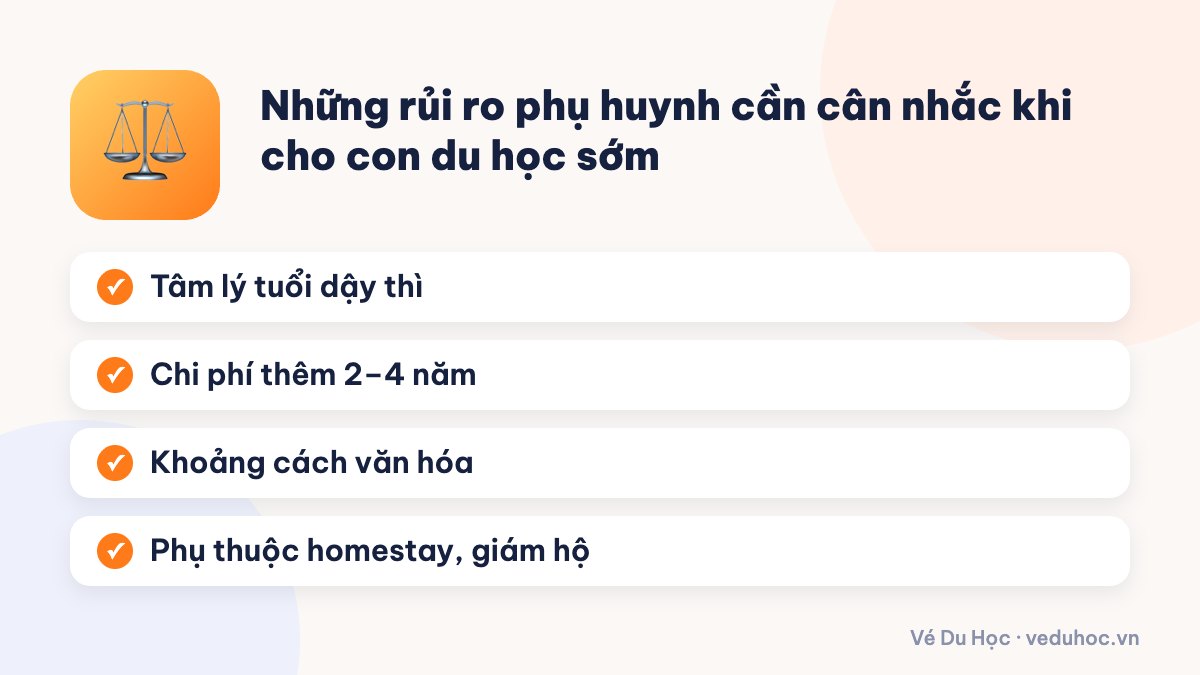
- Psychologically unstable: puberty is inherently volatile; Being away from family can make children lonely and susceptible to negative influences from friends and social networks.
- High cost and lengthy: private school, homestay/boarding fee, guardian fee plus 2–4 years compared to just studying abroad at university. Reference study abroad budget.
- Cultural gap in the family: children change their lifestyle and views quickly; If there is a lack of communication, parents and children can easily grow apart.
- Lose your Vietnamese roots and domestic connections if you don't have a plan to maintain them.
- Depends on guardian, homestay: uneven quality; need to check carefully.
| Criteria | Study abroad since high school | Study abroad from university |
|---|---|---|
| Foreign language, adaptation | Very good | Good, it takes time at first |
| Total cost | Higher (an additional 2–4 years) | Lower |
| Psychological risks | Higher, need supervision | Lower |
| Legal procedures | Complex (custody, parental consent) | More simple |
| Opportunity to enter top universities | There are advantages if you study well | Depends on documents from Vietnam |
Regulations for students under 18 years old in different countries
Each country has its own regulations to protect minor students. Some examples from the official site:
- USA: according to the US Department of State, F-1 visa students can only study at public high schools for a maximum of 12 months and must pay the entire unsubsidized training cost (usually a few thousand to about 10,000 USD). Long-term study often requires choosing a private school.
- Canada: according to IRCC instructions, students under 17 years old when applying must have a guardian in Canada with a notarized commitment; From 17 years old to adulthood (18 or 19 depending on the province), guardianship requests are considered by officials on a case-by-case basis.
- Australia: students under 18 years of age must have a welfare arrangement confirmed by the school or be accompanied by a parent/eligible relative.
- UK: has a Child Student visa for students studying at independent (private) schools; Schools usually require a guardian in the UK.
Detailed profiles for minor students are included in the article Study abroad documents for students under 18 years old.
Are you ready? Self-assessment question set
Before deciding, parents and children should answer honestly:
- Do you really want to go, or are you just following your parents' wishes?
- Does your child wake up on time, study on his own, and arrange his own things without being reminded?
- When you encounter sad things, do you share them with adults?
- Is my child's foreign language level enough to take the class, or do I need a preparatory course?
- Does the family have enough finances for the entire high school + college path without creating too much pressure?
- Do you have relatives or trusted guardians in the destination country?
If many of the answers are "no", you can consider an intermediate route: study an international program in Vietnam, participate in a summer camp/short-term course abroad (see Short-term summer course) then go officially.
Popular forms of high school study abroad
- Boarding school: tightly managed environment, many activities; high cost.
- Boarding school + homestay: children live with a host family; You need to carefully check the homestay arrangement unit.
- 1-year cultural exchange program: lower cost, suitable for "testing" before deciding on a long-term basis.
- Stay with accompanying parent (some countries allow guardian visa).
VeDuHoc supports many families in booking tickets for students under 18 years old: consulting on accompanying services, choosing a safe transit route, checking transit visas, notifying parents of flights via Zalo and 24/7 support. 30+ Booker hunts for multi-carrier tickets, refunds the difference if a better price is found after payment. See article Book air tickets for international students under 18 years old or page air tickets to study abroad.
Frequently asked questions
What age is appropriate for your child to study abroad?
There is no “standard” age. Many experts believe that grades 10–11 are a reasonable time if children are independent and motivated, because they have time to adapt and build a university profile.
Is it possible to study in the US at the high school level? Can I study at a public school?
With an F-1 visa, students can only attend public high school for a maximum of 12 months and must pay all expenses. If they want to complete the high school program, most families choose private schools.
Is a guardian required when a child studies in Canada?
Required if child is under 17 years old when applying. From age 17 to the age of majority in the province, officials consider each case, unless a parent accompanies the entire period of study.
How to stay connected with your child when he or she studies abroad at a young age?
Agree on a fixed calling schedule, pay attention to emotions instead of just asking for scores, and periodically contact the school and guardians. See more Monitor and support your child remotely.
Studying abroad early is a great opportunity if you are ready and your family is well prepared. Once you have decided, please contact VeDuHoc via hotline/Zalo 090.1800.918 to get advice on a safe flight for your child.
Reference source
Booker HVSC gives a free quote in 15 minutes, Zalo reports take-off and landing for the whole family.
📚 Articles on the same topic
 Study abroad handbookHelp your child choose a major and a suitable country to study abroad10/02/25 · 7 phút đọc
 Study abroad handbookWhen children encounter problems abroad: what parents need to do28/05/24 · 7 phút đọc
 Study abroad lifeStaying in touch with family while studying abroad: tools and habits21/01/24 · 6 phút đọc
 Study abroad handbookMonitor and support your child remotely while studying abroad29/06/23 · 7 phút đọc
 Study abroad handbookParents visiting children studying abroad: visit visa and air tickets08/05/23 · 7 phút đọc
 Study abroad handbookTeach your children financial skills before studying abroad25/02/22 · 6 phút đọc
🔥 Read a lot
- Master's scholarships: strategies for choosing majors, choosing schools and contacting professors
- International checked baggage for international students: pieces or scales, 46kg and tips for packing suitcases
- Why should study abroad centers have specialized airline ticket partners?
- Choosing a reputable dispatching company: signs to recognize and avoid scams
- Scholarships to study in Australia at high school and preparatory levels: opportunities for students in grades 10–12




 ▶
▶ ▶
▶ ▶
▶ ▶
▶ ▶
▶ ▶
▶ ▶
▶