
🔄 Cập nhật lần cuối: 08/10/26
The student visa interview usually only lasts a few minutes, but is when the consular officer directly evaluates whether you are a real student, have enough financial capacity and a clear plan. The good news is that you can completely prepare to answer confidently, as long as you understand the purpose of the interview and know your profile.
What do visa officers want to know?
Although each country has its own way of doing things, most interviews revolve around four points:
- Real purpose of studying: you go to school for clear academic and professional reasons, not using studying as a "doorway" to work or settlement.
- Academic capacity: academic results, foreign language proficiency sufficient to study the chosen program.
- Financial capacity: who pays, where does the money come from, is it sustainable?
- Constraints and plans: with countries like the US, nonimmigrant visa applications are reviewed with the initial assumption that the applicant intends to immigrate; you need to show appropriate planning and constraints.
Understanding this helps you avoid remembering model answers. Visa officers interview hundreds of people every day, so it's easy to recognize the "learned" answer. It is important that the answer is truthful, specific and matches the profile.
Common student visa interview question groups
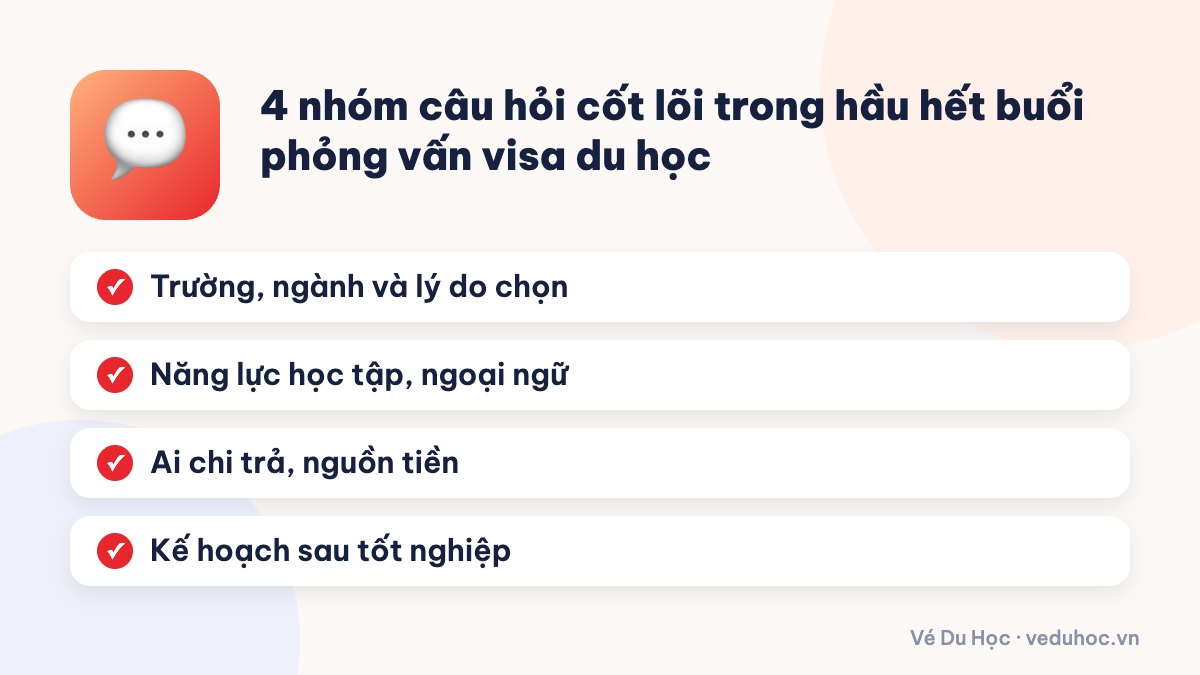
| Question group | For example | How to respond effectively |
|---|---|---|
| School and major | Why choose this school? What will you learn? | State specific features of the program (courses, internships, instructors) that relate to your goals |
| Learning process | What major did you study before? How are the scores? | Answer honestly, explaining briefly if there are gaps or industry changes |
| Finance | Who pays? What do your parents do and how much do they earn? | Accurately grasp the data and match the submitted documents |
| Future plans | What do you do after graduation? | Realistic career plan, related to the field of study |
| Family, individual | Do you have relatives in that country? | Answer honestly; Do not hide information already in the file |
Answer principles
- Short, straight to the question: 2–4 sentences are enough, unless asked more.
- Absolute honesty: false information can be considered fraud, which can have a long-term impact on future visa applications.
- Be specific instead of general: “The program has a medical data analysis module and an internship at a hospital” is more convincing than “a famous school with good quality”.
- Self-answer: parents are usually not allowed to come in together (except in the case of young students according to separate regulations); You need to know your family's financial information yourself.
- Stay calm when you don't hear clearly: politely ask to repeat the question instead of guessing.
Interview characteristics by country
USA (F-1 visa)
According to the US Department of State, most student visa applicants must have an in-person interview, bring their passport, DS-160, I-20 confirmation page and possibly transcripts, certificates, and financial proof. This is the most important interview for the F-1 visa. See details in the article F-1 US student visa: I-20, SEVIS fee and interview.
English (credibility interview)
The UK Home Office may require a credibility interview, usually conducted in English via video at an application center, covering finances, study history, study intentions and personal circumstances. This is also an opportunity to test practical English skills. See more UK study visa.
Australia, Canada, Europe, Asia
Australia and Canada mainly review applications, rarely conduct interviews, but can call or request an interview when clarification is needed. Some countries such as Korea and Germany can interview depending on the profile or program. For Australia specifically, the response to the Genuine Student request in the application acts as a “written interview”; see article Australian student visa subclass 500.
Prepare before the interview day
- Reread all submitted documents: visa application, invitation letter, essay, financial documents. All answers must match.
- Research the school and major carefully: program name, duration, tuition, city, a few main subjects.
- Practice speaking out loud with friends, teachers or record a video yourself; Practice answering in English if the interview is in English.
- Organize documents in order in a folder, easy to retrieve when required. Reference Study abroad application checklist.
- Dress neatly, arrive early, and comply with regulations on what can be brought in (usually electronic devices and large bags are not allowed).
Once you have a visa, VeDuHoc will help you choose a flight that matches your admission schedule and immigration regulations (for example, an F-1 visa does not allow entry earlier than 30 days before the program start date). A team of more than 30 Bookers hunts for multi-carrier tickets, checks transit visas, provides 24/7 support and notifies parents of their journey via Zalo. See more air tickets to study abroad.
Frequently asked questions
Can I have a student visa interview in Vietnamese?
Depends on the consulate. US visa interviews in Vietnam can often be in Vietnamese or English; British credibility interview conducted in English. Please prepare both if not sure.
Should I memorize model answers?
Shouldn't. Prepare your main idea and say it in your own words. Memorized answers can easily be revealed and make you confused when asked in-depth questions.
What to do if you get rejected after the interview?
Read the rejection letter carefully, identify weaknesses (financial, study goals, constraints) and only resubmit when there are real changes. See article student visa failure and how to reapply.
Can parents come to the interview with their children?
Usually not, except for some cases of young students according to the regulations of each consulate. Students should know their own profile information and family finances.
The student visa interview is not a quiz but an opportunity for you to show that you are a serious student. Prepare carefully, answer honestly and confidently. After getting a visa, contact VeDuHoc via hotline/Zalo 090.1800.918 for flight ticket support.
Reference source
Booker HVSC gives a free quote in 15 minutes, Zalo reports take-off and landing for the whole family.
📚 Articles on the same topic
 Study abroad lifeInternational students who are pregnant, married or bring their families over: basic regulations05/02/26 · 10 phút đọc
 Documents & student visaChecklist of complete study abroad documents: documents need to be prepared in each stage09/08/25 · 6 phút đọc
 Study abroad lifeWorking part-time while studying abroad: hour limits, salary and legal notes18/06/25 · 6 phút đọc
 Documents & student visaWhat are CoE, I-20, CAS? "Key" documents to apply for a visa12/03/24 · 5 phút đọc
 Study abroad handbookDocuments to bring with you when flying to study abroad (no deposit)26/12/23 · 6 phút đọc
 Study abroad scholarshipScholarship interview: 30 frequently asked questions and how to score answers31/12/22 · 7 phút đọc
🔥 Read a lot
- Hành lý ký gửi chặng quốc tế cho du học sinh: kiện hay cân, 40kg hay 2 kiện 23kg và mẹo đóng vali
- Master's scholarships: strategies for choosing majors, choosing schools and contacting professors
- Why should study abroad centers have specialized airline ticket partners?
- Choosing a reputable dispatching company: signs to recognize and avoid scams
- Stipendium Hungaricum Scholarship: full study abroad in Hungary




 ▶
▶ ▶
▶ ▶
▶ ▶
▶ ▶
▶ ▶
▶ ▶
▶