
🔄 Cập nhật lần cuối: 08/10/26

Unlike a bachelor's or master's degree, at the PhD level you are not just "going to school" but are also a funded researcher. Therefore, hunting for a PhD scholarship revolves around two questions: is your topic valuable, and who will guide you. This article explains the PhD funding mechanism, how to write a research proposal and how to email your supervisor.
Popular sources of PhD scholarships
| Funding source | How | Popular in |
|---|---|---|
| Teaching assistant/research assistant (TA/RA) | Free tuition + salary/subsidy in exchange for teaching and research work | America, Canada |
| PhD positions have project-based salaries | Professors recruit graduate students for projects that already have funding and sign contracts like employees | Germany, Netherlands, Northern Europe, Switzerland |
| School scholarships, research council | Competitive scholarships pay tuition and living expenses | UK, Australia, New Zealand |
| Government scholarships | For example DAAD (Germany – see DAAD scholarship), MEXT (Japan), GKS (Korea), CSC (China) | Many countries |
| Vietnam Budget Scholarship | State training project, often accompanied by a work commitment | According to the announcement of the Ministry of Education and Training |
In the US, many programs fully fund graduate students. For example, the University of Colorado Boulder's Department of Computer Science claims all admitted graduate students have TA or RA positions, which include tuition, most health insurance, and a monthly stipend. In Europe, many PhD positions are paid jobs posted as job postings.
For comparison with master's degree, see article Master's scholarships: strategies for choosing majors and schools.
How to write a research proposal for a PhD scholarship
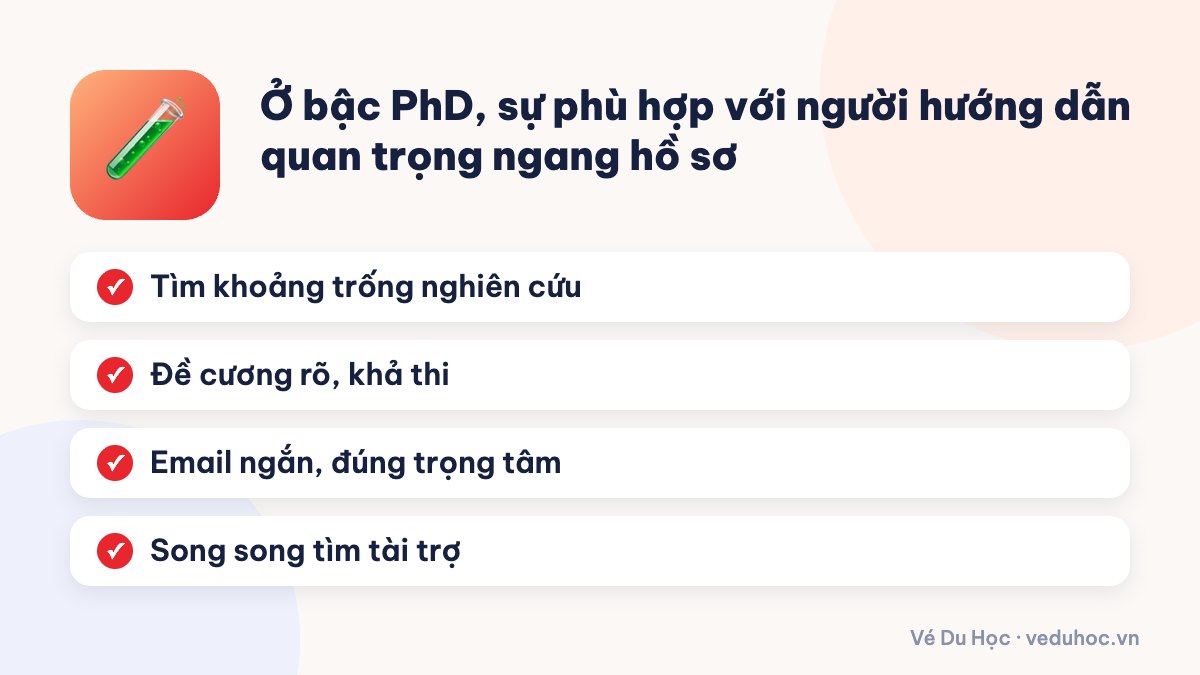
According to the University of Edinburgh's guidelines, the syllabus helps the school evaluate your suitability and ability to arrange a supervisor; It needs to clearly demonstrate the importance of the topic, scope of research and methods. Length depends on the school – always check the template and word limit of the department. Common structure:
- Title: clear, reflects the research question.
- Context and issue: why this issue is important and urgent.
- Literature review: what is known, and the research gap you want to fill.
- Research questions and objectives: 1–3 specific, answerable questions.
- Methods: data, collection and analysis; Why is this method suitable?
- Expected contribution: to science and to society.
- Time plan: key milestones in 3–4 years.
- References.
Writing principles
- Be clear, objective, concise and realistic about your goals.
- Demonstrate novelty: point out specific gaps, not generalities.
- Feasibility: reasonable scope for the duration of a PhD program.
- Use section titles, short paragraphs, short sentences; Diagrams can be added if appropriate for the industry.
The outline is a "living" document: after admission, the topic is often adjusted with the instructor. The committee evaluates your research thinking ability more than the "perfection" of the topic.
How to write an email to your instructor
Before writing
- Read your professor's recent works and identify intersections with your research direction.
- Check the professor's profile to see if the professor is accepting graduate students, has a sponsored position, or has a separate request for contact.
- Check the school's process: some places require contacting the instructor before submitting, some don't.
Suggested email structure (200–300 words)
- Title: “Prospective PhD applicant – [specific topic]”.
- Short introduction: who you are, what you are studying/doing.
- Connection point: specifically mention a professor's work and why it is related to your idea.
- Research idea: 2–3 sentences summarizing the question and approach.
- Competencies: research experience, relevant methodological skills.
- Clear question: will the professor accept graduate students for the next semester, can we discuss further?
- Attachment: CV (see How to write an academic CV) and a short 1–2 page outline if appropriate.
If there is no response after 1–2 weeks, send a polite reminder email. Even if you don't receive a friend, some professors are still willing to give feedback on the syllabus.
Common mistakes when hunting for doctoral scholarships
- Send a sample email to dozens of professors, changing only the names.
- The outline is too broad (“climate change research in Vietnam”) or there is no specific method.
- Not reading professors' work, suggesting directions that are completely different from their expertise.
- Just focus on the scholarship and forget to check the funding source that comes with the PhD position.
- The letter of recommendation does not come from someone who understands research capabilities – see Letter of introduction: who to ask for, how to ask for it.
Frequently asked questions
Can I study straight for a PhD after a bachelor's degree?
Yes, popular in the US, Canada and some schools in the UK and Australia. In many European countries, a master's degree is often required first.
How long is the research proposal?
Depending on the school and industry, it usually ranges from a few pages to about 3,000 words. Always follow the department's templates and limits.
Can I get a PhD scholarship without having a scientific article?
Maybe, if you have other research experience like good thesis, research assistantship, conference paper. Disclosure is an advantage but not a mandatory condition in many places. If you enter the interview round, carefully review the outline and refer to it Frequently asked scholarship interview questions.
Does the PhD scholarship allow bringing family along?
Depends on the visa regulations of the destination country and the scholarship. Many countries allow it, but scholarships usually do not cover dependents.
Conclusion
A PhD scholarship is a combination of a good research idea, the right supervisor, and the right funding source. Investing in an outline and emailing your professor is the most important step. When you're ready to go, check it out air tickets to study abroad or contact hotline/Zalo 090.1800.918 for advice.
Reference source
Booker HVSC gives a free quote in 15 minutes, Zalo reports take-off and landing for the whole family.
📚 Articles on the same topic
 Study abroad scholarshipScholarships to study abroad in Japan: MEXT, JASSO and corporate scholarships19/07/24 · 6 phút đọc
 Study abroad scholarshipHow to find reputable study abroad scholarships and avoid the trap of "virtual scholarships"20/01/19 · 7 phút đọc
 Study abroad scholarshipSummer scholarships and short-term courses: a stepping stone before long-term study abroad24/05/25 · 6 phút đọc
 Study abroad scholarshipScholarships to study in Australia: Australia Awards and university scholarships17/05/16 · 6 phút đọc
 Study abroad scholarshipASEAN scholarships and Southeast Asia regional programs02/04/25 · 9 phút đọc
 Study abroad scholarshipScholarships to study abroad in Malaysia and Thailand: quality learning close to home28/06/18 · 6 phút đọc
🔥 Read a lot
- International checked baggage for international students: pieces or scales, 46kg and tips for packing suitcases
- Master's scholarships: strategies for choosing majors, choosing schools and contacting professors
- Why should study abroad centers have specialized airline ticket partners?
- Choosing a reputable dispatching company: signs to recognize and avoid scams
- Stipendium Hungaricum Scholarship: full study abroad in Hungary





 ▶
▶ ▶
▶ ▶
▶ ▶
▶ ▶
▶ ▶
▶ ▶
▶